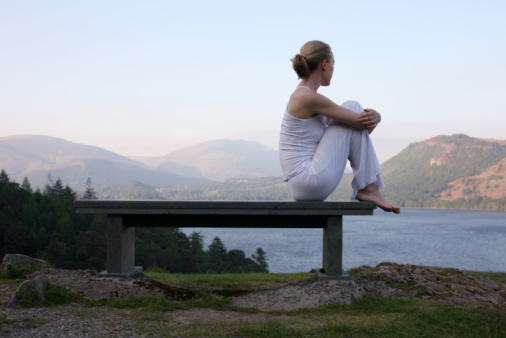
Being fully present

Today’s liturgy read from the gospel of Saint Luke,  the story of Martha and Mary. It is a well known tale. Jesus arrives in the house of his friends after a long journey. Martha is bothered, gets stressed and loses her  calm as she prepares something for him to eat. She complains that Mary is not helping but Jesus states that Mary has chosen the better part – the better way of being –  by simply sitting with him and listening.  It is frequently used to argue for the superiority of reflection over action; I think it is better understood as a priority in the cultivation of aspects of ourseves, both of which are necessary.

However, it also points to another teaching, namely one on being present. One of the greatest gifts we can all experience – and it seemed to have been true for Jesus also –   is knowing that another person is fully tuned into us. Sometimes we have to learn the art of being still so as to better support another person. In this story,  the greatest gift that Mary could offer was not to be useful,  but to be present. When we are lucky enough to have that connection with someone who is there for us, who really listens –  who instinctively senses deep down how we are –  then we are truly blessed.

Most people think of love as a feeling, but love is not so much a feeling as a way of being present.

David Richo

Exercise combats low mood

Mindfulness Stress Reduction encourages a mind-body approach to health. It is part of a growing field of integrative medical care that combines the best scientific medicine with evidence-based  therapies from complementary traditions. Recent research – which we have written about on this blog – has found that it has beneficial effects on stress as well  as changing the function and maybe even the structure of the brain,.

It would seem that physical exercise and aerobic workouts have a similar effect. Indeed, molecular scientists and neurologists have suggested that physical exercise may alter brain chemistry by working on the key neurotransmitters serotonin and norepinephrine. In fact, exercise seems to work in much the same way that antidepressant drugs do. One researcher working in this area is Professor Philip Holmes at the University of Georgia, who has focused on the neurobiological effects of exercise. He has found that, over the course of several weeks, exercise affects certain genes that increase the brain’s level of galanin, a neurotransmitter that appears to tone down the body’s stress response by regulating another brain chemical, norepinephrine. His current work focuses on the link between stress and different addictions, and how exercise can reduce stress which leads to addictive behaviours: “Stress turns on norepinephrine,” says Holmes, “which turns on dopamine, which induces craving. Galanin decreases norepinephrine, so someone with high levels of galanin should experience reduced cravings.”

Researchers at Duke University support these findings. In a randomized controlled trial they found that depressed adults who participated in an aerobic-exercise plan improved as much as those treated with sertraline, the drug which,  marketed as Zoloft,  is one of the most prescribed anti-depressants.

You can find more on this subject in TIME Magazine: : http://www.time.com/time/health/article/0,8599,1998021,00.html#ixzz0rgWOWgm0

Balance 1: Make time

The question in an age of rapid transit and conference calls and triple shift work days is balance. And the answer is balance too.

But what is balance in a society whose skewing of time has it totally off-balance? What is balance in a culture that has destroyed the night with perpetual light and keeps equipment going twenty-four hours a day because it is more costly to turn machines on and of than it is to pay people to run them at strange and difficult hours? In the first place balance for us is obviously not a mathematical division of the day. For most of us our days simply do not divide that easily. In the second place, balance for us is clearly not equivalence. Because I have done forty hours of work this week does nt mean that I will have forty hours of prayer and leisure. What it does mean, however, is that somehow I must make time for both. I must make time or die inside.

Joan Chittister, Wisdom Distilled from the Daily

Balance 2: Resting

Our culture invariably supposes that action and accomplishment are better than rest, that doing something – anything – is better than doing nothing. Because of our desire to succeed, to meet these ever-growing expectations we do not rest.

Because we do not rest we lose our way. We miss the compass points that would show us where to go,  we bypass the nourishment that would give us succor.

We miss the quiet that would give us wisdom. We miss the joy and love born of effortless delight.

Wayne Muller, Sabbath: Finding Rest, Renewal and Delight in our Busy Lives.

Spring: Undoing and letting go

All though our lives, we experience loss, in little and big ways. Some we acknowledge explicitly and grieve for. Others we may not have had the time or space to grieve for and they can come up later on in life, and attach themselves onto some other loss. There can also be the gradual loss of our hopes and dreams, or the plans we have invested in our work, or the direction of our lives.

Robert Neimeyer, who has written extensively in this area, says that when we go through a significant loss we have an undoing of our individual and collective life histories. It affects our world, and changes our sense of self. If it is a significant loss, such as the death of one who meant much to us, or the loss of a partner or even a move from work or familiar suroundings, we can feel uprooted and homesick. He says that what is needed at such times is having people to turn to who care for us, as we “tell and retell our story”. We need someone who can listen.

Why is this? Because as humans we like to give our lives meaning by underpinning them with a coherent and consistent story. Thus when we experience these losses we need to reorganize our sense of sense and our sense of meaning in life. We reach a limit where we are invited to tell our story again, but in a new way. The losses of life can make us hard and fearful of life or can make us more open, more caring for others.

The Tibetan Buddhist master Chögyam Trungpa talks about a soft spot, a raw spot, a wounded spot on the body or in the heart. A spot that is painful and sore. A spot that may emerge in the face of a loss. We hate such spots so we try to prevent them. And if we can’t prevent them we try to cover them up, so we won’t absentmindedly rub them or pour hot or cold water on them. A sore spot is no fun. Yet it is valuable. Trungpa Rinpoche calls the sore spot embryonic compassion, potential compassion. Our loss, our wound, is precious to us because it can wake us up to love, and to loving action.

Norman Fischer, Love, Loss and Anxious Times

Balance 3: Make time and space for questions

When I was a child in New York City in the 1940s there were laws that attempted to legislate the Biblical injunction, “Remember the Sabbath and keep it holy.” Businesses were closed. Shopping stopped. There were no convenience stores. People needed to remember, in advance of the Sabbath, to provide for the upcoming day of rest and spiritual reflection so that, on that day, they could rest. The community collectively caught its breath. Family members spent time with each other. They renewed connections. They visited neighbors.

I like to imagine that, whether or not people went to religious services, there was the possibility in that period of a pause for reflection. “What am I doing with my life?” “Is what I am doing good for me?” “Is it good for other people?” “Does my life make a difference in the world?” “Could my life make more of a difference in the world?”

All of the important fundamental questions in life seem to be waiting, so to speak, next on line at the top of the mind’s agenda, if only we give them the time and the space to present themselves.

Sylvia Boorstein