As wildflowers do

Over and over we break
open, we break and
we break and we open.
For a while, we try to fix
the vessel — as if
to be broken is bad.
As if with glue and tape
and a steady hand we
might bring things to perfect
again. As if they were ever
perfect. As if to be broken is not
also perfect. As if to be open
is not the path toward joy.

The vase that’s been shattered
and cracked will never
hold water. Eventually
it will leak. And at some
point, perhaps, we decide
that we’re done with picking
our flowers anyway, and no
longer need a place to contain them
We watch them grow just
as wildflowers do — unfenced,
unmanaged, blossoming only
when they’re ready — and mygod,
how beautiful they are amidst
the mounting pile of shards.

Rosemery Wahtola Trommer, American Poet, The Way it is


Paradox and ambiguity

As human beings, not only do we seek resolution, we feel that we deserve resolution. However, not only do we not deserve resolution, we suffer from resolution. We deserve something better than resolution: we deserve our birthright …an open state of mind that can relax with paradox and ambiguity

Pema Chodron, Comfortable with Uncertainty

The world goes on

Another Saturday, another Mary Oliver poem:

Meanwhile the world goes on.
Meanwhile the sun and the clear pebbles of the rain
are moving across the landscapes,
over the prairies and the deep trees,
the mountains and the rivers.
Meanwhile the wild geese, high in  the clean blue air,
are heading home again.
Whoever you are, no matter how lonely,
the world offers itself to your imagination,
calls to you like the wild geese, harsh and exciting-
over and over announcing your place
In the family of things.

Wild Geese, (extract)

The Book of LIfe

Just flip the pages of anyone’s life book; get beneath the story line, and what do you notice? Changeability, the unpredictable, the unforeseen (good and bad): to recall that, brings forth faith – be open and alert. A human life is also marked by an ongoing quest to find fulfilment – which hasn’t quite arrived (and maybe isn’t even near). Seeing that brings attention back to the present: what do you really want, and where will that be found? It’s never in that ongoing flow of continuity that the Buddha called ‘becoming’ (bhava). What about if the mind stepped out of that, into the immediate openness of an awareness that isn’t craving or dreading becoming anything? When you even review that tide of “now I’m this and I should be that, and I might get there” you realize that this goes on irrespective of circumstance and identity. So there’s nothing intrinsically personal about this life book, and you don’t have to throw it away and get a better one. The advice is to study it from a different viewpoint: it’s written in personal handwriting, but bear in mind and take it to heart, that the marks of change/risk/unpredictability (anicca), of incompleteness and the unresolved (dukkha), and of impersonality (anatta) are universal marks. Through bearing these in mind, there can be a breakthrough to the unconditioned, the secure, the sorrowless, the place of peace. One can step out of the book.

Ajahn Sucitto, Lockdown Means Opening Up

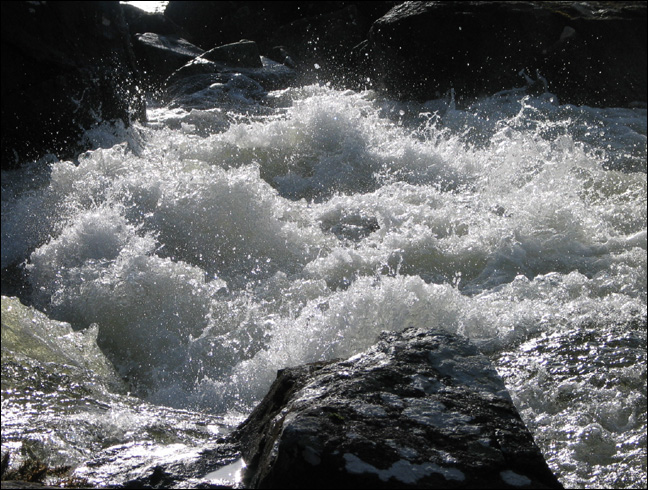
Standing firm in the midst

The only true place of calm in a storm is the very center.

So the only thing to do, once in the storm, is to make our way to the center of it, hard as that may seem.

Mark Nepo

New life

The trees are coming into leaf

Like something almost being said;

The recent buds relax and spread

Their greenness is a kind of grief.

Is it that they are born again

and we grow old? No, they die too.

Their yearly trick of looking new

Is written down in rings of grain.

Yet still unresting castles thresh

In fullgrown thickness every May.

Last year is dead, they seem to say,

Begin afresh, afresh, afresh.

Philip Larkin