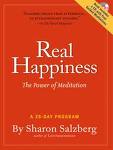
 This is a really excellent book and highly recommended. Sharon Salzberg, one of the leading Buddhist teachers in the United States and co-founder of the Insight Meditation Centre in Barre, Massachusetts, has written here one of the best introductions to meditation as well as an easy-to-grasp introduction to the whole science behind mediation and wellbeing. Despite the fact that there are quite a few books out there on meditation, it is hard to find one that will help those starting off establish a practice in a way that is clear, well-written and experiential. Well, finally, here is such a book. It is written as a 28-Day Programme – or rather “experiment” – for readers to try to see if they notice the beneficial effects in their lives. It includes a CD with guided meditations.
The book explains the science behind meditation and happiness, leads the reader through meditation practices for each day and then goes deeper into some of the assumptions which operate in our lives and which may get in the way of a full and compassionate life. We are led to bring these assumptions into awareness so as to loosen their grip on us: Meditation teaches us to focus and to pay clear attention to our experiences and responses as they arise, and to observe them without judging them. That allows us to detect harmful habits of mind that were previously invisible to us. For example, we may sometimes base our actions on unexamined ideas (“I don’t deserve love, you just can’t reason with people, I’m not capable of dealing with tough situations”) that keep us stuck in unproductive patterns. Once we notice these reflexive responses and how they undermine our ability to pay attention to the present moment, then we can make better, more informed choices. And we can respond to others more compassionately and authentically, in a more creative way. (Page 10f)
This is why we practice meditation – so that we can treat ourselves more compassionately; improve our relationships with friends, family and community, live lives of greater connection and even in the face of challenges, stay in touch with what we really care about so that we can act in ways that are consistent with our values. One of the things I have always found so interesting about the meditation practice is that the arena can seem so small – just you in a room – but the life lessons, the realizations and understandings that arise from it can be pretty big.




 Mindfulbalance