Letting go of the constant flow

As stated earlier, thoughts can make our desire to sit still quite difficult. However, noticing them and, even more importantly,  the emotions that give birth to them is the key towards greater freedom. As we sit, we can easily notice how we are always chasing our tail, moved by a desire to get something other than we have now,   or to get rid of something that is bothering us. The big challenge is to how to switch off this as a process and get to the root of the problem, to discover how we can stop proliferating fears and fantasies and interrupt this quality of “always moving”.  To do this requires that we become skilled at noticing the key moment of “contact”- when the senses, including the mind, encounters something that moves it towards, or away from. We can notice this when we can spot a change in our interior space, when a disturbed, or restless quality takes hold – we were calm one moment, then we see something or remember something or think of something and we are disturbed.  So the practice is to try to notice what it arising, meet it and disengage from it, while bringing our awareness to the process itself. We ask ourselves – “What does it feel like to want this, or to want to get rid of that”….. “How does that concretely feel in the body, or in the heart”?  We practice with trying to  meet this moment without the impulse to fix it, or interpret it or judge it. The traditional teaching state that this is the way to step out of the stream, by not allowing the contact to gain a footing and proliferate:
From where do the streams turn back? Where does the round no longer revolve?
Where does name-and-form cease and stop without remainder?
Where water, earth, fire and air do not gain a footing.
It is from here that the streams turn back
Here that the round no longer revolves
Here name-and-form, ceases, stops without remainder.
Connected Discourses of the Buddha, 68, 69.

A day in the life

Waking up in the morning, I vow with all beings

to listen to those whom I love, especially to things they don’t say.

Lighting a candle for Buddha, I vow with all beings
to honor your clear affirmation: “Forget yourself and you’re free.”

When I stroll around in the city, I vow with all beings
to notice how lichen and grasses never give up in despair

Watching a spider at work, I vow with all beings
to cherish the web of the universe: touch one point and everything moves.

When the racket can’t be avoided, I vow with all beings
to close my eyes for a moment and find my treasure right here.

With tropical forests in danger, I vow with all beings
to raise hell with the people responsible and slash my consumption of trees.

Watching gardeners label their plants , I vow with all beings
to practice the old horticulture and let plants identify me.

On reading the words of Thoreau, I vow with all beings
to cherish our home-grown sages, who discern the perennial Way.

Falling asleep at last I vow with all beings
to enjoy the dark and the silence and rest in the vast unknown.

Robert Aiken, Verses for Zen Buddhist Practice

Do we really go anywhere?

(Practice) ……. is not to be found in moving forwards, nor in moving backwards, nor in standing still. This, Sumedho, is your place of nonabiding.

Ajahn Chah,  Letter to Ajahn Sumedho

As long as we conceive reality in terms of self and time, as a “me” who is someplace and can go some other place, then we are not realizing that going forwards, going backwards, and standing still are all entirely dependent upon the relative truths of self, locality, and time. In terms of physical reality, there is a coming and going. But think about it. Where can we truly go? Do we ever really go anywhere? Wherever we go we are always “here.”

Ajahn Amaro

What we think we need for happiness

On one of the few sunny days recently, I was walking  along the lanes near our house and took this photograph of the cows happily eating in the farm next door. It reminded me of the old Buddhist tale which I have posted about before, but because it follows some of the themes of the last few days I will return to it again here. Mindfulness practice helps us see that our sense of wellbeing can be increased if we stop trying to hold onto our idea of what life should be like, and instead move towards what life actually is like. So this leads to another meaning in the words “let go” – letting go what we think we need for happiness and the conditions we feel must be fulfilled in order for happiness to come.

The story is here told by Thich Nhat Hahn, and like all parables can speak to us in different ways at different moments in our lives. Hopefully it may speak to you in some way today:

One day the Buddha was sitting in the forest with some monks when a farmer approached them. The farmer said, “Venerable monks, did you see my cows come by? I have a dozen cows and they all ran away. On top of that I have five acres of sesame plants and this year the insects ate them all up. I think I am going to kill myself. It isn’t possible to live like this”

The Buddha felt a lot of compassion toward the farmer. He said “My friend, I am sorry, we did not see your cows come this way”. When the farmer had gone, the Buddha turned to his monks and said “My friends, Do you know why you are happy? Because you have no cows to lose”

I would like to say the same to you. If you have some cows you have to identify them. You think they are essential to your happiness, but if you practice deep looking, you will see that it is not these cows that have brought about your happiness. The secret of happiness is being able to let go of your cows.

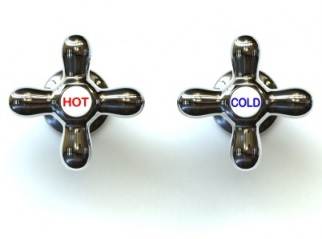
Working with hot and cold today

Winter has finally arrived here, with snow on the nearby mountains. So a little reflection on working with the things that we cannot change or with things that inconvenience us:

A disciple asked the Zen master Tung-shan: “When the heat of summer and the cold of winter arrive, how can we escape them?” Tung-shan answered, “Why don’t you go where there is no heat or cold?” “Where is this place,” asked the disciple, “where there is no heat or cold?” At this the master replied, “When it is hot, be completely hot; when it is cold, be completely cold.”

The disciple’s question had a symbolic meaning, and the answer was given on the same level. Heat and cold stand for circumstances that affect our daily existence but are out of our hands to regulate or rectify. Impersonal facts with far-reaching effects on us include: general economic conditions; situations of war, violence or peace; accidents; laws, policies and prejudices; possibilities and opportunities available in a particular community; mechanical and technological breakdowns  and so on.  The disciple wished to know how to escape such restraints. He wished to live in an ideal country where it is never too hot or too cold.

The Zen master’s reply was also symbolic. Instead of offering an escape route, he invited the disciple to plunge directly into the current situation and become completely hot in summer, completely cold in winter. According to an interpretation by Francis Dojun Cook, the Zen master was suggesting a radical affirmation of one’s very conditionedness in order to transcend it. By plunging directly into the current, one flows with it and on it. When resistance is futile, yielding to the flow of the current of events offers the promise of life. In order to understand the reply of Tung-shan, we have to realize that he was speaking of a change in attitude. Rather than attempting to change the facts of the situation, or escape them by flight, we may change our attitude, accept things as they are, and thereby move beyond them to a point where we find peace of mind. That point or region of peace is the country where “there is no heat or cold.” These conditions no longer exist as problems for us, although they continue to exist as facts. What has changed is our attitude toward them.

Charles Cummings, The Best Place to Live

Stopping the spinning

One way to cultivate relaxation is through the practice of meditation. The practice of meditation has two elements: simplicity or peacefulness and insight, or clarity. The application of mindfulness allows us stop the world from spinning, by stopping the spinning of our own minds. This is the essence of the simplicity or peacefulness of shamatha. Then we can see the confusion. We can shine the light of vipassana,  or clear seeing, on confusion, and that brings the clarity of seeing things as they are. When we begin to see the situation as it is, and when we begin to see our own minds clearly, we diffuse the panic. From this experience we have in meditation, we may begin to see how we can relax on the spot in the midst of the most difficult experiences in our lives.

Carolyn Rose Gimian, Smile at Fear.