To a heart, full of hesitations

When today you have doubts and fears, why not follow the advice in this Mary Oliver poem. To look at nature all around you –  the buds beginning to appear, the early flowers blooming – and see there a support for your inner self.

Oh, my dear heart,
My own dear heart,
Full of hesitations,
Questions, choice of directions,

Look at the world.
Behold the morning glory,
the meanest flower,
the ragweed, the thistle.
Look at the grass.

Mary Oliver, The Singular and Cheerful Life

Facing ourselves in our relationships

Each day, as we grow older, we are challenged to live as the person we would like to be. This is not always easy when we are stressed or we are hurt or let down. And also we can, at times, choose selfishness rather than genuine care for others. And what I increasingly notice is how much of our behaviour has it roots in fear.

The places where these fears are most often activated is in relationships with others. Frequently we instinctively act in defensive ways to protect our hearts. Relationships have the capacity to trigger our deepest fears, which often reflect patterns established in our childhood. I notice this when a strong emotional reaction is triggered, and automatic,  deeply believed – often fearful – thoughts dominate, which are very easy to take as the truth. Normally my first move is to maximize distance in order to protect myself and act as if the other person is a threat to the security of my deepest self.  Relationships open our hearts and expose our needs. Sometimes we clearly feel that is not safe. And when that happens we all follow some strategy to escape feeling the fears that silently run our life.

However, the truth about relationships is that they reflect closely our relationship with ourselves and reveal a lot about the clarity or confusion in our inner life. In fact our relationships with others can never be better than the relationship we have with ourselves. We often project on to the other what is going on inside ourselves, often what we are unable to manage properly, and this is at the root of our fears, and the reason they are so strong. Thus we can blame the other for confusion which is actually inside ourselves.

I have noticed this often in myself recently. Therefore I am now trying, when strong fears are triggered, to turn towards them and let them in, looking on them as a ‘what’ instead of as ‘me’. Instead of running story lines of anger and blame, I try and just stay with the original feeling of hurt. Even if the fear triggered is strong, if I manage to do this soon afterwards, I notice the fear loses its power quickly and a more open response can emerge. The fear can thus becomes a teacher, hopefully leading to understanding rather than paralyzing.

Fear tells us to stop, to stay within the boundary of our protected cocoon-world. Yet when we feel fear, if we take even one small step toward it rather than yielding to our habitual pulling away, we move one step closer to the vast mind that lies beyond. When we feel fear instead of saying ‘I’m afraid,’ thus reinforcing our identification with our fear as who we are, we can simply say, ‘Fear is present.’  Thus fear’s power gradually dissipates, and we begin to free ourselves from it. When we simply experience fear just as it is — without our opinions, judgments, and reactions — fear is not nearly so frightening.

Ezra Bayda, Saying Yes to Life (Even the Hard Parts)
Realities which make life beautiful

I was talking earlier today with someone about time spent I spent in the Ecumenical community in Taize in France many years ago, when the founder, Br. Roger,  was still alive. His extraordinary simplicity and humanity was very striking, managing to combine a deep inner life with an understanding of what makes for full human growth. He witnessed a time of hatred and war in his youth and went on to create a community that healed divisions. Many of his words, like these ones, reduce life down to its essence, away from the fears which make us lose faith in each other.

Are there realities which make life beautiful and of which it can be said that they bring a kind of fulfillment, an inner joy? Yes, there are. And one of these realities bears the name of trust. Do we realize that what is best in each of us is built up through a simple trusting? This is something even a child can do.

Br Roger.

How to bring light into the dark places within us

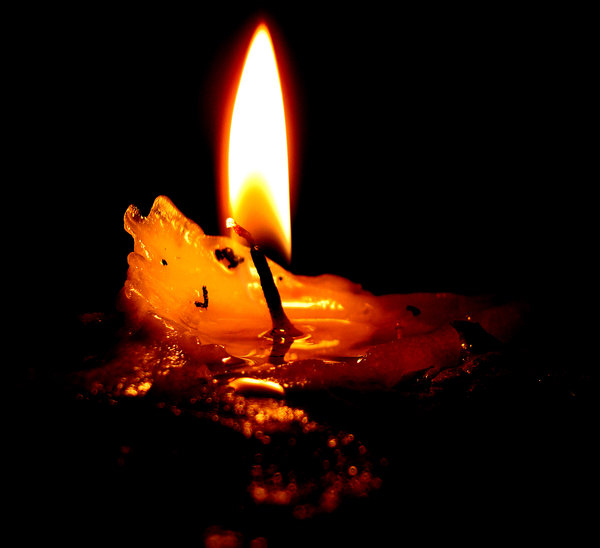
In the Christian Calendar today is the feast of Candlemas. While not as old as the Celtic feast of yesterday, it does date from the 4th Century in Jerusalem, and reflects the same need to mark this period of winter with light and hope. Traditionally it was celebrated by a procession of candles and the blessing of candles for use in the home.

From time to time difficulties occur in our lives which can then seem dark and without hope. Bringing awareness to what is going on inside us at those moments can allow light to shine in the darkness. We sit and observe  what arises and passes away in the mind and body. We  name it – “there is anger“, “there is fear” – thus creating a gap and allowing what we experience to become something known. In this way, our mood and behaviour will not be shaped entirely by invisible, unconscious conditioning, but can become a more reflective response.

When we meditate, we kindle a fire that never dies away.

When we meditate, we’re not idly passing time. In following the breath and learning to deal with our thoughts, we’re laying the foundation for a shift in attitude that has the power to change our lives in a truly meaningful way. There’s a lot of darkness and aggression in our world. Developing our best qualities has an immediate effect on ourselves and others. When we apply ourselves in practice, we’re not only doing something very present; we’re also creating the conditions for how our lives can move forward.

Sakyong Mipham Rinpoche

Fear as a constant companion

One more post prompted by recent references to Adam and Eve. These ancient stories attempt to do justice to the fundamental truth of the human condition, using the language  of  those days. And we are told that after they ate of the tree of knowledge, Adam and Eve hid themselves. This simple fact – the need to hide and protect themselves, the existence of judgmental thoughts and guilty emotions – alerted God to the fact that something had changed. When he asked them why they were hiding, Adam replied “I was afraid because I was naked and I hid myself”

As I said, the writers were reflecting on what their own experience was. And it is similar to ours. We feel fear and that leads us to pull back and hide from others, because of the anticipation that we will get hurt. The openness and ease of the original days is not easy to find, even in the closest relationships. And most of us have been hurt along the way, from early childhood onwards. There is a relationship between how reliable things were in our childhood and how confused and difficult our relationships are as adults. So there can be an ongoing struggle between the part of us that loves and the part of us that fears, the part that wishes to be open and be seen and the part that want to protect itself and hide. And so all of us will struggle from time to time to keep believing in love, in allowing ourselves get close to others.

What we can learn from these ancient stories is that some undercurrent of fear has always been present in human history and will likely always be present in our lives. The difference between adulthood and childhood is that we do not have to allow it dominate. We can act in spite of our fears. Mindfulness is based on this same understanding that there are fears  at the heart of life, and that  does not mean there is anything wrong with our life, or with us,  just because we feel them. We do not have to turn this fact into a judgment about ourselves or others. We can choose not to hide. We can work through our fears.

Staying with the feeling

This statement by Tara Brach contains the essence of practice: All of our reactions to people, to situations, to thoughts in our mind – are actually reactions to the kind of sensations that are arising in our body.

See if you can practice this today: Notice the sensations in your body, before thinking sets in. Notice how the body reacts to pleasant and unpleasant events or experiences.  Stay with fear as a feeling in the body before it gets to thoughts or emotions.  Can you allow the sensation just remain a sensation in the body? Can you stop judging your whole life just because of a disturbing feeling in the body?