Seeing possibilities and not waiting

File:Spring Perspective.png

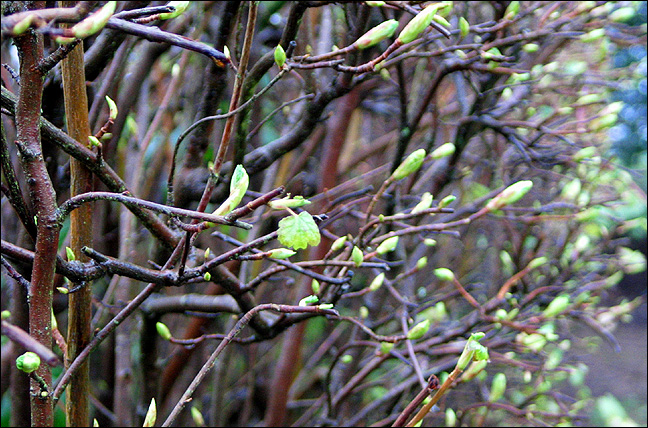
In my own life, as winters turn into spring, I find it not only hard to cope with mud but also hard to credit the small harbingers of larger life to come, hard to hope until the outcome is secure. Spring teaches me to look more carefully for the green stems of possibility; for the intuitive hunch that may turn into a larger insight, for the glance or touch that may thaw a frozen relationship, for the stranger’s act of kindness that makes the world seem hospitable again.

Parker Palmer, Let your Life Speak

photo fluous


Begin afresh

buds

I was reminded of Larkin’s beautiful poem by the buds opening on the trees in the garden and on the hedgerows around here in County Kildare.  This time of year  moves him from a reflection on loss and grief, to thoughts on being born again,  to finally being convinced to begin over again.  The message is like something “almost being said”, so we need to create time to see this: we learn from nature and from this season if we are still enough to listen.

The trees are coming into leaf
Like something almost being said;
The recent buds relax and spread,
Their greenness is a kind of grief.

Is it that they are born again
And we grow old? No, they die too,
Their yearly trick of looking new
Is written down in rings of grain.

Yet still the unresting castles thresh
In fullgrown thickness every May.
Last year is dead, they seem to say,
Begin afresh, afresh, afresh.

Philip Larkin, The Trees

Difficult moments as our teachers

flight-cancellations

[If] we truly want to progress on the path, we must regard our enemies as our best teachers.  For whoever holds love and compassion in high esteem, the practice of tolerance is essential, and it requires an enemy. We must be grateful to our enemies, then, because they help us best engender a serene mind! Anger and hatred are the real enemies that we must confront and defeat, not the “enemies” who appear from time to time in our lives.

The Dalai Lama

Letting life’s lessons sink in

allondon1 rocks

Another post inspired by the season of Lent, but a reminder for all of the value in slowing down, making space, “meandering” in life, rather than always focusing on driven, purpose-filled activities.

More than giving up or self-denial, Lent, when practiced intentionally, can allow time for self-examination, reflection, and preparation. It’s a time of slowing down, intentionally, so that life is given a chance to sink in, not just run off in so many directions. Induced meandering, if you will.  The slowing that is an inherent part of Lent is not just for the sake of slowing down, but so that life can sink in. In so doing, this season of irrigation provides health and vitality long after its rains have passed. Lent offers us an opportunity to slow down, to meander rather than to rush, to allow life to sink in a bit, to find ways to go deeper and not always stay on the surface. A time to observe, to pay attention, and then to act — and in so doing provide the space to move from rush to replenish. When we take this practice seriously, we plant its blessings so that they benefit not only us in our lives for this season, but also extend to the world around us.

Erin Dunigan, The Induced Meandering of the Lenten Season

In its own time

sycamore

There is no expected pace for inner learning. What we need to learn comes when we need it, no matter how old or young, no matter how many times we have to start over, no matter how many times we have to learn the same lesson. We fall down as many times as we need to , to learn how to fall and get up. We fall in love as many times as we need to , to learn how to hold and be held. We suffer pain as often as is necessary for us to learn how to break and how to heal. No one really likes this of course, but we deal with our dislike in the same way, again and again, until we learn what we need to know about the humility of acceptance.

Mark Nepo, The Book of Awakening

The seeds within

File:Pinus cembra shoot.jpg

Mindfulness involves paying attention to and nurturing what is helpful, as well as evaluating,  and not allowing a footing to, those seeds which will cause confusion and distress:

If we take good care of everything in us, without discrimination, we prevent our negative energies from dominating. We reduce the strength of our negative seeds so that they won’t overwhelm us. Mindfulness means to be present, to be aware of what is going on. This energy is very crucial for the practice. The energy of mindfulness is like a big brother or big sister, holding a young one in her arms, taking good care of the suffering child, which is our anger, despair, or jealousy. So mindfulness recognizes, embraces, and revives. Mindfulness helps us look deeply in order to gain insight. Insight is the liberating factor. It is what frees us and allows transformation to happen. 

Thich Nhat Hahn, Taming the Tiger Within

photo Ude