Creating a more stable base for attention

One reason we need to create periods of rest is to counteract some of the effects of modern society on the brain, and nurture habits of stability and patience.

Nicholas Carr is the author of the book, The Shallows: What the Internet is Doing to our Brains. In it he outlines some of the ways that modern technologies are not only affecting our ability to pay attention but are also changing our brains. These technologies tend to fragment our attention, speeding up our need to know and plan, thus reducing our capacity to just rest in ourselves and our own space. This can increase the sense that our  day to day is running from here to there, with no time for ourselves, just a succession of  things to get done.

In an interview with CNN he said, “I became aware of changes in my own thinking a couple of years ago….… I came to realize [that] I was losing my ability to pay deep attention to one thing over a long period of time. When I’d sit down to read a book, for instance, I was only able to sustain my concentration for a page or two. My mind would begin to crave stimulation and distraction — it wanted to click on links, jump from page to page, check email, do some Googling….The habits of mind the net encouraged had become my dominant habits of mind.

It is no surprise that when we have an activity that demands patience and perseverence, we find it difficult to concentrate, missing the inner quiet needed for sustained activities. We become what we practice: If we are continually practicing distraction and small, bite-sized bursts of information, the brain can get used to distraction. If we practice resting and calm, the brain can become more calm.  As Carr continues: Other people – and I’m one of them –  believe that while it’s important to be able to skim and scan and multitask, our deepest and most valuable thinking requires a calm and attentive mind. If you exist in a perpetual state of distractedness, you’ll never tap into the deepest sources of human insight and creativity.

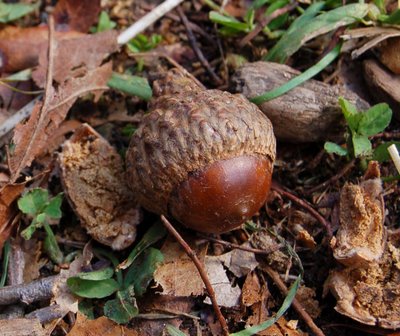
Once again, we can learn from nature in these days. Real growth takes time and is patient. As the proverb reminds us  “Mighty oaks from tiny acorns grow”, not immediately, but slowly, over time. Let us create gentle periods of less “productive”, more reflective activities – walking, reading, reflecting, meditating – and thus nurture other habits of mind.


Me, a Saint?

The Pope is in England for the start of the process of making John Henry Newman a “saint”. Newman was a good man and a very fine thinker, personalifying a gentle, open-minded search for truth. The school I went to in Ireland,  founded in 1867, was influenced by his principles of education. Most wisdom traditions hold up examples of people wo can act as an encouragement to us, such as the Bodhisattvas in the Buddhist tradition or the Saints in the Catholic and Orthodox history. Sometimes, however, the focus is on their extraordinary deeds which can lead us into thinking that full contentment is only to be found there. In this light, I like this quote from Thomas Merton:

For me to be a saint means to be myself.

Therefore the problem of sanctity and salvation is,  in fact,

the problem of finding our who I am and discovering my true self.

Thomas Merton, New Seeds of Contemplation

Encouragement

I have always liked the person of Barnabas in the New Testament. He was known as the “Son of Encouragement”. I have always felt that I would love to be known like that, as one who encourages. We all need encouragement and know what it feels like when someone believes in us. Someone who sees us, not as we are, but as we have the potential to become. That gives us courage.

…… If I accept the other person as something fixed, already diagnosed and classified…then I am doing my part to confirm this limited hypothesis. If I accept him as a process of becoming, then I am doing what I can to confirm or make real his potential.

Carl Rogers

Sunday Quote

There is a time for departure

even when there’s no certain place to go.

Tennessee Williams

A long conversation

We sometimes mistakingly think that life will unfold magically in a flash, or that we will be born mature and fully developed, just as Athena sprung from the head of Zeus. It would be nice if we saw clearly, immediately, our path and role, but that would take away a lot of the lessons we gain from slowly finding out or from taking wrong turns. Life is, rather, a slow process, a long conversation and dialogue, where we do not often see clearly and are always searching,  as this beautiful Mary Oliver poem reminds us:

Another morning and I wake with thirst
for the goodness I do not have. I walk
out to the pond and all the way God has
given us such beautiful lessons. Oh Lord,
I was never a quick scholar but sulked
and hunched over my books past the hour
and the bell; grant me, in your mercy,
a little more time. Love for the earth
and love for you are having such a long
conversation in my heart. Who knows what
will finally happen or where I will be sent,
yet already I have given a great many things
away, expecting to be told to pack nothing,
except the prayers which, with this thirst,
I am slowly learning.

Mary Oliver, Thirst, Beacon Press, 2006

Sunday Quote : What is my path?

Traveller,  your footprints
are the only road,

There is no path.

Paths are made by walking.

Antonio Machado