Distracting ourselves from where we are

We have all kinds of ways of imagining the future that distract us from actually living in the present.

What  sitting practice is really about, is living in the present so that we can actually manifest this precious life in a way that feels right.

Blanche Hartman, Soto Zen teacher,  This life which is wonderful and evanescent

Hope

Hope is not the conviction that something will turn out well,

but the certainty that something makes sense,

regardless of how it turns out

Vaclav Havel

How to transform your work

Even if you have a lot of work to do,
if you think of it as wonderful,
and if you feel it as wonderful,

it will transform into the energy of joy
and fire, instead of becoming a burden.

Tulku Thondup Rinpoche

Be happy

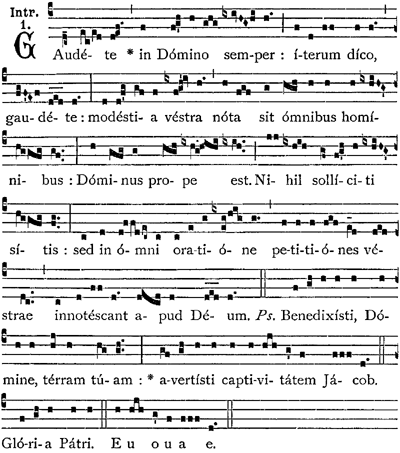
The third Sunday of Advent, is traditionally called Gaudete Sunday, or Be Happy Sunday.  For those preparing for Christmas,  this joy comes from knowing that the coming of Jesus is near. which puts the up’s and down’s of daily life be put into context.  This exhortation is shared by most wisdom traditions.  We are reminded  of a fact, sometimes forgotten by earnest religious practioners, that at the heart of all inner practice is joy, which leads us to understand the true nature of happiness.

Joy does not come from having everything perfect as we want it, by having a preconceived perfect day, but by accepting how life actually is and not fighting against it. It is possible even in the midst of difficult moments. It comes from seeing deeper into the heart of things. understanding that it is born from within and not from the external conditions of our lives.  It is based on choices we make. It has its roots in the security we find within ourselves and from love:

Joy is the experience of knowing that joy and freedom comes from knowing you are unconditionally loved and that nothing — sickness, failure, emotional distress, oppression, war, or even death — can take that love away.

Joy is not the same as happiness.  We are inclined to think that when we are sad we cannot be glad, but ….. sorrow and joy can exist together. That isn’t easy to understand, but when we think about some of our deepest life experiences, such as being present at the birth of a child or the death of a friend, great sorrow and great joy are often seen to be parts of the same experience. Often we discover the joy in the midst of the sorrow. I remember the most painful times of my life as times in which I became aware of a spiritual reality much larger than myself, a reality that allowed me to live the pain with hope. I dare even to say: ‘My grief was a place where I found joy.’ Still, nothing happens automatically in the spiritual life. Joy does not simply happen to us. We have to choose joy and keep choosing it every day.

Joy is what makes life worth living, but for many it seems hard to find. They complain that their lives are sorrowful and depressing. What then brings the joy we so much desire? Are some people just lucky, while others have run out of luck? Strange as it may sound, we can choose joy. Two people can be part of the same event, but one may choose to live it quite differently than the other. One may choose to trust that what happened, painful as it may be, holds a promise. The other may choose despair and be destroyed by it.

What makes us human is precisely this freedom of choice.

Henri Nouwen
Do not be ashamed

A reminder to drop the “comparing mind” that leads us to evaluate our life in relation to others’ successes, lives or even opinions.  It is good to develop a security in our sense of self that does not overly concern itself with how others regard us, but is founded in our own goodness. When we have this there is no need to hide or cover ourselves, to avoid others seeing us.

Many of us have hearts that are overlaid with anxieties, fears, and other defensive behaviours which arose in our attempts to deal with disappontment. One of these is a strong protected sense of personal space,  constructed to ensure that others do not get too close. This can be rooted in shame, which is often related to how we sense our own competence. It is a way in which we learnt to deal with the disappointment of realizing that our needs were not noticed by our parents, leading to us growing up feeling inferior and unlovable.  Thus we arrive with a mind that judges, compares and endlessly works and worries to make life be a certain way, to ensure our core self stays hidden. Meditation practice allows us to  slowly let go of some of our defensiveness. It nourishes a trust that the strength and compassion  we need are already within us, just as we are. It allows us to stop hiding from ourselves, and lets us stand confident before others.

When you are content to be simply yourself

and don’t compare or compete,

everybody will respect you.

Lao Tzu

The feast of Saint Nicholas

Traditionally, it was on this night that children would place their shoes at the end of the bed or at the door in the hope of getting some small gifts from Saint Nicholas. The practice was founded upon the attributed generosity of the Saint towards those who were poor, as in the legend where he threw bags of gold into the house of a widower to ensure that his daughters would not be sold into slavery.

This practice lies at the root of our modern Christmas celebrations. They are based on a tradition of giving, of generosity. In our world today the advertising at Christmas time can lead to a focus on receiving. It is common to hear the question “What are you getting for Christmas”. Such an emphasis can lead us to compare what we have with others, and strengthen a normal sense that we are lacking in some things or in some way defective. The “comparing mind” is deeply rooted in our psyche, probably evolving as a necessary survival strategy. However, today, when not linked to physical survival,  it has free range to stir up all kinds of self-judgments in a society which links wellbeing to who was the latest gadget, the nicest clothes or the fittest body. Getting caught up in the comparing game is one of the major ways that we create our own suffering. We can do it in work, in how we look and feel, when we consider how others celebrate festive occasions, with the holidays they are taking or the way they celebrate as a family. We can find ourselves implicitly thinking, “If only I had that, then I would be happy.” Constantly measuring ourselves against others leads to a bitter taste about our life, and does not allow us develop the  inner peace which comes from knowing that we are good enough. Its relentless search for being better or having more –  and linking our security, love, and self-esteem to this –  ends in insecurity, anxiety and even self-hatred. Comparing is one way in which we solidify ourselves, fixing ourselves to how we are at this moment in comparison to someone else.

We have an opportunity this season to work with this tendency. In meditation we observe our inner processes, allowing us to notice and liberate the mind from this constant comparing. We start by not comparing one breath with another; we simply observe each one as unique. We go on to notice this comparing voice – appearing as thoughts or impressions of what others would say – and how it leads us to be focus on ourselves in a critical manner. We notice the mind and see it inclining towards wanting. Over the next weeks, if we  work at replacing the emphasis on what I have or would like to get with an emphasis on giving to others, then our eyes turn away from ourselves  and are placed then on others. This practice replaces a critical mind – which is always finding fault with ourselves and others – with a mind that relaxes in celebrating the good and spreading joy. We celebrate our life and their life, allowing our protective shells to dissolve, not measuring, just living.

Love is an activity, not a passive affect; it is a “standing in,” not a “falling for.” In the most general way, the active character of love can be described by stating that love is primarily giving, not receiving.

Erich Fromm