The way we look at others

File:Andrew Choy - Moon (by).jpg

Admit something:
Everyone you see, you say to them, “Love me”
Of course, you do not do so out loud; otherwise
Someone would call the cops
Still, though, think about this, this great pull in us
To connect.
Why not become the one who lives with a full moon
In each eye that is always saying,
With that sweet moon language,
What every other eye in this world is dying to hear?

Hafiz

photo andrew choy

Not needing to go far

File:Costa Fascinosa in VE.JPG
I was reminded this morning, when visiting the Cistercian monastery near my house,  that today is the feast of St Augustine. Even in his quieter time people preferred distraction to awareness, and sought happiness outside,  rather than realizing that its roots are within and in the ordinary.
Men go abroad to wonder at the heights of mountains,
at the huge waves of the sea, at the long courses of the rivers,
at the vast compass of the ocean,
at the circular motions of the stars,
and they pass by themselves without wondering.

St Augustine, Confessions, c 397
photo abxbay

Sunday Quote: The process, not the result

Macro shot of tiny flowers on a wall

We think that accomplishing things will complete us,

when it is experiencing life that will.

Mark Nepo, The Book of Awakening

Photo from the beautiful site http://www.judesphotography.wordpress.com

Not being identified

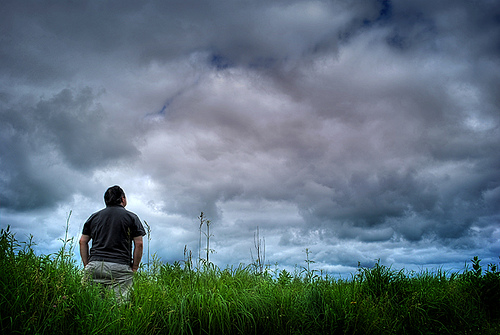
looking at clouds

A student came to Zen Master Bankei and said: “Master, I have an ungovernable temper – how can I cure it?” “Show me this temper,” said Bankei, “it sounds fascinating.” “I haven’t got it right now,” said the student, “so I can’t show it to you.” “Well then” said Bankei, “bring it to me when you have it.” “But I can’t bring it just when I happen to have it,” protested the student. “It arises unexpectedly, and I would surely lose it before I got it to you.” “In that case,” said Bankei, “it cannot be part of your true nature. If it were, you could show it to me at any time. When you were born you did not have it, and your parents did not give it to you — so it must come into you from the outside.”

While anger is happening, if you suddenly become conscious it drops. Try it. Just in the middle, when you are feeling very hot and would like to commit murder, suddenly become aware, and you will feel something has changed: a gear inside – you can feel the click. Something has changed, now it is no more the same thing. Your inner being has relaxed. It may take time for your outer layer to relax, but the inner being has already relaxed. The cooperation is broken; now you are not identified.

Osho, And the Flowers Showered

Bankei, 1622 – 1693,  was a hugely influential Japanese Zen Master, who emphasized our Original Mind – the natural, unchanging,  goodness within – which he felt we simply had to tune in to,  and not identify with the different moods which pass through each day.

Beyond the seen

File:View of Pondicherry Auroville Beach.jpg
The search for reason ends at the known; on the immense expanse beyond it only the sense of the ineffable can glide: reason cannot go beyond the shore, and the sense of the ineffable is out of place where we measure, where we weigh. We do not leave the shore of the known in search of adventure or suspense or because of the failure of reason to answer our questions. We sail because our mind is like a fantastic seashell, and when applying our ear to its lips we hear a perpetual murmur from the waves beyond the shore. Citizens of two realms, we all must sustain a dual allegiance: we sense the ineffable in one realm, we name and exploit reality in another. Between the two we set up a system of references, but we can never fill the gap. They are as far and as close to each other as time and calendar, as violin and melody, as life and what lies beyond the last breath.
 
Abraham Joshua Heschel, Man Is Not Alone: A Philosophy of Religion
photo rosh prakash

Not giving up on ourselves

File:Climbing Meldon Hill - geograph.org.uk - 1478803.jpg

The idea of developing courage doesn’t seem to trigger people’s inadequacies. I think they know they have some courage. The problem is they think they’re supposed to be courageous in facing the outside world, whereas what is so profoundly transformative is the courage to look at yourself. It’s the courage to not give up on yourself, even though you do see your aggression, jealousy, meanness, and so on. And it turns out that in facing these things, we develop not self-denigration but compassion for our shared humanity.

Pema Chodron

photo Derek Harper