
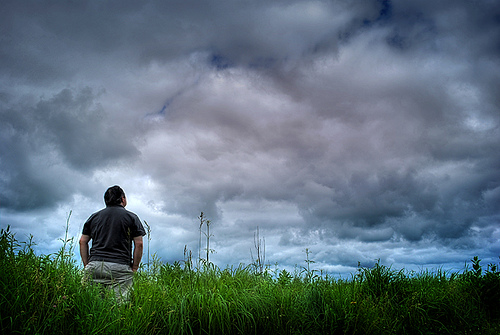
We think that accomplishing things will complete us,
when it is experiencing life that will.
Mark Nepo, The Book of Awakening
Photo from the beautiful site http://www.judesphotography.wordpress.com
We think that accomplishing things will complete us,
when it is experiencing life that will.
Mark Nepo, The Book of Awakening
Photo from the beautiful site http://www.judesphotography.wordpress.com
A student came to Zen Master Bankei and said: “Master, I have an ungovernable temper – how can I cure it?” “Show me this temper,” said Bankei, “it sounds fascinating.” “I haven’t got it right now,” said the student, “so I can’t show it to you.” “Well then” said Bankei, “bring it to me when you have it.” “But I can’t bring it just when I happen to have it,” protested the student. “It arises unexpectedly, and I would surely lose it before I got it to you.” “In that case,” said Bankei, “it cannot be part of your true nature. If it were, you could show it to me at any time. When you were born you did not have it, and your parents did not give it to you — so it must come into you from the outside.”
While anger is happening, if you suddenly become conscious it drops. Try it. Just in the middle, when you are feeling very hot and would like to commit murder, suddenly become aware, and you will feel something has changed: a gear inside – you can feel the click. Something has changed, now it is no more the same thing. Your inner being has relaxed. It may take time for your outer layer to relax, but the inner being has already relaxed. The cooperation is broken; now you are not identified.
Osho, And the Flowers Showered
Bankei, 1622 – 1693, was a hugely influential Japanese Zen Master, who emphasized our Original Mind – the natural, unchanging, goodness within – which he felt we simply had to tune in to, and not identify with the different moods which pass through each day.


The idea of developing courage doesn’t seem to trigger people’s inadequacies. I think they know they have some courage. The problem is they think they’re supposed to be courageous in facing the outside world, whereas what is so profoundly transformative is the courage to look at yourself. It’s the courage to not give up on yourself, even though you do see your aggression, jealousy, meanness, and so on. And it turns out that in facing these things, we develop not self-denigration but compassion for our shared humanity.
Pema Chodron
photo Derek Harper

No despair of ours can alter the reality of things,
or stain the joy of the cosmic dance which is always there.
Indeed we are in the midst of it, and it is in the midst of us,
for it beats in our very blood, whether we want it to or not.
Yet the fact remains that we are invited to forget
ourselves on purpose, cast our awful solemnity to the winds and join in the
general dance.
Thomas Merton, New Seeds of Contemplation

It all depends on how we look at things, and not on how they are in themselves.
The least of things with a meaning is always worth more in life than the greatest of things without it.
Jung, The Collected Works of C. G. Jung: The practice of psychotherapy

