
Even when we cannot see the while picture, it is good to have an underlying trust.
Let me fall if I must.
The one I will become will catch me
Baal Shem Tov, 1698 – 1760, Jewish rabbi and mystic, founder of Hasidic Judaism
Even when we cannot see the while picture, it is good to have an underlying trust.
Let me fall if I must.
The one I will become will catch me
Baal Shem Tov, 1698 – 1760, Jewish rabbi and mystic, founder of Hasidic Judaism

A predictable but sad post today on hearing of the death of Mary Oliver
When death comes
like an iceberg between the shoulder blades,
I want to step through the door full of curiosity, wondering:
what is it going to be like, that cottage of darkness?
And therefore I look upon everything
as a brotherhood and a sisterhood,
and I look upon time as no more than an idea,
and I consider eternity as another possibility,
and I think of each life as a flower, as common
as a field daisy, and as singular,
and each name a comfortable music in the mouth,
tending, as all music does, toward silence,
and each body a lion of courage, and something
precious to the earth.
When it’s over, I want to say all my life
I was a bride married to amazement.
I was the bridegroom, taking the world into my arms.
When it’s over, I don’t want to wonder
if I have made of my life something particular, and real.
I don’t want to find myself sighing and frightened,
or full of argument.
I don’t want to end up simply having visited this world.
Mary Oliver, When Death Comes

Once a young woman said to me, “Hafiz, what
is the sign of someone who knows God?”
I became very quiet, and looked deep into her
eyes, then replied,
“My dear, they have dropped the knife. Someone
who knows God has dropped the cruel knife
that most so often use upon their tender self
and others.”
Hafiz, Persia, 1315 – 1390

This is a lovely idea…
When you go out into the woods and you look at trees, you see all these different trees.
And some of them are bent, and some of them are straight, and some of them are evergreens, and some of them are whatever.
And you look at the tree and you allow it. You appreciate it. You see why it is the way it is.
You sort of understand that it didn’t get enough light, and so it turned that way. And you don’t get all emotional about it. You just allow it. You appreciate the tree.
The minute you get near humans, you lose all that. And you are constantly saying “You’re too this, or I’m too this.”
That judging mind comes in.
And so I practice turning people into trees. Which means appreciating them just the way they are.
Ram Dass, On Self-Judgment
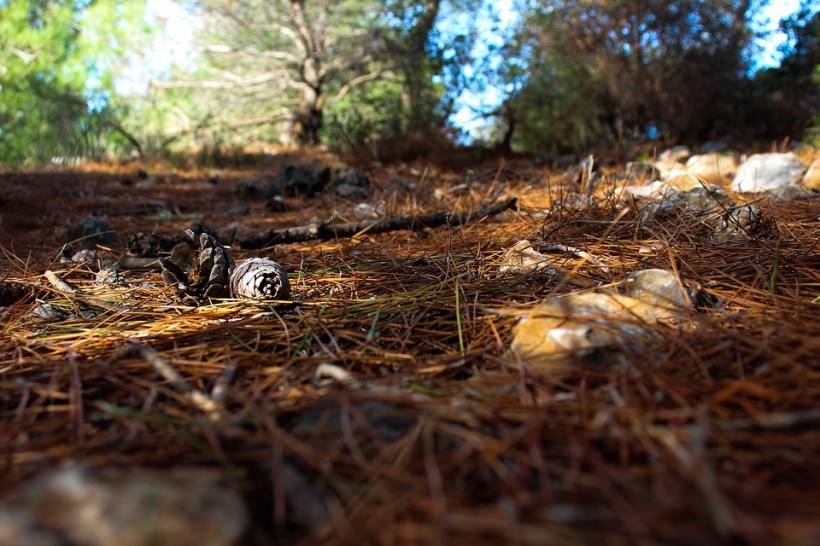
Just yesterday I watched an ant crossing a path, through the
tumbled pine needles she toiled.
And I thought: she will never live another life but this one.
And I thought: if she lives her life with all her strength
is she not wonderful and wise?
And I continued this up the miraculous pyramid of everything
until I came to myself.
Mary Oliver, Reckless Poem (extract)

There is great practical wisdom in understanding how the mind
creates boundaries of concern and interest, and how we can work
with these. Of course there are boundaries; there are other beings
on earth. But what counts is how those boundaries are maintained,
opened and closed.
When we consider otherness — the way beings
are different from us — we can feel either insecurity, ‘How does
she compare with me?’ or contempt, ‘You’re not as good as me’; or
fear and intimidation, ‘You’re better or stronger than me.’ Or, we
can feel adoration/attraction — ‘I want to be bonded to you.’
These immediate assumptions are called ‘conceit’: that is, we conceive
of people as worse, better or the same as us. The effect is that the
mind’s responsiveness gets stuck.
Caught in the conceit of self-view, the heart doesn’t extend its boundaries of appreciation and concern.
We take each other for granted as ‘my wife,’ ‘my boss,’ ‘my teacher’; and that fixing of them freezes our sensitivity. In that state, the heart easily tips over
into complaining about the other not being the way they ‘should
be’ (or rather the way I want them to be), and so the heart becomes
a breeding ground for ill-will.
Ajahn Sucitto, Parami: Ways to Cross Life’s Floods

