More thoughts on our underlying shifting ground

Similar thoughts to the ones posted on Monday, this time from a Christian perspective, written by probably the most influential Catholic Theologian of the 20th Century. He uses the word “pessimism” to describe the underlying sense of groundlessness which we frequently feel. His ideas are remarkably similar to ones found in other traditions, such as posts I have already written based on the work of  Pema Chodron.

This perplexity in human existence is not merely a transitory stage that, with patience and creative imagination, might eventually be removed from human existence. It is a permanent existential of humanity in history and, although it keeps assuming new forms, it can never be wholly overcome in history……. Of course, we cannot say that human finitude and historicity alone explain the fact that history cannot follow its course without friction and without blind alleys. Nor can this Christian pessimism be justified merely by the fact that it is impossible fully to harmonize all human knowledge with its many disparate sources, or to build a fully harmonious praxis on the basis of such disparate knowledge. We might also mention that we can never fully understand the meaning of suffering and death. Yet in spite of all this, the Christian interpretation of human existence says that within history, it is never possible wholly and definitively to overcome the riddles of human existence and history, which we experience so clearly and so painfully…..

People are afraid of this pessimism. They do not accept it. They repress it. That is why it is the first task of Christian preaching to speak up for it.

Karl Rahner, “Christian Pessimism”, in Theological Investigations XXII

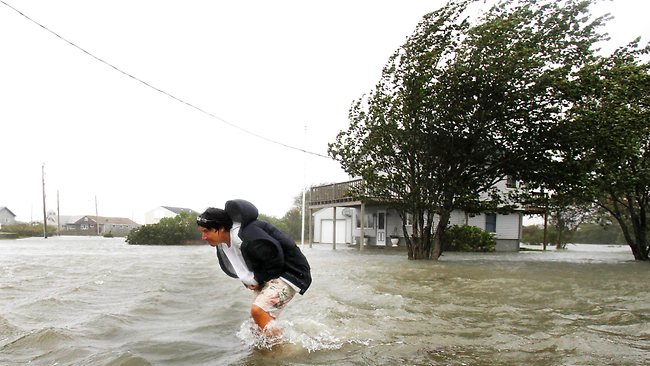
(Photo Credit: AP/Winslow Townson)

Trusting, even when there are storms

I am in love with the Oceanlifting her thousands of white hats in the chop of the storm, or lying smooth and blue, the loveliest bed in the world.

In the personal life, there is always grief more than enough, a heart-load for each of us on the dusty road.

I suppose there is a reason for this, so I will be patient, acquiescent.

But I will live nowhere except here, by Ocean, trusting equally in all the blast and welcome of her sorrowless, salt self.

Mary Oliver, Red Bird

On shaky ground

We often find ourselves blown by this wind or that, unsettled, subject to varying emotions.  Inside ourselves we are restless, uncertain, or can feel entangled. This experience is nothing unusual, but rather is at the heart of the human condition.  In most moments, even after periods when  things go well, there is an underlying hum of  disquiet, of shifting ground.  Some writers call this ongoing feeling  “groundlessness”, others “loneliness”. Our first thought is to consider this as negative and it often leads us to feel disturbed. In today’s culture, the idea that one is unsettled or not completely happy is often considered a sign of failure.  It does not harmonize with the media insistence on happy people or the myth of easily established social relationships. So we can react to this inner sense by doing more, seeking to improve ourselves, or by keeping ourselves busy and distracting ourself or by looking to a relationship to take the feeling away. However, at the heart of mindfulness practice is the understanding that  life is always shifting and changing, that this change is unpredictable,  that we always have some inner sense of incompleteness and that this is ok. It does not mean that there is something wrong with us or our life. It can be a liberation to use this as our starting point. Life has a changing and unsatisfactory character. It is hard to establish a consistent  oneness of mind and heart that remains stable in such a way that there is never any disappointment. Accepting this truth opens the way to wisdom.

And this is the simple truth –  that to live is to feel oneself lost.

He who accepts it has already begun to find himself to be on firm ground.

José Ortega y Gasset, Spanish Philosopher, Who Rules the World.

What helps us grow

How strange that the nature of life is change, yet the nature of human beings is to resist change.

And how ironic that the difficult times we fear might ruin us,

are the very ones that can break us open and help us blossom into who we were meant to be.

Elisabeth Lesser, Broken Open

The decisive question

The decisive question for man is: Is he related to something infinite or not? That is the telling question of his life. Only if we know that the thing which truly matters is the infinite can we avoid fixing our interests upon futilities, and upon all kinds of goals which are not of real importance. Thus we demand that the world grant us recognition for qualities which we regard as personal possessions: our talent or our beauty. The more a man lays stress on false possessions, and the less sensitivity he has for what is essential, the less satisfying is his life. He feels limited because he has limited aims, and the result is envy and jealousy. If we understand and feel that here in this life we already have a link with the infinite, desires and attitudes change.

Jung, Memories, Dreams, Reflections

What happiness is not

We tend to equate happiness with two things, pleasure and lack of tension. Hence we fantasize that for us to be happy we would need to be in a situation within which we would be free of all the tensions that normally flood into our lives from: pressure, tiredness, interpersonal friction, physical pain, financial worry, disappointment in our jobs, frustration with our churches, frustration with our favorite sports teams, and every other headache and heartache that can appear. Happiness, as it is superficially conceived of, means perfect health, perfectly fulfilled relationships, a perfect job, no anxiety or tension in life, no disappointments, and the time and money to enjoy the good life.

But that isn’t what constitutes happiness. Meaning is what constitutes happiness and meaning isn’t contingent upon pain and tension being absent from our lives. C.S. Lewis taught that happiness and unhappiness color backwards: If our lives end up happy, we realize that we have always been happy even through the trying times, just as if our lives end up unhappy we realize that we have always been unhappy, even during the pleasurable periods of our lives. Where we end up ultimately in terms of meaning will determine whether our lives have been happy or unhappy. Happiness has a lot more to do with meaning than with pleasure.

Ron Rolheiser, Meaning and Happiness.