Moving into disorder

In human beings there is a constant tension between order and disorder, connectedness and loneliness, evolution and revolution, security and insecurity. Our universe is constantly evolving: the old order gives way to a new order and this in its turn crumbles when the next order appears. It is no different in our lives in the movement from birth to death. Change of one sort or another is the essence of life… when we try to prevent the forward movement of life, we may succeed for a while… but inevitably there is an explosion.

To be human is to create sufficient order so that we can move on into insecurity and seeming disorder.

In this way we discover the new.

Jean Vanier, Becoming Human

On learning from nature

There is often an unspoken assumption that things should go smoothly in life, or that the Universe has a direct plan for us, and that it communicates it easily. Consequently,  we get upset that things are not always that straightforward. When things go wrong we can often regard it as a violation of some supposed natural entitlement to order and predictability. However, if we look at the natural world we do not find complete support for this underlying assumption. The recent turbulence in the weather, and the natural disasters of this past year,  demonstrate that things in nature are frequently unpredictable and disruptive.  So we should not expect anything different in our lives. Bad things can happen and our lives can change, in ways that we cannot predict. Things happen in indirect ways, and reasons are not always immediately evident. Patience is needed if we wish to understand or work out what is our path.

Clouds are not spheres,  Mountains are not cones, 

Coastlines are not circles and bark is not smooth,

nor does lightning travel in a straight line. 

Nature exhibits not simply a higher degree but an altogether different level of complexity.

Benoit Mandelbrot, French-American  mathematician.


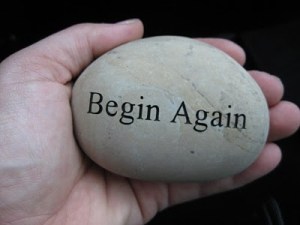
Starting over and over again

As I said in this morning’s post, mindfulness practice renews itself every day, as we start over again and again, returning to the present moment which is always different, always new. This is because life is continually changing, and what we are presented with today is not the same as yesterday, no matter what our thoughts tell us. So the underlying attitude is key: a gentle, non-judging, attitude towards ourselves and our efforts.

I first heard the phrase “just start over”  some 20 years ago from the meditation teacher Sharon Salzburg….who told us about her own struggle with learning to meditate – how she would become lost, distracted, and discouraged and would constantly second-guess herself and her teachers. Gradually she learned to pay no attention to the mental and emotional chatter and to just start over by meditating on her breath as she had been instructed. “Just start over” became her mantra, which she now teaches to her students.

Each time Salzburg repeated this phrase, I was deeply inspired. I realized that she was pointing to a radical attitudinal shift in which you cease to be reactive when you are knocked off your intended path. Instead, when you discover that you have lost your focus, you just begin again without getting caught up in emotional stories about why you can’t achieve your aim or judgments about how unworthy you are or why the change you seek is impossible.

As you know if you’ve ever tried to meditate, the mind is constantly being pulled away from its object of concentration by bodily sensations and mental activity, causing you to lose awareness of the present moment. In this same way, when strong feelings arise during your daily life, you get swept up in the story they create. You lose the awareness that enables you respond skillfully to events and that gives you peace of mind in the face of difficulty….. You have the mistaken notion that you must know why you have a problem and must get rid of it before you can act in a more self-empowering manner. Starting-over practice takes a different approach. It switches your focus away from dwelling on those characteristics that limit you and redirects it toward recognizing your strengths from which you can realize your potential…. In so doing, you free yourself from your judging mind that thinks it can control results and creates the grandiose expectation that you can do more than you can do in the present moment. You become a more effective person by simply learning to use your time and energy to do what you can do right now.

Phillip Moffitt, Starting Over

Not chasing after happiness

Some more reflections on not going anywhere, from a lovely recent book by Thomas Bien, entitled The Buddha’s Way of Happiness. Letting go of our instinctive need to “fix” ourselves – of the drive to do more and more –  is the key to change.  Staying put is a secret to getting places.

We get stuck in the drama of our lives. If we are to find happiness we instinctively feel that we have to go through something, endure some difficulty, go on a quest, slay dragons or monsters and ultimately find the gold or the princess in order to find the resolution and the peace which we seek. When we are told that happiness is available right now, we can hardly escape thinking what we have to do, endure and struggle to find it. We almost can’t help it.

Seeing life as “story” gets us caught in the notion that we don’t have happiness. We have to go after happiness somehow.When we learn that we can be happy right now, just breathing in and out, and seeing a leaf for the miracle it actually is, instead of the idea of “leaf”, we’re almost disappointed. We want it to be a great achievement. If we can’t find a way to see it as an achievement, then we can’t feel special and feed the ego. Instead, in seeing things as they actually are, we step outside the ego.

….. staying with what is here

When we encounter things during the day, they can frequently spark off a rush of thoughts and emotions. Or sometimes even deeper reflections upon the direction we are going or how we have gotten to this point. Occasionally these are useful but at other times they can easily lead into self-judgment and doubt. Most of our daily practice is just staying with the awareness of how things are now, in this moment, and not the thoughts about this moment. And it is still the same practice if strong emotions have been triggered automatically – often before we can even notice – by some of the things we meet. So, instead of going too far into the thoughts provoked, we try to stay with the sensations in the body, holding a space around them. Staying with what is here, not thinking ourselves into what is not here.

Who was the first man to see the moon on the river bank?  In what year did the moon first shine on man?

Human lives ceaselessly come and go, generation after generation, but the moon and the river stay constant year after year.

I don’t know who the moon and the river are waiting for, I only see the waters of the Yangtze flowing away.

Zhnag Ruoxu, Tang Dynasty poet.

The eye of the storm

One reason why people  meditate is to remain calm and focused in the face of the storms and pressures which face they encounter each day.  Here Ajahn Sumedho breaks down how to do that, in practical terms.  The simple ability to be aware – which we all have –  is the key.  Awareness is the calm place from which we can observe and notice those things that  change – moods, good and bad, thoughts, positive and negative – without trying to hold on to them, or becoming identified with them. This is how we can remain at the eye of the storm and not get blown by the winds. We are aware of what we are feeling emotionally, but do not get caught up in it by analyzing it, judging it, or becoming it.

The stillpoint, the centredness, that’s awareness. When I cannot notice it and go out into the turning world, I become a person and get caught in my habits, my loves and hates, my likes and dislikes.  But if I am centered at this point, it’s like the island you cannot go beyond, or the stillpoint of the turning world, the eye of the storm. And then the world revolves around it. The mood you are in is not the stillness. The mood comes and goes. It changes, revolves; it’s happy, sad, elated, depressed, inspired, bored, loving, hateful, and on and on like this….It’s so easy to say “I’m in a bad mood” or “I’m in a good mood” Our langauge is like that, so we become the mood – “I feel happy today, everything’s fine” or “Today is one of my bad days”. That’s why I encourage this investigation of thought, so that you are not creating yourself, endlessly reinforcing the sense of self through your proliferating thoughts.

Ajahn Sumedho, The Sound of Silence