Changing and unchanging

File:Moon in dawn reflection on lake scenic.jpg

In the MBSR group last night in Moone we were talking about how each day we are confronted with new experiences and challenges – unexpected deadlines, getting a parking ticket, the wind bringing down trees. We can be faced with changing feelings and attitudes, moods and emotions. However, as we said,  it is not so much the experiences in our life that are crucial but how we relate to our experiences. Through sitting we are nourishing something that does not change – our awareness – which allows us say, as Tara Brach suggested yesterday,  “This too”:

The water in the stream may have changed many times,

but the reflection of the moon and the stars remains the same.

Rumi

Staying solid and enduring

tree

The strong winds in Ireland this morning remind me of this teaching on being shaken and standing firm

When you look at a tree in a storm, you see that its upper branches move more violently in the wind. But if you look at its trunk, you see that it is very solid and still. Your belly is the trunk of your being. It is important to allow everything in your head to move down to your abdomen. Place your hands on your abdomen and practice your breathing.  After five, ten, fifteen minutes the storm will pass and you will be ok.

Nguyen Anh-Huong and Thich Nhat Hahn, Walking Meditation

Living in the future

File:The Future Man.JPG

A lot of our anxiety comes from what we imagine the future to be like, and how we tend to fill in the worst possible scenarios and seem to not imagine positive alternatives. I have noticed since returning to Ireland that a lot of media time is taken up by discussions of possible disasters and downturns which may soon befall the country, particularly in the economic realm. Since, as the Roman poet Terence reminded us,  there are as many opinions as there are people, this speculation only succeeds in maintaining a sense of anxious rumination, without always having any solid base. It can often be the same in our personal stories, and therefore a good remedy can be simply to recognize our mental chatter for what it is and practice staying in the present.

Just as we tend to treat the details of future events that we do imagine as though they were actually going to happen, we have an equally troubling tendency to treat the details of future events that we don’t imagine as though they were not going to happen. In other words, we fail to consider how much imagination fills in, but we also fail to consider how much it leaves out.

Dan Gilbert, Stumbling on Happiness

picture:  “The Future Man” by Paul Klee

Here, now, amounts to so much

IMG_2078

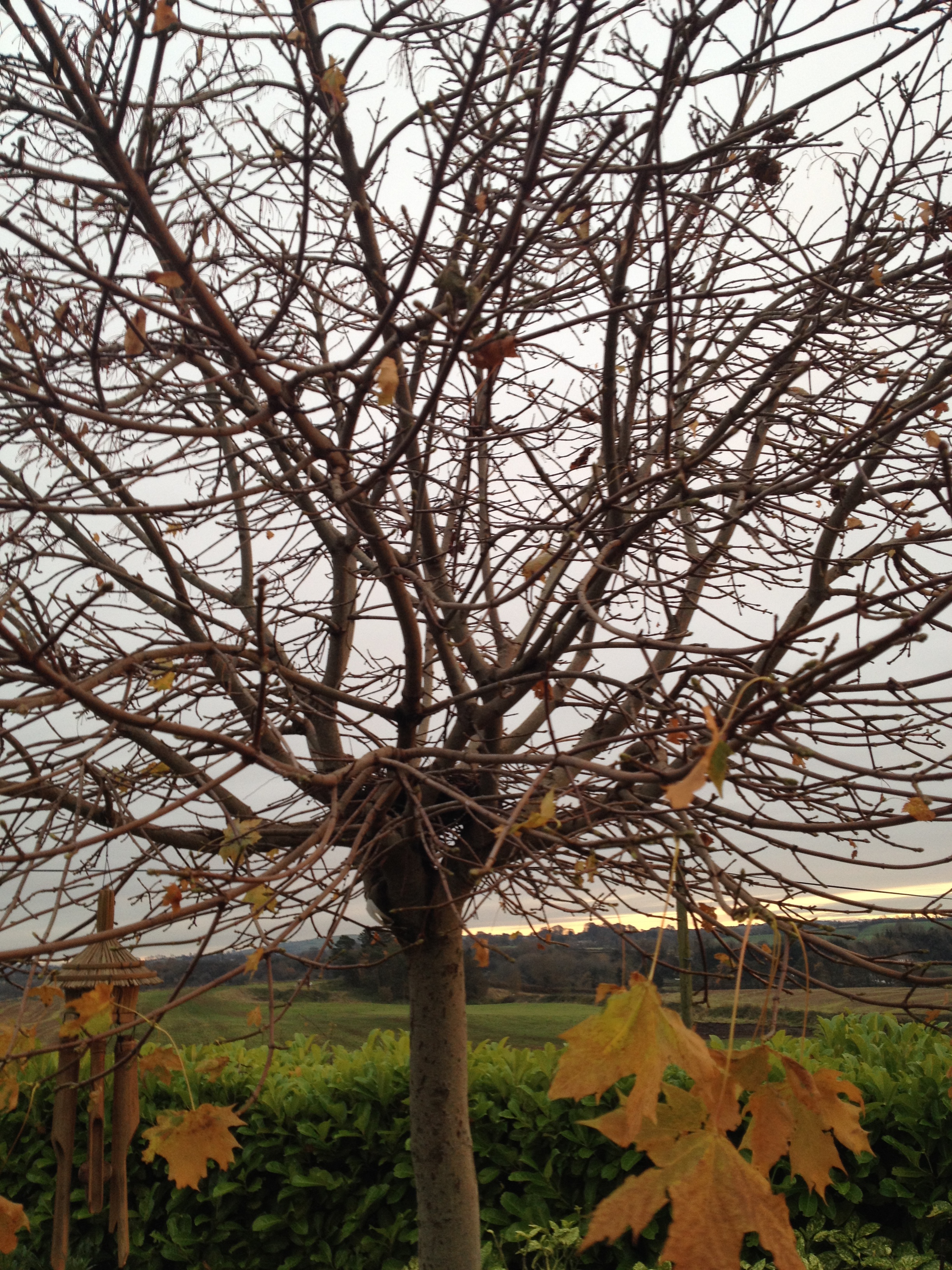
The trees in the garden have finally shed their leaves. We have had a long autumn here in Ireland but it finally begins to make way for winter. There is a certain sadness in seeing the yellow leaves and yet a beauty in the bareness of the branches. Two aspects of a life – it moves on and yet is fully here:

Why… Have a yearning for destiny?

because being here amounts to so much, because all

this Here and Now, so fleeting, seems to require us and strangely

concerns us.  Us the most fleeting of all….

Having been once on earth – can it ever be canceled?

            Rainer Maria Rilke, The Ninth Duino Elegy

Speeding up or slowing down

File:Flickr - law keven - I love my nuts....jpg

The days are getting much shorter here in Ireland, and the colder weather and darker afternoons begin to be felt. This is no surprise as we have passed the old date for the start of winter – the feast of Saint Martin – last Monday. Traditionally, a period of forty days preparation for Christmas began then, a custom dating from the 5th Century.  These days coincided with a sense of the natural beginning of winter,  with a winding down of work outdoors and the body’s response to that in letting things go and taking recovery time for itself. It was  a time of reflection and a simplification of intake, of taking stock and winding down. In today’s world,  technology allows us to promote the opposite – longer  shopping hours and a  speeding up in preparation for the holidays, as  Thanksgiving and Christmas  advertisements begin to dominate.  An ancient way of doing things – probably more in tune with nature’s rhythms – and a modern  one.  Thus we have a choice.

The first step in any letting go is ‘stepping back’–  non-involvement. This initiates letting go by unhooking the mind from the topic that is stirring it up. It’s not a matter of avoiding or suppressing the topic, but of seeing it in a clear and spacious way. Non-involvement is about settling back into the present moment, relaxing into the way things are right now; it’s about letting go of the ‘shoulds’ and ‘shouldn’ts,’ the past, the future and the imaginary, and meeting things as they arise in the present…. Letting go is also about giving things time to shift and settle, and being patient with oneself. It’s about not comparing yourself with others, and letting go of self-images. Letting go makes us more flexible and broad-minded. It’s grounded in the understanding that things change; and that they can change for the better if we’re attentive, mindful, and put aside distractions and negativity.

AjahnSucitto, Meditation, A Way to Awakening

photo kevin law

Always off balance

dawn_166598t

 Heavy rain this morning in Ireland, after a bright autumn day yesterday. An easy lesson in the inevitability of change and that our real work lies in becoming familiar with movement, not in standing still.  Moreover, this constant change allows us develop insight into another learning, namely that we should never expect to really arrive at a competed work and that, as Theologian Karl Rahner said, in this life “all symphonies remain unfinished”. Sitting with this allows us  relax in the knowledge that things are never quite perfect, yet still can be complete for that moment:

We realize this life as something always off its balance, something in transition, something that shoots out of a darkness through a dawn into a brightness that we feel to be the dawn fulfilled. In the very midst of the continuity our experience comes as an alteration. ‘Yes,’ we say at the full brightness, ‘this is what I just meant.’ ‘No,’ we feel at the dawning, ‘this is not yet the full meaning, there is more to come.’ In every crescendo of sensation, in every effort to recall, in every progress towards the satisfaction of desire, this succession of an emptiness and fullness that have reference to each other and are one flesh is the essence of the phenomenon

William James, A Pluralistic Universe