Not too big or too small

File:Glacier scratched pebble.JPG

Modern science is finding out that a lot can be learned from contemplative traditions, both in the East, as seen in Ajahn Sucitto’s quote this morning, and in the West, as can be seen in monastic orders like the Cistercians both here at Bolton Abbey in Ireland or all around the world. They both emphasize the health benefits of sitting still, which has effects on brain function, even in small doses.

The claim…that stillness of body leads to stillness of mind is not the exclusive preserve of Indian traditions: the desert fathers maintained that simply sitting still, preferably on or close to the ground, would greatly aid their attempts to keep the mind focused and thus resist the distracting chatter of demons. To sit still is to be present, and fully attentive to what is. How often do we really give our undivided attention to the things we do, or the people we are with? To be present is to accept what is,  as it is, without wishing things were otherwise, or imagining that if only they were, then everything would be so much better. It is to be able to pick up a pebble and see that it is perfect – just as it is – neither too big or too small. 

Nicholas Buxton, Tantalus and the Pelican

photo b navaz : basalt pebble scratched by glacier erosion

Ambiguity

window

The magnitude of our personal journeys,

require that we learn to tolerate ambiguity,

in service to a larger life.

James Hollis, What Matters Most

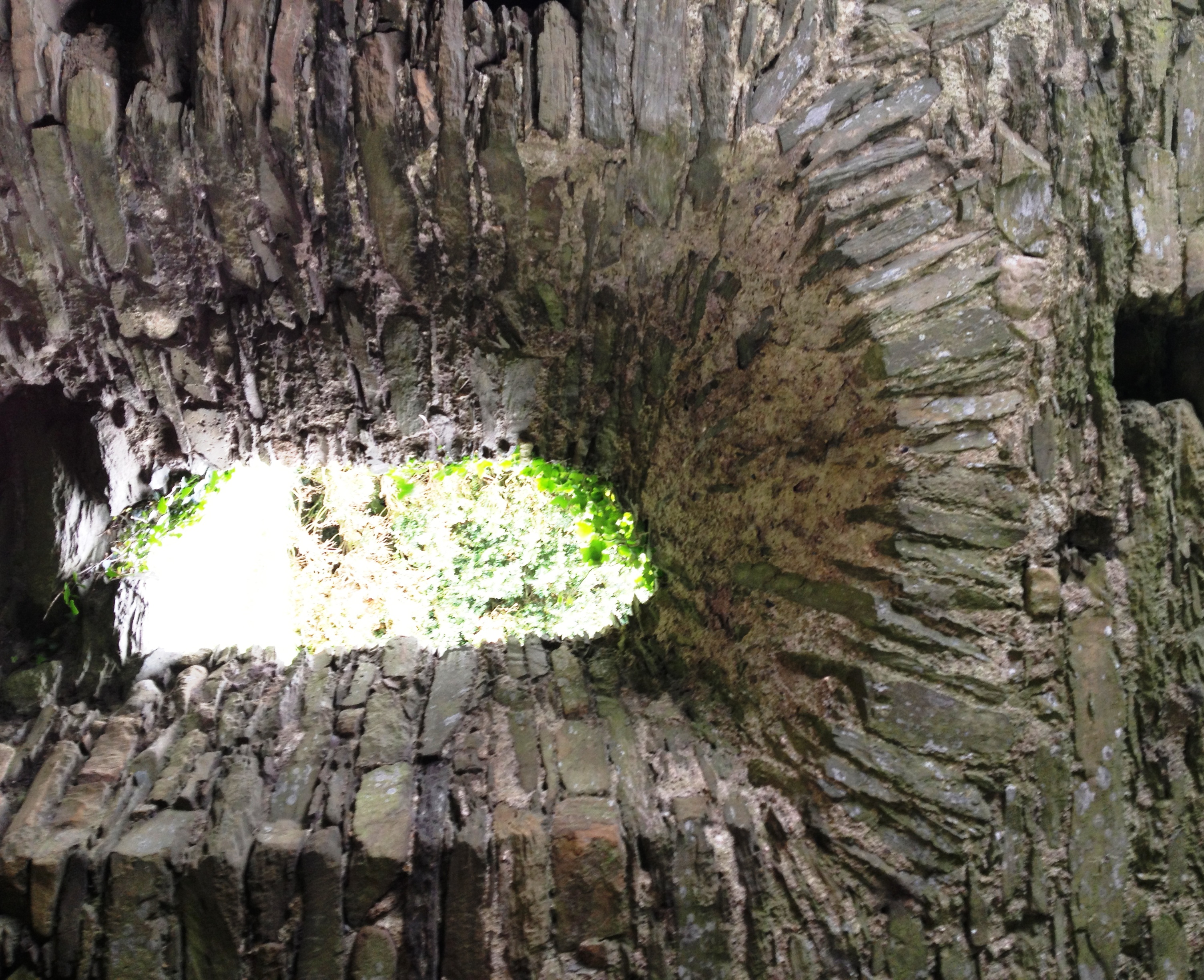
photo of 13th century Killelan Abbey (Knights of St John of Jerusalem),  Moone, Co. Kildare

The deeper meaning to work

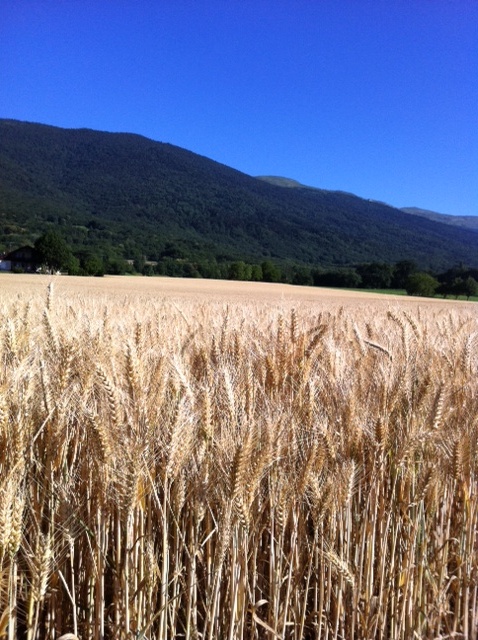
wheat and the jura June 25

The other day I  had a small problem with the heating and water system so I called a plumber. Like many people he was interested to hear of my impressions of Ireland since I returned. I told him that they were mostly positive and of the changes I had noticed. He said that he felt the time of the economic boom in Ireland had shifted many people’s focus onto  more materialistic aspects of life, and that many people had “lost their heads” during that time.  A lot of people tend to associate greater wealth with a less caring attitude, which may or may not be the case. It is true that an economic model focused just on growth will not automatically lead to compassionate or sustainable, inclusive,  development. However, what struck me more is the need for a framework of values which Ireland traditionally had and which it has moved away from, sometimes with good reason. However, replacing them with an alternative consumer framework may not be the best solution.  As this quote says, our work needs to refer to some overall direction or else it risks losing it capacity to nourish all aspects of the person and society:

The outward harmony  that we desire between our economy and the world depends finally upon an inward harmony between our own hearts and the originating spirit that is in the life of all creatures…We can grow good wheat and make good bread only if we understand that we do not live by bread alone.

Wendell Berry

Which myth we live by

 File:Obilisk and gravestones of the Big Church in Templemore.JPG

It is clear that many things have changed in Ireland in the time I have been abroad, such as the confidence placed in institutional elements such as government, banking and most especially the church. However, we never really get rid of our guiding myths, just simply replace them with others – new populist ideologies, fads and obsessions with fashions and celebrity leaders – which play a similar role.

The crises of the world are not just “out there” in the geopolitical sphere but “in here” in the individual soul. The questions, explanations and great rhythms that once guided the soul by way of living myth are still within us, still guiding our lives. And we are obliged to render this process more conscious lest we live blindly, false to ourselves and false to nature. . . . we must more consciously create our own myth or be enslaved to the myth of another.

James Hollis, Tracking the gods

photo Templemore abbey, Laurel Lodged

The end of suffering

standing still

This is an interesting, important text, one of my absolute favourites, and merits some ongoing reflection. On first reading it seems strange – living in Ireland it is obvious we live on an earth, with plenty of water and wind! Obviously we come and go, either on holidays or as in relocating from country to country. It must mean something deeper about the causes of suffering.  There is a lot of evidence that people can benefit fairly immediately from some of the centering and calming practices that are found in meditation and mindfulness. They bring a certain release from the stresses and suffering of everyday life. However, texts like this suggest that real, lasting  and full liberation comes from coming to a felt knowledge of the dynamics beneath the human capacity for stress. It is somehow related to a stepping out of the continual movement of the mind towards or away from experiences –  what is referred to as the “shackles of constant becomings” – to a place that observes all comings and goings without judgment.

There is that sphere of being where there is no earth, no water, no fire, nor wind;

this sphere of being I call neither a coming nor a going nor a staying still,

neither a dying nor a reappearance; it has no basis, no evolution, and no support:

it is the end of suffering

The Buddha

Balancing different aspects

File:Round hay bale at dawn.jpg

When I was young I went on holidays to my uncle’s farm in the West of Ireland and this day, which was a holiday, was seen as  marking the change from the Summer season to Autumn. My aunt would say that the days started getting shorter once this day was over.  Maybe so,  here in this part of Western Europe.  However, there is a different awareness in mainland Europe  –  in countries such as Italy – where this day ,  Fer Agosto , is the central day of the Summer Holidays, characterized by warm weather and family meals.  This is an ancient day of celebration, stretching back to the Roman feriae Augusti  (August break) when horse races were organized, as they are still in the famous Paleo in Siena.  It marked the high point of the Summer heat, realizing a human need for a break before the important work of the harvest began,

The religious calendar often piggy-backed on these human rhythms and celebrations and August 15th is no exception, celebrated by Catholics as the Assumption of Mary,  the mother of Jesus, believing that Mary was taken directly, bodily,  into heaven.   I am not too interested in understanding the theological mystery of this day or looking at things from the viewpoint of what may or may not happen at the end of time. I am more interested in the fact that Carl Jung stated that establishing this feastday was the most important religious event since the Reformation in the 16th Century. He felt it finally gave due recognition to the feminine aspect of the person, emphasizing the role of the anima alongside the animus.

Jung said that this was “the profoundest problem afflicting the human psyche: an imbalance which favored masculine principles and archetypes over the feminine ones”It is an imbalance which seems to have been recognized in all religions and wisdom traditions, as we find representations of female figures from the Virgin Mary in Catholicism and Orthodoxy  to Quan Yin in BuddhismHowever, what  Jung is drawing our attention to, is the need to acknowledge these aspects not just outside us, in our religious figures, but also within ourselves and within society, a task which clearly has a long way to go. 

It is clear that Western Society is built on an over-emphasis of traits and activities that are considered masculine –  logical thinking, analysis, action, and has neglected its feminine,  more contemplative side (while ironically at the same time, having an objectified,  sexualized version of romantic love). So Jung prompts us to reflect on the need to balance aspects within ourself and within society, embrace the energies and understandings that come from both male and female principles.  In simplistic terms this may alert us to the need to hold both logic and creativity, decisiveness and compassion, inner work and outer ambition. He goes on to say that this can fulfil “that yearning for peace which stirs deep down in the soul, and for a resolution of the threatening tension between opposites. Everyone shares this tension and everyone experiences it in his individual form of unrest”. 

Jung seems to suggest that the unrest we experience comes when we do not get a balance between the different elements within us. It seems that becoming whole is a matter of balancing the different intelligences with us, the head, body and heart, and this can be help by a meditation practice which consciously holds the  inner and outer, the self and others.  However,  we frequently overemphasize one aspect over another. working too much at times, such as spending too much energy on the outer while neglecting relationships or leisure. Furthermore, when we do not find the balance inside we tend to project it outside.  This can often be noticed when we are moved to see in another person or in an object or career all the qualities which we think will definitely fulfil and complete us, alerting us to the fact that what we are actually glimpsing are missing aspects of ourselves, or unlived parts of our life. .

The quality of all of our relationships is a direct function of our relationship to ourselves. Since much of our relationship to ourselves  operates at an unconscious level, most of the drama and dynamics of our relationships to others and the transcendent is expressive or our own personal psychology. The best thing we can do for our relationships with others, and with the transcendent, then, is to render our relationship with ourselves more conscious.

James Hollis, The Eden Project

photo Fir0002/Flagstaffotos