Moving forward in spite of our fears

curragh

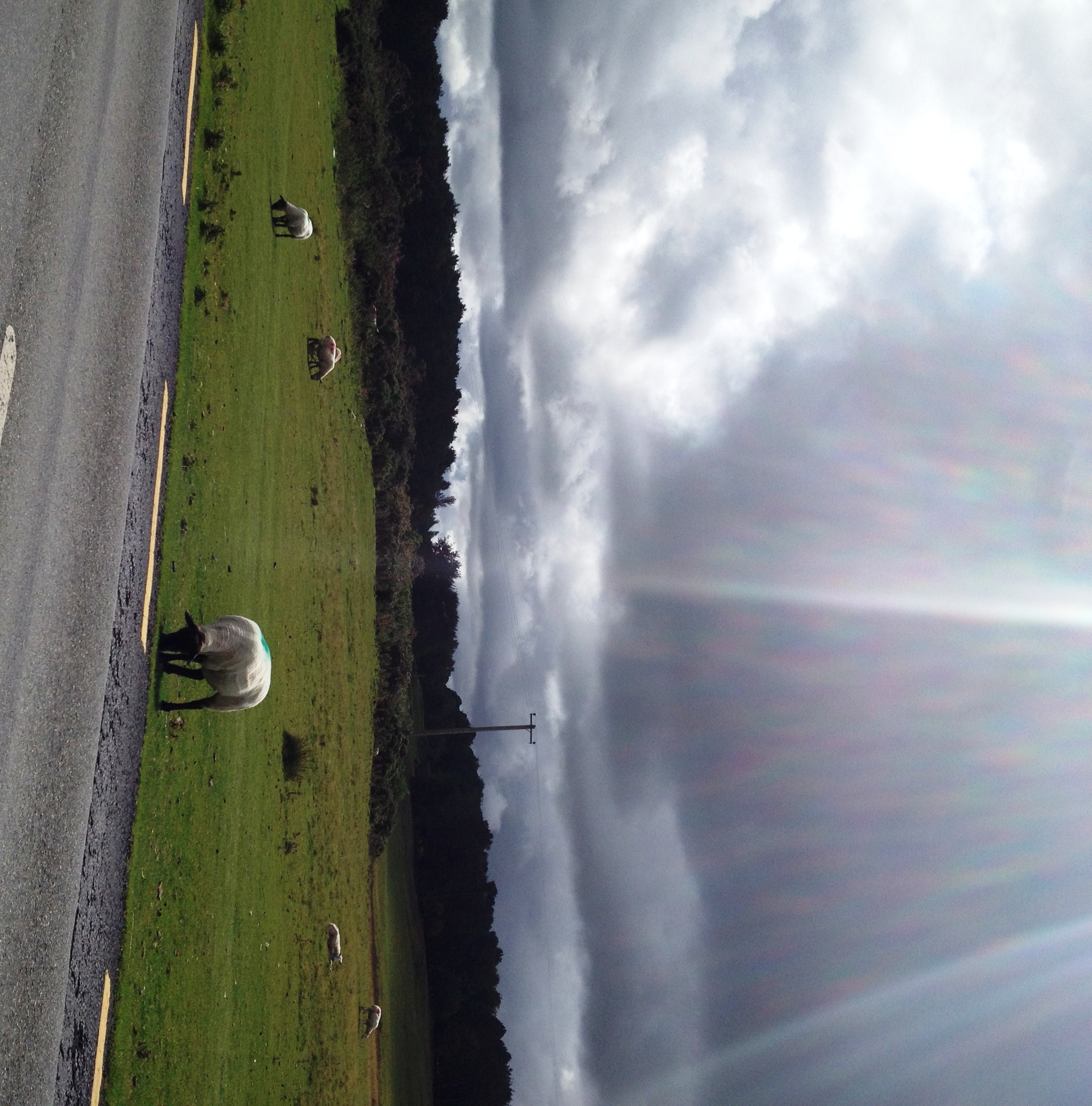
I drove back from some meetings yesterday across the Curragh, which is unique in Ireland as a flat open plain of land which has existed for thousands of years as uncultivated land, nowadays used for grazing.  It is without fences, so the sheep roam freely, and sit at the side of the road, or, as was the case yesterday, simply wander out in front of the car without any regard for safety or “rules”. It was interesting to see them behaving without fear because of their familiarity with traffic and because they have become used to the freedom of the area, having grown up in flocks where this “courage” was normal.  Most of our fearful behaviour is learnt, often due to frightening responses or lack of encouragement when we were young, or simply by being in proximity with people whose dominant narrative was fearful.  Knowing where they originate is less important than recognizing their presence in us as adults, where they frequently operate as thoughts, feelings and bodily sensations that we may not be aware of or simply think are inevitable.

We are more addicted to fear than to fearlessness. Notice how much of the day you hold tightly to your fears, especially the fear of the loss of control. All of our “what if” thinking falls into this category: “What if I don’t do it right?” “What if it’s painful?” “What if I look bad?“ These thoughts are based on wanting to control some imagined future more than on what’s happening now. It’s crucial to see and to label them with the question: “What is my most believed thought right now?”

After seeing the mental constructs, we just sit, experiencing what’s happening right now, aware of the intense physical sensations of anxiety — the tightness, the queasiness, the narrowing down. We might ask the practice question, “What is this moment?” What happens when we do this? Finding the answer is what practice is really about.

Again, the simplicity and clarity of practice amounts to this: first, we must see through the mental process, dropping the story line of “me.” What is the story line of “me”? It’s the addiction to comfort and thoughts, to our self-judgments and emotions, to our identities and our fears.

Ezra Bayda

Fixed views

File:Changing the places.JPG

Problems arise depending on how fixed our ideas are, or how “attached ” we are to a particular vision of what a “good life” means. Is it a certain lifestyle or income, and is our role to provide that for our family? If so, then if something gets in the way of our earning enough o achieve this lifestyle, we will suffer. If ones identity is attached or stuck to a particular role…then disappointment, depression, anger and shame will arise if we can’t live up to it. Remember, everything in life is changing, impermanent.

Karuna Cayton, The Misleading Mind

photo Artur Andrzej

A special calling…to be ourselves

File:GalwayCorrib gobeirne.jpg

In the Ireland of my youth the word “vocation” was quite frequently heard, something which is not so common today. It could refer to jobs which required self-sacrifice and dedication, such as nursing or relief work abroad. However, it most frequently meant that you felt called to serve God in ministry in the Church.  As such it had a special, mysterious quality, almost as if taking you by surprise, from without. While the understanding of life in the context of a deeper purpose and meaning is quite beneficial psychologically, there was a danger of seeing vocation as something reserved for special people. In this quote, Parker Palmer, reminds us that becoming fully who we are, wherever we are at this moment, and not running away from it through regret or living in our thoughts, is the real way of finding purpose in life. It is not by looking elsewhere, but by accepting and inhabiting who and where we are.

What a long time it can take to become the person one has always been. How often in the process we mask ourselves in faces that are not our own. How much dissolving and shaking of ego we must endure before we discover our deep identity — the true self within every human being that is the seed of authentic vocation.

I first learned about vocation growing up in the church. But the idea of vocation I picked up in those circles created distortion until I grew strong enough to discard it. I mean the idea that vocation, or calling, comes from a voice external to ourselves, a voice of moral demand that asks us to become someone we are not yet — someone different, someone better, someone just beyond our reach.

Today I understand vocation quite differently — not as a goal to be achieved but as a gift to be received. Discovering vocation does not mean scrambling toward some prize just beyond my reach but accepting the treasure of true self I already possess. Vocation does not come from a voice ‘out there’ calling me to become something I am not. It comes from a voice ‘in here’ calling me to be the person I was born to be, to fulfill the original selfhood given me at birth by God.

Parker Palmer, “Now I Become Myself,”

photo Old man, Ballyknow Quay,  Galway, Ireland, by Greg O’Beirne

The normal way is not the way home

A short piece on change and the unknown, by the Irish poet and writer John O Donohue:

The greatest friend of the soul is the unknown. Yet we are afraid of the unknown because it lies outside our vision and our control. We avoid it or quell it by filtering it through our protective barriers of domestication and control. The normal way never leads home.

Once you start to awaken, no one can ever claim you again for the old patterns. Now you realise how precious your time here is. You are no longer willing to squander your essence on undertakings that do not nourish your true self; your patience grows thin with tired talk and dead language. You see through the rosters of expectation which promise you safety and the confirmation of your outer identity. Now you are impatient for growth, willing to put yourself in the way of change. You want your work to become an expression of your gift. You want your relationship to voyage beyond the pallid frontiers to where the danger of transformation dwells. You want your God to be wild and to call you to where your destiny awaits.

The Question Holds the Lantern

pilgrims climbing Croach Patrick,  July 28, 2013

Moving toward wholeness, not perfection

This part of Ireland has quite a lot of interesting early Christian remains,   so last weekend I visited the ruins of the monastic settlement in Castledermot.  It is a site which is left somewhat untended, so that the crosses and tombs have a certain craggy beauty in a natural setting.  Rough stones, some seeming unfinished.  And yet, unfinished or ongoing does not mean “not right”, much as we tend to prefer tidyness and a clear direction or order.  We often think we have to be the finished product, or have everything resolved and clear, so that other people will give us the feedback that we are doing OK.  Seeing this “lack of completion” reminded me of these words from  Jung  – which echo the idea from Pema Chodren posted last Friday. We never really arrive at “perfection” (even though the mind thinks in terms of it) but rather at a wholeness which is more like a continual “coming together and falling apart”.  When we give up that notion of  the idealized life we wish we had, we allow ourself to work with the life we actually have.  Each moment may not be perfect, but it is, in some way, complete.

The realization of the self….leads to a fundamental conflict, to a real suspension between opposites …and to an approximate state of wholeness that lacks perfection. . . . The individual may strive after perfection . . . but must suffer from the opposite of his intentions for the sake of his completeness.

Jung, Christ, A Symbol of the Self,

photo of ancient Celtic cross Castledermot, Ireland, taken from dialogue ireland website.

Letting go of the ideal to work with the now

File:Downpatrick sunset (01), September 2009.JPG

One thing that I am getting used to being back in Ireland is the changing nature of the weather, which varies from day-to-day and  even a number of times during the day. Yesterday was a lovely warm, sunny, day,  with a beautiful sky at sunset, while today the sky is hidden behind grey clouds with the prospect of rain later. I was talking with friends in Switzerland who are going through a period of very hot weather, and immediately my mind formed the idea of the “ideal” summer, with constancy and reliability in the weather. However, nice as that would be, one advantage of changing weather is that it allows us practice with letting go of ideals and “shoulds”,  and moving with how things actually are.  This is a good training in letting go of the “push-pull” dynamic of happiness which is ingrained in us.  We seem to alternate between “pulling” – wanting some things that are going on in our lives (or in others’ lives or in an idealized version of our life) or “pushing away” –  not wanting elements of what is happening to us at the moment. Real happiness comes from stepping out of that dynamic, from waking up to to the root cause.

Here are some thoughts from Ajahn Sucitto on how to work with the way the mind likes to form ideals – the weather, the ideal day, the ideal way our life should be –  which can become judgmental  and oppressive. He suggests the development of  a working philosophy of “good enough”, and argues that this cannot achieved through thinking alone, but in a balance between the head, the heart and being grounded in the body, here and now. There is a kindness in approaching life this way, which is often lacking in the thinking mind. 

Not feeling good enough is a true experience. Something’s wrong. But you don’t get good enough through following the idea or the ideal or those performance-driven drives that cause you to fragment. Good enough begins with being whole, with the heart, head and body senses all in the same place. So you enquire: is my body with me now? Is my heart unwilling? Resisting? Or settling into being here? How do I free myself from self-criticism and feeling inadequate? And to look at the topic in another light – where would that self-respect come from? That has to be a relational sense; which is a heart sense, not my thinking mind. The problem is that we mostly orient through the thinking faculty. And for this faculty absolutes and ideals are easy. You can think in terms of absolute right and wrong. You can conceive of the perfect person and the perfect society. What you can’t conceive of in any clear and definite way is what is good enough. The thinking mind can’t grasp that one.  It’s only realizable through the heart faculty.

Ajahn Sucitto, Good Enough

photo ardfern