
You may be capable of great things,
but life consists of small things
Deng Ming-Dao, Chinese author of 365 Tao
You may be capable of great things,
but life consists of small things
Deng Ming-Dao, Chinese author of 365 Tao

The art of cleaning is a simple spiritual activity that is often overlooked. The image of the monk sweeping the courtyard has a deep significance, because without the practice of cleaning there can be no empty space, no space for a deep communion with the sacred. Outer and inner cleaning belong to the foundation of spiritual practice, and as the monk’s broom touches the ground, it has a particular relationship to the Earth. We need to create a sacred space in order to live in relationship to the sacred within ourselves and within creation.
Our present culture teaches us to accumulate, but not how to make empty. But for real spiritual work in the inner and outer worlds, in order to give space to the divine, in order to return to the sacred, we need to practice a certain purification in our daily lives. We learn to eat consciously, to be attentive to our outer environment, to sweep our courtyard. We also need to learn how to clean our house, both physically and inwardly. Just as we need to learn to empty our mind in meditation, to clear away the clutter of unnecessary thoughts, so do we need to consciously clean our living space.
Llewellyn Vaughan-Lee, The Art of Cleaning
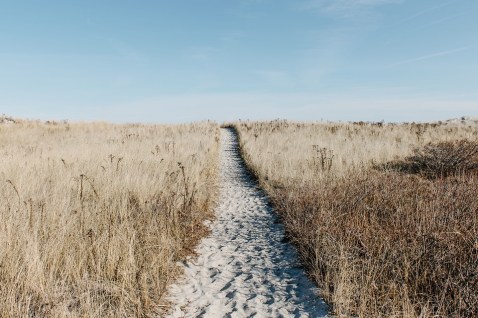
Certainly there is within each of us a self that is neither a child, nor a servant of the hours. It is a third self, occasional in some of us, tyrant in others. This self is out of love with the ordinary; it is out of love with time. It has a hunger for eternity.
Mary Oliver, Upstream


It is not the thoughts that create problems for us.
It is our harboring them.
Shunryu Suzuki, Zen Mind, Beginner’s Mind

If we commit ourselves to staying right where we are, then our experience becomes very vivid.
Things become very clear when there is nowhere to escape.
Pema Chodron, When Things Fall Apart

