Learned helplessness

It is good to remember that …there is a part of you that has always said yes. There is a part of you that is Love itself, and that is what we must fall into. It is already there. Once you move your identity to that level of deep inner contentment, you will realize you are drawing upon a Life that is much larger than your own and from a deeper abundance. Once you learn this, why would you ever again settle for scarcity in your life? “I’m not enough! This is not enough! I do not have enough!” I am afraid this is the way culture trains you to think. It is a kind of learned helplessness. The Gospel message is just the opposite — inherent power.

Richard Rohr

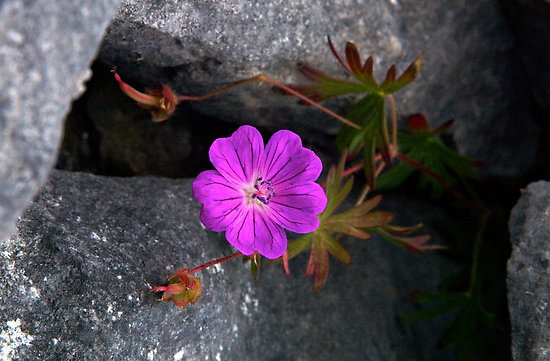
The rarest wildflowers

I dream of a quiet man
who explains nothing and defends 
nothing, but only knows 
where the rarest wildflowers 
are blooming, and who goes, 
and finds that he is smiling 
not by his own will.

Wendell Berry,  from Given

No destination in mind

The mark of a moderate man
is freedom from his own ideas.
Tolerant like the sky,
all-pervading like sunlight,
firm like a mountain,
supple like a tree in the wind,
he has no destination in view
and makes use of anything
life happens to bring his way.

Lao Tzu, Tao Te Ching, 59, translated Stephen Mitchell 

Sunday quote: Eyes of wonder

Everything is ceremony

in the wild garden of childhood

Pablo Neruda

Comparing and complaining

The comparing mind frequently takes us away from the unique form of our own life …

One morning the teacher announced to his disciples that they would walk to the top of the mountain. The disciples were surprised because even those who had been with him for years thought the teacher was oblivious to the mountain which looked serenely down on their town.

By midday it became apparent that the teacher had lost direction. Moreover, no provision had been made for food. The disciples grumbled but he continued walking, sometimes through underbrush and sometimes across crumbling rock.

When they reached the summit in the late afternoon, they found other wanderers there ahead of them who had strolled up a well-worn path.

The disciples complained to the teacher. He only said, “Those others have climbed a different mountain.”

From James Carse, Breakfast at the Victory: The Mysticism of Everyday Life

In the concrete

Money is human happiness in the abstract;

He, then, who is no longer capable of enjoying human happiness in the concrete devotes himself utterly to money.

Schopenhauer