
Yoga fights off depression, better than some other exercises

Researchers at Boston University School of Medicine (BUSM) and McLean Hospital have found that practicing yoga may increase the levels of  gamma-aminobutyric (GABA) in the brain, a   neurotransmitter associated with calming anxiety. It was found that three sessions of yoga a week can help fight off depression because by boosting GABA, it stimulates the function of brain and central nervous system and helps promote a state of calm within the body.

The research was published in the Journal of Alternative and Complementary Medicine, and found that the levels of  GABA are much higher in those that do yoga than those do the equivalent of a similarly strenuous exercise such as walking. Using magnetic resonance spectroscopic (MRS) imaging, the researchers compared the GABA levels of eight subjects prior to and after one hour of yoga.  The study also involved questions about their psychological wellbeing throughout the study. The finding were that those who did yoga reported lower levels of anxiety and higher increases in their mood than the walkers.

Our findings clearly demonstrate that in experienced yoga practitioners, brain GABA levels increase after a session of yoga,” said lead author Chris Streeter, MD,  assistant professor of psychiatry and neurology at BUSM and a research associate at McLean Hospital. These finding support the use of yoga-based exercises in the 8 week MBSR Programme.
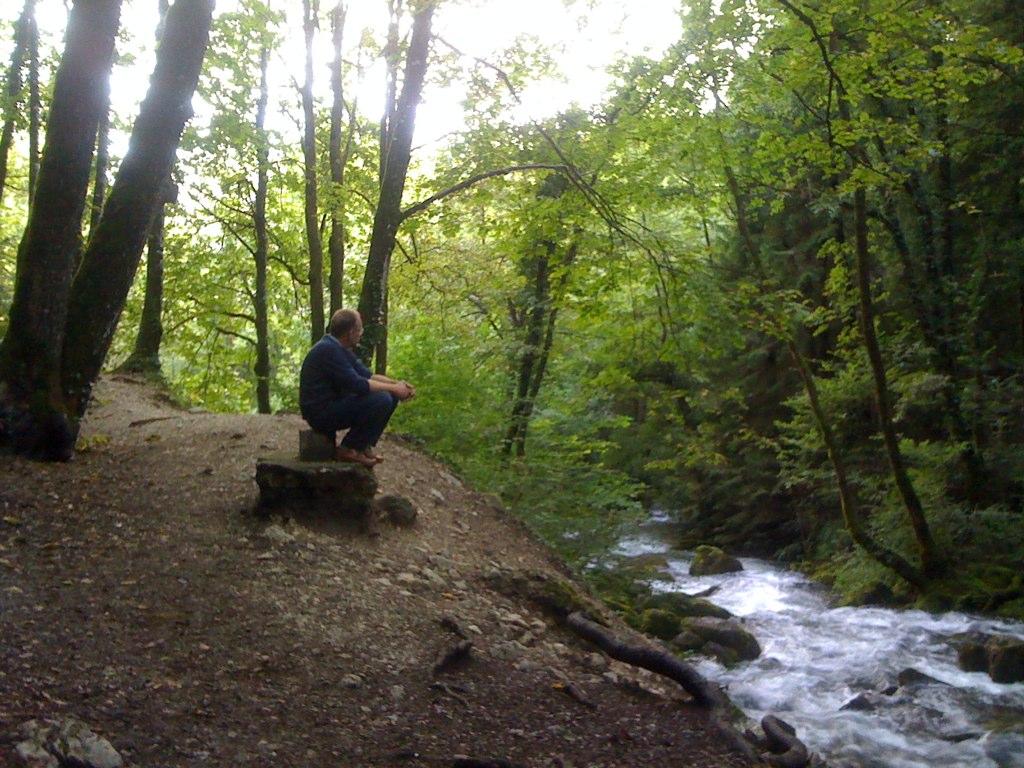

Trying to become something

Practice is based on a complete acceptance of ourselves, as we are, balanced with a gentle, non-judging movement to change aspects of our behaviour which lead to unhappiness. Any desire for change comes within the framework of that non-judgmental acceptance, and an ease with the status quo.

We know when we are far from that. We can feel an urgency in our desire to change, a leaning forward that is tinged with fear. There can be all sorts of reasons for this, such as an fundamental lack of acceptance of ourselves. Or we have an “indirect acceptance“,  when we can only see good in ourselves if someone outside approves us. Or we get mixed up between been needed and being loved. Whatever the reason,  we can look to mediation to fix us, and it becomes attached to an outcome, ultimately adding to our unhappiness with ourselves. The reality of our lives is that we are three-steps-forward-two-steps-back-kinda-people, and need to accept ourselves as that.

Ajahn Sumedho encourages an awareness of what we call “the becoming tendency”, meaning the use of meditation to become something. You do this to get that. It’s a kind of busy-ness and doing-ness and leaning — taking hold of a method, or others’ ideas, or quick  solutions in order to get somewhere. This habit is the cause of many of our troubles, and can so easily take over our meditation. It can permeate the whole effort of spiritual practice. Indeed, he states that the becoming tendency can take over and gets legitimized by being called “meditation.”

Meanwhile, we miss the fact that we are losing the main point and that what we are doing has turned into a self-based program. We get caught in the illusion, trying to make the self become something other. We can relax without switching off, and consequently we can enjoy the fruits of our work. This is what we mean by letting go of becoming and learning to be. If we’re too tense and eager to get to the other end, we’re bound to fall off the tight rope.

Ajahn Amaro

It’s quite simple really

I spoke to my mother on the phone this afternoon. I had missed her call earlier in the week when she had hoped to persuade me to come home for a visit. And when she expressed that wish today I had to decline,  due to a busy schedule in the next weeks. She was disappointed and so I listened,  as best I could, providing a presence across the phone.  She spoke of the things of her day and the up’s and down’s of her week. Mainly simple things, a way of masking greater concerns. My job was to be silent. No greater work for those moments.

Ironically this week I had thought of helping in a bigger way. Sometimes I can think that life and support means grand gestures, a greater endeavour. And I spend my time planning for that in the future, to reach out more. However, what I realize this weekend is that the bigger picture can easily distract and become a way of avoiding. Even something as simple as kindness can take on  proportions that are not human. It misses the real family member who needs us. And then it is no longer love but rather our own day dreams pulling us away.

Real love encourages us to embrace the ordinariness of life. Whatever so distracts us from seeing and loving the familiar of the daily has the potential to be unhealthy. These distractions can appear in all shapes and sizes, many of them wholesome aspirations. However, they put our hopes for life elsewhere – on some shelf we may never reach – and pull us away from what is under our noses.

What is love? It is such a deep need of the human heart. Can it be as simple as being present to one another as fully as we can? I remember speaking to an old monk in Ireland once, who told me that life was quite straightforward really. It consisted of loving, he said, to the best of our ability, those whom we encountered each day. The people who were in our life at that moment.  Most of our days offer these simple encounters, little things –  dropping people off at the airport, making lunch and telling each other that things will work out. Maybe that is the essence of this life that I love – we are here,  we have each other, and do the best we can with what little time we are given. No dramatic gestures, no spectacular love, just ordinary stuff like partners, friends, mothers, sisters, phone calls and listening in silence.

Sunday Quote

The one guardian of life is love,

but to be loved you must love.

Marsilio Ficino


Mini-Movies and other strategies

We have a tendency to do anything to avoid our life as it actually is –  its unsatisfactory nature, its lack of clarity, the way it can give rise to anxiety. Our fear-driven instinct is to get away, to escape. One way we do this is by imagining a different future, a better place, a life with a better script. This is how Rich Hanson describes it , in his excellent book, Buddha’s Brain:

The brain produces simulations…even when they have nothing to do with staying alive. Watch yourself daydreaming  or go back over a relationship problem, and you’ll see the clips playing – little packets of simulated experiences, usually just seconds long. If you observe them closely, you’ll spot several troubling things:

  • By its very nature the simulation pulls you out of the present moment. There you are, following a presentation at work, running an errand or meditating, and suddenly your mind is a thousand miles away, caught up in a mini-movie. But its only in the present moment that we find real happiness, love or wisdom.
  • In the simulator,  pleasures seem pretty great, whether you are considering a second cupcake or imagining the response you will get to a report at work. But what do you actually feel when you enact the mini-movie in real life? Is it as pleasant as promised up there on screen? Usually not.
  • Clips in the simulator contain lots of beliefs…. In reality,  are the explicit and implicit beliefs in your simulations true? Sometimes yes, but often no. Mini-moives keep us stuck, by their simplistic view of the past and their defining out-of-existence possibilities for the future, such as new ways to reach out to others or dream big dreams.

In sum, the simulator takes you out of the present moment and sets you chasing after carrots that aren’t really so great.

Rich Handon, Ph.D, Buddha’s Brain: The practical neuroscience of happiness, love and wisdom, p., 44.

The Sun Never Says

Even after all this time
The sun never says to the earth,

“You owe Me.”

Look what happens
With a love like that,

It lights the
Whole Sky.

Hafiz