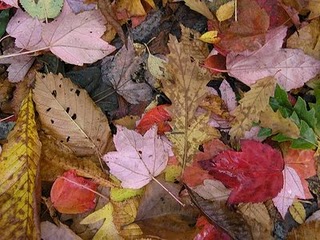
Leaves falling

A wild and windy Autumn day. The leaves are falling in earnest. Am reminded of Shelley’s words: O wild West Wind, thou breath of Autumn’s being… The wind is related to the breath in many of the wisdom traditions, and the breath to the Spirit or the life force within us. In the poem,  the wind moves Shelley to reflect on his inner self, and see parallels between his life and that of the nature around him.

Make me thy lyre, even as the forest is:
What if my leaves are falling like its own!

The tumult of thy mighty harmonies  Will take from both a deep, autumnal tone,
Sweet though in sadness. Be thou, Spirit fierce, My spirit! Be thou me, impetuous one!

Drive my dead thoughts over the universe
Like withered leaves to quicken a new birth!
And, by the incantation of this verse,

Scatter, as from an unextinguished hearth Ashes and sparks, my words among mankind!
Be through my lips to unawakened Earth

The trumpet of a prophecy! O Wind,
If Winter comes, can Spring be far behind?
What is of real value

Those things of real worth in life are worth going to any length in love and respect to safeguard.

Julia Butterfly Hill,

Envioronmentalist Activist

The difficulties are the way

View all problems as challenges.
Look upon negativities that arise as opportunities to learn and to grow.
Don’t run from them, condemn yourself, or bury your burden in saintly silence.

You have a problem? Great.
More grist for the mill. Rejoice, dive in, and investigate.

Bhante Henepola Gunaratana, Mindfulness in Plain English

Everything comes around

Don’t grieve.

Anything you lose comes round in another form

Rumi

Unfinished symphonies

The goal of mindfulness practice is to increase the conditions which lead to our happiness and our freedom. However, the major world wisdom traditions seem to have come to an awareness that  full happiness may not be possible in this world and propose different perspectives based on that. The Buddhist tradition’s fundamental teaching is that life has ultimately an unsatisfactory quality to it and that our suffering comes from not recognizing that. The Old Testament believes that we are on this world with a timeless longing deep inside us, which means that we can never fully find a complete contentment here. As the author of the Book of Ecclesiastes puts it He has also set eternity in their heart. From this perspective therefore, there will always be an restless quality to our life here, because there are (eternal) desires in our hearts which cannot be satisfied by the (finite) experiences which we have. This goes against a lot of what advertising and modern society like to tell us, as they place in front of us a succession of created needs. Although both the Buddhist and the Judeo-Christian traditions differ in the way they resolve the problem, they agree in telling us that no person or no thing can ultimately satisfy our deepest longings and that we will not be fully happy unless we realize that. There is an unfulfilled quality which can manifest itself in our relationships, in disappointments in our families, in a job which does not live up to our dreams, in the place where we live seeming poor in comparison to other places and other lives. To be unfulfilled in this way is to be human. Realizing that it has to be so is the first step to genuine peace.

In the torment of the insufficiency of everything attainable, we finally learn that here in this life all symphonies must remain unfinished.

Karl Rahner

Decluttering our minds

Gaps between activities allow our minds to reopen, expand and have original, often time-and-effort-saving big ideas. So don’t walk with your head down, lost in thought. Don’t just text and call folks when you’re driving or waiting. Don’t read the newspaper when you’re in the bathroom. Allow a little space in your life. Doing nothing is the foundation for doing anything – and it’s one thing we Americans are really, really bad at.

So let go of one or two minutes of entertainment a day – and look out upon this life and world.

Waylon Lewis, Huffington Post