Not letting our fears control us 1: Let go

The river flows rapidly down the mountain, and then all of a sudden it gets blocked with big boulders and a lot of trees. The water can’t go any farther, even though it has tremendous force and forward energy. It just gets blocked there. That’s what happens with us, too; we get blocked like that.
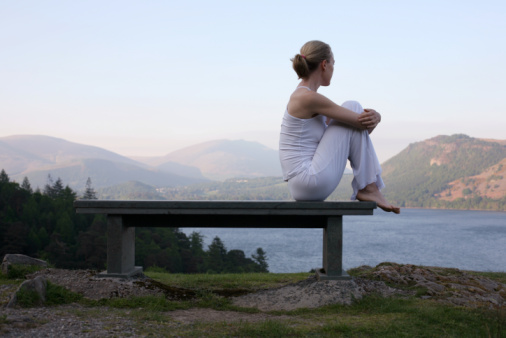

Letting go at the end of the out-breath, letting the thoughts go, is like moving one of those boulders away so that the water can keep flowing, so that our energy and our life force can keep evolving and going forward. We don’t, out of fear of the unknown, have to put up these blocks, these dams, that basically say no to life and to feeling life.

Pema Chodron

More mindfulness research

Some people have wondered whether the effects of the MBSR programme could be due to other factors, such as the presence of the group, people simply taking time to reflect on their lives, or whether just listening to relaxing music would have the same effect. However research at the University of Tilburg in the Netherlands found support for the effectiveness of mindfulness meditation. They looked at 40 women and 20 men who were experiencing distress, separated out different factors, and found evidence for the effects of mindfulness as an individual stress reliever in its own right, independent of other stress reduction factors in the intervention. This gives research backing to what many people have found – the practices of mindfulness are effective against the stresses which modern life can throw at us.

Nyklíček I, Kuijpers KF. “Effects of Mindfulness-Based Stress Reduction Intervention on Psychological Well-being and Quality of Life: Is Increased Mindfulness Indeed the Mechanism?” Annals of behavioral medicine, June 2008.

Balance 3: Make time and space for questions

When I was a child in New York City in the 1940s there were laws that attempted to legislate the Biblical injunction, “Remember the Sabbath and keep it holy.” Businesses were closed. Shopping stopped. There were no convenience stores. People needed to remember, in advance of the Sabbath, to provide for the upcoming day of rest and spiritual reflection so that, on that day, they could rest. The community collectively caught its breath. Family members spent time with each other. They renewed connections. They visited neighbors.

I like to imagine that, whether or not people went to religious services, there was the possibility in that period of a pause for reflection. “What am I doing with my life?” “Is what I am doing good for me?” “Is it good for other people?” “Does my life make a difference in the world?” “Could my life make more of a difference in the world?”

All of the important fundamental questions in life seem to be waiting, so to speak, next on line at the top of the mind’s agenda, if only we give them the time and the space to present themselves.

Sylvia Boorstein

Staying fluid 1: The weather changes, so does life

Life’s energy is never static. It is as shifting, fluid, changing as the weather. How we relate to this dynamic flow of energy is important. We can learn to relax with it, recognizing it as our basic ground, as a natural part of life; Or the feeling of uncertainty, of nothing to hold on to, can cause us to panic, and instantly a chain reaction begins.

We panic, we get hooked, and then our habits take over and we think and act in a very predictable way. The source of our fear is the unfilfillable longing for a lasting certainty and security, for something solid to hold on to. Unconsciously we expect that if we could just get a better job, a better partner, a better something, then our lives would run smoothly. We get caught up in a fearful, narrow holding pattern of avoiding any difficulty and continually seeking comfort.

Pema Chodron, Taking the Leap

Fibromyalgia

The widespread pain of fibromyalgia is hard to treat, but a small clinical study published in Psychotherapy and Psychosomatics shows that meditation may deliver lasting benefits. 39 women with fibromyalgia attended the 8 week MBSR Programme, focusing on deepening mind-body awareness and cultivating acceptance of parts of their condition that they were unable to control. At the end of the Course – and at a three-year follow-up – the women in the Mindfulness group coped better with pain than those whose classes included relaxation training and exercise.

The MBSR Programme included elements on managing stressful situations, which National Fibromyalgia Association senior medical adviser Patrick Wood M.D. considers important. “Fibromyalgia pain is often triggered by some sort of stressor” he says, “so learning to handle stress better can make a big difference in terms of symptom experience”

Jung on Patterns

“Nothing has a stronger influence psychologically on their environment and especially on their children than the unlived life of the parent.” Carl Jung

Factors which can lead to stress come from many sources. They can be due to external circumstances such as the current economic situation or being far away from family and familiar supports.

However some factors are internal, such as those caused by the patterns or conditioning we have built up over the years. Thus we may have learnt that we need to push ourselves hard in order to get attention and worth, and this manifests in our life as a compulsive, driven focus on work or success.

There also seems to be patterns that have been passed on to us, unconsciously, when we were very young. Jung’s observation prompts us to consider how where and how our caretakers were stuck in their development, and how this can becomes an internal paradigm for us also to be stuck. Jung goes on to say: “The child is so much a part of the psychological atmosphere of the parents that secret and unsolved problems between them can influence its health profoundly. The participation mystique, or primitive identity, causes the child to feel the conflicts of the parents and to suffer from them as if they were its own. It is hardly ever the open conflict or the manifest difficulty that has such a poisonous effect, but almost always parental problems that have been kept hidden or allowed to become unconscious”

Without developing some non-judgmental, gentle capacity for awareness of these influences on our inner life we can fail to transform or integrate them into who we are. Thus even into adulthood, our psyche can remain trapped and unconsciously serve the agendas and the lacks of others. In this way we can fall short of achieving our own potential and end up repeating patterns in relationships and in our work life. An awareness of these repeating schemes seems to frequently happen in mid-life when some of the paradigms adopted up until can fail. It was in this period of our lives that Jung said that we need to “decently go unconscious“.

The first step in doing this is to slow down, to make space, to stop the constant flood of information and activity that assails the mind. Making space for art, for meditation, journaling and reflection are all ways we can be kind to ourselves and develop a greater understanding of the factors that lead to our freedom. Slowing down in meditation quickly reveals the first type of internal stressors – our compulsive repeating conditioning – and can perhaps go on to heal some of the unconscious processes which have left their mark on our inner lives.