
All we need to do is awaken to the here-and-now
– to stop jabbering to ourselves –
and be present in this moment.
Steve Hagen
All we need to do is awaken to the here-and-now
– to stop jabbering to ourselves –
and be present in this moment.
Steve Hagen
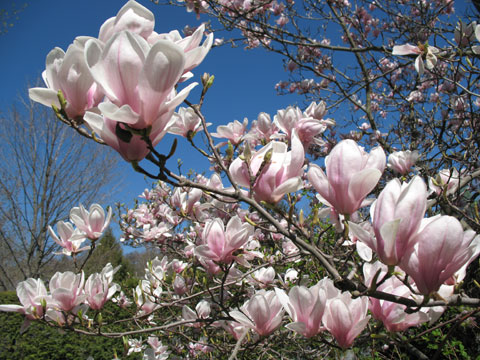 Today is the first day of Spring. The weather is beautiful here at the moment and it is easy to feel the “joys of spring”. The cherry blossom and magnolia trees are in bloom. Time passes quickly. I can remember taking photographs of the same magnolia tree last year. Short term joys come easily; Long term happiness develops when we see into their true nature:
In Spring, hundreds of flowers.
In Summer, refreshing breeze.
In Autumn, a harvest moon.
In Winter, snowflakes accompany you.
If you do not have
the upside-down views
every season is
a good season for you.
Buddhist classic texts (translated by Eido Shimano Roshi)

Do you have the patience to wait until your mud settles
and the water is clear?
Lao Tzu
 At any moment we can say that we are on our way somewhere. We are between what has happened ( which is now a memory, but may be quite active in our emotions and fears) and what could happen (which is at this moment just a thought). We are in the present, which is really the only time there is. This may lead us to feel unfulfilled. However, when we look at in creatively, it can help us respond to life in new ways.
For example, it can change our attitude towards the future. If we are anchored in the present, we do not lean into the future. We can break it down into steps, thus ensuring that it does not overwhelm and frighten us. We do not have to live the whole of the future. Just this moment. Then the next moment. It can also change our attitude towards ourself. If we can bring a gentle non-judgment to ourselves and to our life, we can soften in the moment, and resist the natural tendency to become rigid, especially if we are going through a difficult period. This helps us go against a primitive defense mechanism, which Melanie Klein referred to when she said that one way of dealing with anxious thoughts is simply to avoid them and remove them from awareness, thereby prolonging the problem. Thus. awareness of the present help us work with the past also, by allowing us see repeating unhelpful patterns of thinking, and their accompanying instinctive feelings. It allows us move beyond the categories of right or wrong, by focusing on just being with what is going on inside ourselves at this moment. Gently. Without adding the extra burden of bad self or bad other.
This is not so easy, because if we notice strong emotion in the moment it normally means that we are already caught or hooked by it. However, contrary to our normal instinct, it is by learning to become more open to others and to what is happening that we grow stronger. It has been said that the whole of the inner life begins with generosity in the heart, because that is about creating space. Space for this actual moment. It softens us rather than freezing us into what Srikumar Rao calls the “if – then” model. “If only this moment was different then I would be happy….If only such or such happens then I will be happy”
Being present in the present moment is a skill, that we try to cultivate in our practice. I find that life continually gives me occasions for practicing this skill and a lot of time I fail. However, when I do, I find I do not add to life’s difficulty by struggling with it, or by resenting it, or by resisting it. I find my mind relaxes when I remember to be generous and non-judgmental, firstly towards myself and then towards others and the world.
In-between is where humans always are,
thats what we have to welcome,
a story with an uncertain ending.
And this condition is interesting if you inhabit it;
it’s alive.
If I’m facing something that I don’t know what to do,
the “not knowing” is what is true,
and the resources that I have,
deeply ignorant that I am,
will have to be enough.
John Tarrant
 The very basis of fear itself is doubting ourselves, not trusting ourselves. You could also say it is not loving ourselves, not respecting ourselves. In a nutshell, you feel bad about who you are. So the very first step, and perhaps the hardest, is developing an unconditional friendship with oneself. Developing unconditional friendship means taking the very scary step of getting to know yourself. It means being willing to look at yourself clearly and to stay with yourself when you want to shut down. It means keeping your heart open when you feel that what you see in yourself is just too embarrassing, too painful, too unpleasant, too hateful.
If you do stay present with what you see when you look at yourself again and again, you begin to develop a deeper friendship with yourself. It’s a complete friendship, because you are not leaving out the parts that are painful to be with. It’s the same way you would develop a complete friendship with another person. You include all that they are. When you develop this complete friendship with yourself, the parts you’re embarrassed about—as well as the parts you’re proud of—manifest as genuineness. A genuine person is a person who is not hiding anything, who is not conning themselves. A genuine person doesn’t put up masks and shields.
Pema Chodron

Remembered this poem on Saturday night when we had a clear night and a very bright “Supermoon”, and even an epic victory over the English in rugby is part of the 10,000 things.
Sitting alone in peace before these cliffs
the full moon is heaven’s beacon
the ten thousand things are all reflections
the moon originally has no light
Han Shan

