Have no agenda

My own experience is that the less you have in the way of expectations, the more effectively your efforts will bring fruits and beneficial results. Here in the West we are very idealistic, we create a fixed image – usually unconsciously – of how we want to be or what we want to change. Then through having that fixed idea, we miss the actual changes that we need to make. While our attention is riveted to the horizon, we miss where we are putting our feet. The more we can put aside any particular expectations or agendas, and the more we can engage wholeheartedly in the particular work or practices we are doing, then the better off we are in the long run.

Ajahn Amaro

Watch the mind

Practice is separate from any posture. It is a matter of directly looking at the mind. This is wisdom….. You must examine yourself. Know who you are. Know your body and mind by simply watching. In sitting, in sleeping, in eating, know your limits. Use wisdom. The practice is not to try to achieve anything. Just be mindful of what is. The whole of meditation is looking directly at the mind.

So, be patient.  Live simply and be natural. Watch the mind. This is our practice.

Ajahn Chah

Every moment has potential

Looking back, I can see that my biggest obstacle at the time was that I thought of meditation as something that would help me get rid of the parts of myself that I didn’t like. I sincerely hoped that meditation would lead me to happy, peaceful states of mind where panic and fear could not touch me. Yet what my father was leading me to was much more radical than that: He wanted me to see that the only way out of suffering is to move toward it; that the path of true awakening lies in experiencing every single moment, whether pleasant or painful, with complete and unconditional love.

Unconditional love is something we can immediately see the value of when it relates to others, but how often do we think of cultivating unconditional love for ourselves? How often do we not only accept, but even cherish our own tender spots and painful feelings?  What my father taught me in those early years was that when we simply let be and open ourselves to the richness of the present moment, we experience every thought, feeling, and experience as an expression of the mind’s luminous nature. From the perspective of awareness, no thought or emotion is any better or any worse than another. They are all manifestations of the mind’s infinite potential.

Yongey Mingyur Rinpoche

Being in nature makes the heart bigger

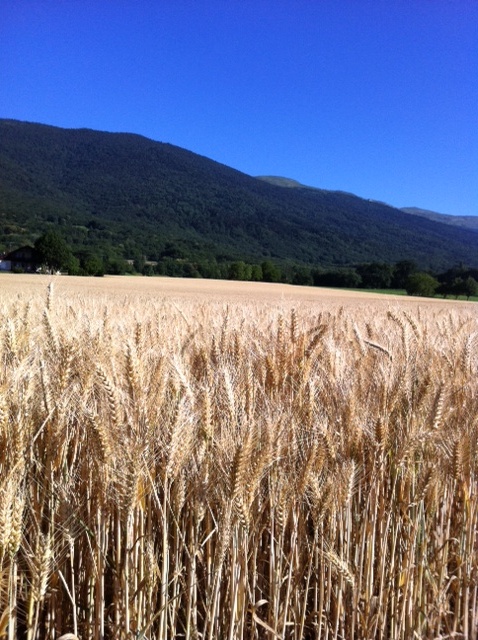
Took this photo on this beautiful morning,  walking near the barley fields at the foot of the Jura. It does scant justice to the sweep of the mountains and the wideness of nature. We draw such scenes into our heart and take a sense of openness from them. In their space we find space.

By association with nature’s enormities, a man’s heart may truly grow big also. There is a way of looking upon a landscape as a moving picture and being satisfied with nothing less big as a moving picture, a way of looking upon tropic clouds over the horizon as the backdrop of a stage and being satisfied with nothing less big as a backdrop, a way of looking upon the mountain forests as a private garden and being satisfied with nothing less as a private garden, a way of listening to the roaring waves as a concert and being satisfied with nothing less as a concert, and a way of looking upon the mountain breeze as an air-cooling system and being satisfied with nothing less as an air-cooling system. So do we become big, even as the earth and firmaments are big. Like the “Big Man” described by Yuan Tsi, one of China’s first romanticists, we “live in heaven and earth as our house.”

Lin Yutang

Setting an intention for this day


I have noticed that folks are generally as happy

as they make up their minds to be

Abraham Lincoln

Simple daily practices 1: Relax the body

There are many simple practices that support the transformation of the mind. These are easy to do at any time throughout the day and prevent us from getting caught in patterns of preoccupation. One practice is to relax the body, particularly the eyes and face, whenever we can remember. When the face is more open and the eyes are soft, the mind tends to connect with the present moment with increasing ease. We have found that this particular practice supports the letting go of powerful and unconscious habits of mind. We can disentangle ourselves more rapidly from those thoughts, feelings and sensations that consistently propel us into the next moment. we can settle into the here and now without always attaching to some agenda of what should or shouldn’t be happening.

Michael Liebenson Grady