On not running away in times of difficulty

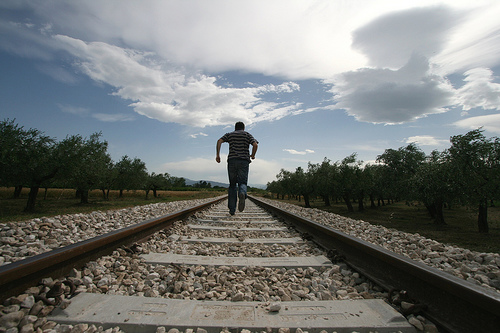
Building on yesterday’s post about staying with the fears and difficulties that are prompted by relationships and manifest themselves as emotions or feelings in the body. As I have said before, the essence of our practice is learning to stay, and in concrete terms this can mean simply staying with the feeling in the body. Running away – into distractions or compulsive activity, or in a more decisive way such as  starting a new relationship or initiating sudden changes of lifestyle – can take us away from the growth which a crisis often offers. Our sitting practice is the place where we work at learning how to do this. It is where we gradually strengthen our capacity  for faithfulness to our actual daily existence, no matter what arises.

The problem with running away when a relationship becomes difficult is that it’s also turning away from ourselves and our potential breakthroughs. Fleeing the raw, wounded places in ourselves because we don’t think we can handle them is a form of self-rejection and self-abandonment that turns our feeling body into an abandoned, haunted house. The more we flee our shadowy places, the more they fester in the dark, and the more haunted this house becomes. And the more haunted it becomes, the more it terrifies us….. Naturally we want to do everything we can to avoid this place, fix it, or neutralize it, so we’ll never have to experience such pain again……This is a vicious circle that keeps us cut off from and afraid of ourselves.

John Welwood, Intimate Relationship as a Spiritual Crucible.

….and endures all kinds of change

If we think of happiness as a way of being, as something that represents a state of flourishing, of fulfillment, of a well-being that endures through all events in life, even all different kinds of emotions and mental states, something that gives you the inner resources to deal with whatever comes your way—pleasant, unpleasant circumstances, helpful circumstances, adverse circumstances—something that gives you some kind of platform or way of being that’s behind all that, and that gives you the resources to deal with all that.

Matthieu Ricard

Our sense of self and our early experiences

Our early experiences strongly shape our sense of self.  They become hard-wired into our unconscious system and then are triggered easily at important moments in adulthood. Because they are so deeply ingrained in our cells they can influence us when we are drawing conclusions about the kind of person we are. Frequently they are concerned with laying down a blueprint as to how reliable or safe the world is, and to what extent others can be trusted. This influences the broad autobiographical narrative which tends to be established by our late teens, colouring our expectations about life and about people. We are balancing our experiences of attachment or closeness with our experiences of unreliability and disappointment. Early disappointment affects our  ability to trust or feel safe, or to fully give  ourselves in adult relationships. Consequently we often approach a relationship in the hope that it will be the one which will finally heal these early disappointments –  hoping to rewrite the relational blueprint which caused us problems as a child – or behave in a way that our negative expectations will be confirmed.  Sometimes the repair happens, but often we are looking outside for something which needs inner work to be fully achieved.

We are wired for attachment
in a world of impermanence.

How we negotiate that tension
shapes who we become.

Robert Neimeyer, Ph.D.

Living in a distracted age

Philosopher Alain de Botton on the effects of the relentless barrage of information which our minds are subject to in today’s world and how we need to re-learn and practice the ability to switch off:

One of the more embarrassing and self-indulgent challenges of our time is the task of relearning how to concentrate. The past decade has seen an unparalleled assault on our capacity to fix our minds steadily on anything. To sit still and think, without succumbing to an anxious reach for a machine, has become almost impossible…..The need to diet, which we know so well in relation to food, and which runs so contrary to our natural impulses, should be brought to bear on what we now have to relearn in relation to knowledge, people, and ideas. Our minds, no less than our bodies, require periods of fasting.

More on Mind-Body medicine: Meditation’s effect on the brain

This study on the effects of the MBSR Course on the Brain, is getting a lot of attention. I posted about it last week already. Here is a link, which Carol sent me,  to a very nice piece in the New York Times. It summarizes well the current debate about the effects of meditation on the brain and health and links to some hard data in the area of mind-body medicine.

http://well.blogs.nytimes.com/2011/01/28/how-meditation-may-change-the-brain/

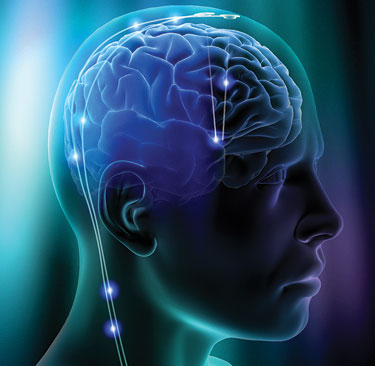
Mindfulness meditation changes the brain

Participation in the 8 week MBSR programme affects the brain in areas which are responsible for memory, sense of self, empathy and stress, according to a new study due to be published next week in the Journal Psychiatry Research: Neuroimaging. The research was led by Sarah Lazar at the Massachusetts General Hospital and looked at MRI scans of participants before and after they took part in the MBSR Programme and compared them with a control group of non-meditators. They found, for example, that participant-reported reductions in stress  were correlated with decreased density in the amygdala, which is known to play an important role in anxiety and stress. This change was not found in the control group, meaning that it was not just due to passage of time.

As Britta Hölzel, PhD, first author of the paper states: It is fascinating to see the brain’s plasticity and that, by practicing meditation, we can play an active role in changing the brain and can increase our well-being and quality of life. What is interesting about this study is that it shows how the reported effects of the MBSR Course are now beginning to be tracked in the underlying structures of the brain.

You can check out a report of the study here:  http://www.sciencedaily.com/releases/2011/01/110121144007.htm