Developing a secure sense of self:2 – True self, False Self

In the previous related post we saw how our sense of self is shaped in our early years. There is a relationship between a strong inner sense of self-cohesion and the consistency of love we got in our early relationships. However we also saw that an  insecure working model of relationships can be formed and will be reflected in the way we relate to others in adult life, due to the fact that we did not feel safe some or most of the time. The last post ended with the encouragement to understand your childhood insecurity and the force it still contains. This post will suggest some other reflections.

One way we respond to our unmet needs when we are a child is to create a False Self. We realized that safety and affection were more likely when we behaved in certain ways. Thus the False Self is created, effectively to please the parents or other caregivers and maintain their love, which we instinctively grasped to be based on certain conditions –  such as that we always perform well. It develops when the mother, father or other caregiver reflect their own defenses or emotional lacks onto the infant rather than reflecting the infant’s actual moods.  It then goes on, even into adulthood, to constantly anticipate the demands of others and keeps up this mask  because it believes that is the best way to get approval.

Now,  most of us, to some extent, have masks or public personas which we use in different situations in adult life. However, what we are referring to here is a False Self functioning which operates in an unconscious way in repeating patterns and internal demands in our adult choices.

The False Self helps comes about to hold the family together by balancing or denying problems and keeps a certain functional harmony alive. However, it becomes so well constructed and adapted that eventually the true self can become lost to us. We find it hard to “be ourselves”. We use the False Self as our “better self” because our true self feels  too weak at times to gain approval.

This can lead to low self-esteem.  Self-esteem is a person’s core belief about himself or herself,  and although it varies depending on circumstances, the pattern usually leans toward a optimistic  or pessimistic sense of self. In general,  one way of dealing with a pessimistic view is to look for anything outside to make us feel better. For example we may have chosen  to become a perfectionist.  The reasons are clear: if we do something perfectly, then we will be praised and get the affection of others.  Or we can develop dependent behaviour, when as Dr Weiss states, one’s “whole life is spent in wildly swinging arcs to meet others’ expectations. If you’re nice to me, I’m a good person. If you look at me funny, I’m a bad person. I don’t know who I am. I am incredibly dependent on other people to tell me who I am.”

Developing Self Compassion is one way to work with low self esteem. This is the ability to  treat oneself kindly in the face of failure, rejection, defeat, and other negative events. Being self-compassionate means we are less likely to compare ourselves with others, to seek all our support outside ourselves and to dwell too long on negative feedback. We will post more on this in the next post.

Developing a secure sense of self: 1

Being comfortable with our life as it is, does not just mean that we are ok with the external elements in our life, such as our job, where we live, our relationships.  It also means that we have some degree of comfort and security in our sense of self. The self can be understood as the system that organizes our experience. It consists of the sensations, feelings, thoughts, and attitudes we have toward ourself and towards the world.

Our emotional health is related to us having a cohesive, strong, balanced and joyful sense of self. When this is not so strong,  and we are constantly uncertain of ourselves, we may find that we are always looking for approval and the validation of others. We can get unduly knocked down by their criticism. In other words, when we feel we are disapproved of, we feel crushed, and when we are praised, we are on cloud nine. Our sense of value comes not from within ourselves, but is dependent on others. If we have a  dependent personality structure, we are incredibly quick at sensing what will please others and will do those things in order to gain  security. However, because our sense of self is reactive, we can find our moods changing constantly, as if blown by the wind.

On the other hand,  when we have a strong inner sense of self-cohesion we have confidence about the acceptability of our personality even when others are not around. We develop a sense of inner security,  and this inner resilience calms us in times of stress. We can bounce back from the inevitable wounds which are caused by temporary failures, rejections, and disappointments. When we are young this sense of self grows through a dependence on significant others, However, this dependence on others reduces as we develop and we find a secure base inside ourselves. In other words, we can regulate our emotions inside ourselves, without too strong a need for others. We are secure with ourselves. We are able to be psychologically alone.

Winnicott spoke of the development of this capacity to be alone. He said that as we develop as a child we receive love from our parents. This allows us to begin to feel secure within ourselves and crucially we internalize the  feelings of love which we receive from our parents. We incorporate the  sense of security, safety and confidence into our  body, mind, and psyche, so that, normally sometime around the age of four or so,  we have arrived at the psychological capacity to be alone.

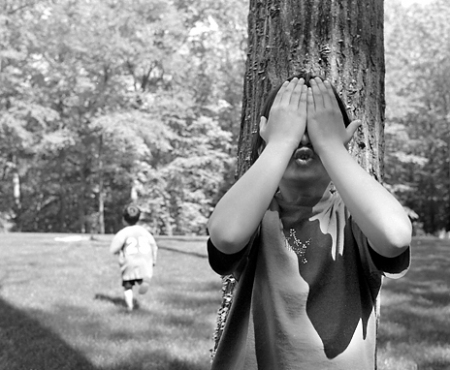
Winnicott used a lovely image to illustrate this secure sense of self. He said that “therapy is completed when a child can play alone”. What he means,  is that the child is secure enough inside him or herself that it is content with his or her own company, by itself, regardless of the mood, actions or attentions of the parent. This is a key sign of growing confidence in the developing self but is crucial for us as adults also. We too need the contentment with ourselves that we can “play” alone, without needing to look over our shoulders to others for their validation.

Does meditation help in this? It does, but with certain cautions. It is clear that silent sitting  increases our capacity to be with ourselves. As I have said before, through it we learn to be with ourselves, allowing our fears arise and pass away without giving them undue space, because we are strengthening our contentment with ourselves.  We can develop our capacity to be at home in the silence. As Ajahn Sucitto wrote, in meditation it is “time to go home”, where we find our own space “bright and cheery”. Meditation helps us be with ourselves, in this moment, not always leaning forward. In the context of this reflection on our secure self, this means that we are not leaning onto other people for their presence; we are content with our own.

However, meditation can sometimes be used to run away from this work of strengthening our sense of self. As Jack Engler,  a psychotherapist and meditation practitioner,  said,  “You have to acquire a sense of self before you can lose a sense of self.” Thus meditation practice and psychological work need to progress hand-in-hand.  John Welwood* has written extensively in this area,  and reminds us that sometimes we can be attracted to “teachings about selflessness and ultimate states, which seem to provide a rationale for not dealing with [our] … own psychological wounding. In this way, [we]… use Eastern teachings to cover up … incapacity in the personal and interpersonal realm”. We can use the teachings as  an outside,  substitute family, and this can slow down the necessary work of developing the inner secure base which will anchor us through life.

So psychological work needs to proceed alongside spiritual work. What steps can we take to strengthen our sense of self? How can we develop this secure base? I will give some ideas in the next related post but just to start here with the first step, awareness. When young, we form mental representations or “Internal Working Models”  (i.e., expectations, beliefs, “rules” or “scripts” for behaving and thinking)  regarding relationships, based on our early caregiving experience. Getting to know those models by gently reflecting on our relationship patterns is a key to moving on, and to stop repeating patterns which just serve to strengthen our insecure self. In other words, understand your childhood insecurity and the force it still contains. Identify the pattern and the pain which manifests in the way you approach relationships now.

In the next post of this series I will look at other ways we can work on our inner securuity.

*John Welwood, “Embodying your realization: Psychological work in the service of Spiritual Development” www.johnwelwood.com/articles/Embodying.pdf


Things we are not aware of

When an inner situation is not made conscious, it appears outside as fate. That is to say, when the individual … does not become conscious of his inner opposite, the world must perforce act out the conflict.

C.G. Jung

A lot of the time, we are not fully conscious of everything that is going on within us; our unlived life, or the parts that have been formed by the unlived lives of others,  is out of sight but exercising influence over our choices. We can see this sometimes when we look back at decisions made or life choices and wonder why we ended up in a certain place. Or when we see repeating patterns in our relationships. Jung suggests that if we do not attend to what is going on inside us, things or people appear in our outer lives in accord with that inner dynamic, and the outer choices we make reflect this inner drama. He suggests that the more we ignore the inner issues, the more we act them out in the world  around us. If we do not do this work, we risk remaining on the surface of life, rather than than incorporating our opposites into healthy choices.

Spiritual Bypassing

Following yesterday’s reflection on the need to assimilate the feminine and masculine dimensions within ourselves, another post on integrating the different aspects of our lives. John Welwood has written some excellent books on the links between relationships, psychology and spiritual growth. He draws attention to the need to ground our selves in the vulnerability of our human condition, not run away from it.  He reminds us that we exist on different dimensions, including the key one of close relationships with other people, and notes the difficulties we can have in bringing our full awareness to that area.   A key concern of his is understanding how we relate to love. One term he uses is “spiritual bypassing”, which happens when we use the spiritual life to run away from our actual life, or from human, psychological work which needs to be done.

While many teachers are extremely warm, loving, and personal in their own way, they often do not have much to say about the specifically personal side of human life.  Coming out of a philosophy based on traditional Asian societies, they may have a hard time recognizing or assessing the personal, developmental challenges facing Western students. They often do not understand the pervasive self-hatred, shame, and guilt, as well as the alienation and lack of confidence in these students. Still less do they detect the tendency toward spiritual bypassing— using spiritual ideas and practices to sidestep personal, emotional “unfinished business,” to shore up a shaky sense of self, or to belittle basic needs, feelings, and developmental tasks, all in the name of enlightenment. And so they often teach self-transcendence to students who first of all need to find some ground to stand on.

In this way, spirituality becomes just another way of rejecting one’s experience. When people use spiritual practice to try to compensate for low self-esteem, social alienation, or emotional problems, they corrupt the true nature of spiritual practice. Instead of loosening the manipulative ego that tries to control its experience, they are further strengthening it.

How you talk about others says a lot about you

We do not see the world as it is, we see the world as we are.
The Talmud

New research carried out at Wake Forest University has found that we reveal a lot about ourselves in the way we talk about others. They found that how positively we speak about others is linked to how happy and emotionally stable we are ourselves. The study, which appears in the July 2010 issue of the Journal of Personality and Social Psychology, found strong associations between how positively a person judges others and then how happy, kind-hearted,  emotionally stable and capable they are described by others.

By way of contrast, negative perceptions of others are linked to higher levels of narcissism and antisocial behavior. As Dustin Wood, Assistant Professor of Psychology at Wake Forest and lead author of the study states,  A huge suite of negative personality traits are associated with viewing others negatively. The simple tendency to see people negatively indicates a greater likelihood of depression and various personality disorders.

Thus our speech about others reveals information about our own characteristics, such as our well-being, and our mental health. Mindfulness helps us be more deliberate in the words we use, by enabling us be more aware of  all the discussions taking place in the committee of voices running our minds. By practicing right speech, this study seems to suggest that we not only help our relationships become kinder. We also change our own level of happiness.

Wood et al, “Perceiver Effects as Projective Tests: What Your Perceptions of Others Say About You”, Journal of Personality and Social Psychology,  July 2010

Stories 2: How the past defines us

More on story and myth, this time from an excellent recently-published Buddhist perspective:

The Buddha taught that,  over time, the unobserved thought settles into character. Character is more than our temperament and personality; it is the fundamental way we see life, including our suppositions, ideas and views of who we are and what life is. When we look out of our eyes we see what we have been conditioned to see, and part of that conditioning is the assumed reality of the person who is having the experience.

Character is reinforced through our narrative, the ongoing story of “me”. We confirm our current reality through the recollection of how we have always been. For instance, if we have assumed a victim mentality from our past, we may have a predisposition to overcompensate and react strongly when we are imposed upon. Our personal narrative reveals our strengths and limitations, and engenders a self-attitude. As our story moves on, each chapter predisposes “me” to behave in a certain way, and though this proliferating tendency was never specified in our early history, the ongoing story gets captured within its momentum.

Rodney Smith, Stepping out of Self-Deception