Being comfortable with our life as it is, does not just mean that we are ok with the external elements in our life, such as our job, where we live, our relationships. It also means that we have some degree of comfort and security in our sense of self. The self can be understood as the system that organizes our experience. It consists of the sensations, feelings, thoughts, and attitudes we have toward ourself and towards the world.
 Our emotional health is related to us having a cohesive, strong, balanced and joyful sense of self. When this is not so strong, and we are constantly uncertain of ourselves, we may find that we are always looking for approval and the validation of others. We can get unduly knocked down by their criticism. In other words, when we feel we are disapproved of, we feel crushed, and when we are praised, we are on cloud nine. Our sense of value comes not from within ourselves, but is dependent on others. If we have a dependent personality structure, we are incredibly quick at sensing what will please others and will do those things in order to gain security. However, because our sense of self is reactive, we can find our moods changing constantly, as if blown by the wind.
On the other hand, when we have a strong inner sense of self-cohesion we have confidence about the acceptability of our personality even when others are not around. We develop a sense of inner security, and this inner resilience calms us in times of stress. We can bounce back from the inevitable wounds which are caused by temporary failures, rejections, and disappointments. When we are young this sense of self grows through a dependence on significant others, However, this dependence on others reduces as we develop and we find a secure base inside ourselves. In other words, we can regulate our emotions inside ourselves, without too strong a need for others. We are secure with ourselves. We are able to be psychologically alone.
Winnicott spoke of the development of this capacity to be alone. He said that as we develop as a child we receive love from our parents. This allows us to begin to feel secure within ourselves and crucially we internalize the feelings of love which we receive from our parents. We incorporate the sense of security, safety and confidence into our body, mind, and psyche, so that, normally sometime around the age of four or so, we have arrived at the psychological capacity to be alone.
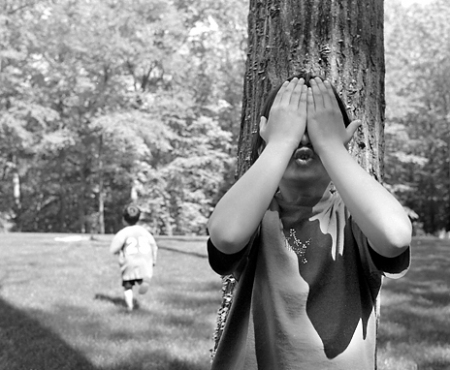
 Winnicott used a lovely image to illustrate this secure sense of self. He said that “therapy is completed when a child can play alone”. What he means, is that the child is secure enough inside him or herself that it is content with his or her own company, by itself, regardless of the mood, actions or attentions of the parent. This is a key sign of growing confidence in the developing self but is crucial for us as adults also. We too need the contentment with ourselves that we can “play” alone, without needing to look over our shoulders to others for their validation.
Does meditation help in this? It does, but with certain cautions. It is clear that silent sitting increases our capacity to be with ourselves. As I have said before, through it we learn to be with ourselves, allowing our fears arise and pass away without giving them undue space, because we are strengthening our contentment with ourselves. We can develop our capacity to be at home in the silence. As Ajahn Sucitto wrote, in meditation it is “time to go home”, where we find our own space “bright and cheery”. Meditation helps us be with ourselves, in this moment, not always leaning forward. In the context of this reflection on our secure self, this means that we are not leaning onto other people for their presence; we are content with our own.
However, meditation can sometimes be used to run away from this work of strengthening our sense of self. As Jack Engler, a psychotherapist and meditation practitioner, said, “You have to acquire a sense of self before you can lose a sense of self.” Thus meditation practice and psychological work need to progress hand-in-hand. John Welwood* has written extensively in this area, and reminds us that sometimes we can be attracted to “teachings about selflessness and ultimate states, which seem to provide a rationale for not dealing with [our] … own psychological wounding. In this way, [we]… use Eastern teachings to cover up … incapacity in the personal and interpersonal realm”. We can use the teachings as an outside, substitute family, and this can slow down the necessary work of developing the inner secure base which will anchor us through life.
So psychological work needs to proceed alongside spiritual work. What steps can we take to strengthen our sense of self? How can we develop this secure base? I will give some ideas in the next related post but just to start here with the first step, awareness. When young, we form mental representations or “Internal Working Models” (i.e., expectations, beliefs, “rules” or “scripts” for behaving and thinking) regarding relationships, based on our early caregiving experience. Getting to know those models by gently reflecting on our relationship patterns is a key to moving on, and to stop repeating patterns which just serve to strengthen our insecure self. In other words, understand your childhood insecurity and the force it still contains. Identify the pattern and the pain which manifests in the way you approach relationships now.
In the next post of this series I will look at other ways we can work on our inner securuity.
*John Welwood, “Embodying your realization: Psychological work in the service of Spiritual Development” www.johnwelwood.com/articles/Embodying.pdf
 Everything has to do with loving and not loving. Rumi



 Mindfulbalance