Opening to the soul in ordinary life

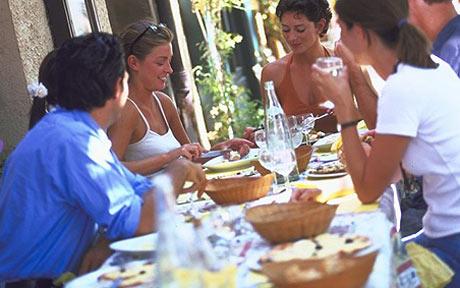
The three days of the Easter Festival contain a number of beautiful rituals  which have been celebrated  by human beings for thousands of years. These rituals  touch of the big themes of human life –  loss and death, betrayal and loyalty, meaning and love –  and do so in a way that  allow us ways to share significant emotions with others. The city of Geneva was quiet this morning, as it has been the last  few days.  It is good to have seasons and rhythms in our lives, periods of less activity with time to celebrate with family and friends.  These celebrations  can become familiar rituals in our lives – they bring us together and allow us to connect, and through connection find support and meaning. They open us up to something which is beyond the rush of each day and the limitations of work:

Ritual maintains the world’s holiness. Knowing that everything we do, no matter how simple, has a halo of imagination around it and can serve the soul enriches life and makes the things around us more precious, more worthy of our protection and care. As in a dream a small object may assume a significant meaning, so in a life that is animated with ritual there are no insignificant things. When traditional cultures carve elaborate faces and bodies on their chairs and tools, they are acknowledging the soul in ordinary things, as well as the fact that simple work is also ritual. When we stamp out our mass-made products with functionality blazoned on them but no sign of imagination, we are denying ritual a role in ordinary affairs. We are chasing away the soul that could animate our lives.

Thomas Moore, Care of the Soul

How to be serene

All the world religions and wisdom traditions come to the same conclusion: True contentment comes about through  working out, through the twists and turns of one’s own life, a personal understanding of these deeply different realities.

For whoever has learned to love,

for whoever has learned to suffer,

life is imbued with serene beauty

Br Roger

We like to have a coherent story

We human beings have a great need to tell our life stories in a coherent and, we believe, in a complete way. Thus, we like to see that where we are now makes some sense, and we spend a lot of our time internally discussing where we are, justifying our choices and the turns that our life has taken. What we often find when we sit in meditation is that we prefer to go back to our stories rather than just sit there with what is in the present. I know that most of my distractions are me telling – to myself –  the “Karl story” with its usual embellishments and drama. What I fail to notice is that this story is really a fiction as it tends to select  the parts of my current life or history that were painful or that  I have elaborated on – or chosen to magnify – because  I  see them as successes and like the direction they show my life  to be headed in. However, it can help if we see our lives as always a work in progress, and that we can never be sure of the meaning behind certain events until we reach the last chapter. It is good to challenge the notion that our ongoing story needs to be somehow complete to save us from getting trapped in our own stories. This can free us to approach each moment with fresh eyes.

All that we are is the result of what we have thought.

The mind is everything.

What we think we become

The Buddha

We don’t need to be perfect: Stop running, be “good enough”

More on what I wrote about earlier this week prompted by seeing the hawk,  and echoing Ajahn Sumedho’s words this morning,  on simply being ourselves, and believing that this is enough, that it is a safe place to be.  Over these past weeks I have met a lot of people who were tormented by self-doubt, by thoughts of never being “good enough”. Often this has led  them to adopt strategies of pushing themselves in order to cover up some deep sense of lack. Some were afraid to admit their own needs because they had come to believe that the only way of being accepted was to be the perfect partner, the perfect girlfriend or boyfriend, doing everything for the other.  Or others responded to their inner insecurity by controlling their partner  or life so much, thus ensuring that they will therefore never leave them or never be left just with themselves.

Healing comes when we realize that we are perfect, just as we are, before we do anything, from being secure in our sense of self. The more we can sit simply with ourselves, the more we realize that everything we need for our happiness is already here, even with  the histories we have had or the disappointments we have endured. Once again we can learn from nature:  like the still  hawk in the sky  or the silent rose in  the quote below, we try to be still and not run after happiness outside ourselves. Agere sequitur esse as the Medieval Philosophers liked to remind us: our actions flow out of our being. However, this is not just a philosophical truth. It is a practical way of increasing happiness moment by moment, day by day. Let go of all we think we have to add on to ourselves in order to be accepted or for this moment to be whole.

Does the rose have to do something? No, the purpose of a rose is to be a rose. Your purpose is to be yourself. You don’t have to run anywhere to become someone else. You are wonderful just the way you are. This teaching …. allows us to enjoy ourselves, the blue sky, and everything that is refreshing and healing in the present moment. We already have everything we are looking for, everything we want to become. I am happy in the present moment. I do not ask for anything else. I do not expect any additional happiness. Aimlessness is stopping and realizing the happiness that is already available.

Thich Nhat Hahn

….by seeing the deeper meaning

The real challenge that faces us as we go through this day is staying open: open to the mystery of others and of events we cannot fully understand, open to a deeper meaning in our lives, open to seeing our lives from a different vantage point than that of our fears:

Can you hold the door
of your tent
wide to the firmament?

Lao Tzu

When you are centered

You’re very busy doing your practices……and you get into a state of mind where you accept that whatever is happening is happening. Even the most awful things that happen, if you’re centered, you’ll be O.K. If not, the most trivial thing will send you off. It has nothing to do with the experience or the circumstance: it is the attitude that’s important. We have to stop clinging to the conditioned path and learn to be open to the unconditioned path.

Jetsunma Tenzin Palmo