Remembering on All Souls Day

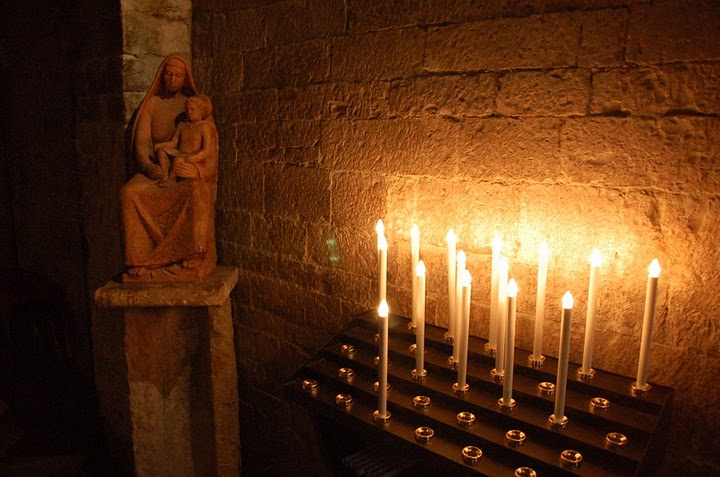
Today is All Souls Day, the traditional day for remembering those dear to us who have died. It is still celebrated as an important day in the Latin countries, such as Italy, where cemeteries are covered in flowers as families take time to visit and remember. Sadness on occasions such as this is related to love, when we cannot be with someone who is dear to us. This day reminds us that taking a moment  for consciously remembering loved ones who have passed is an important inner practice in our lives.
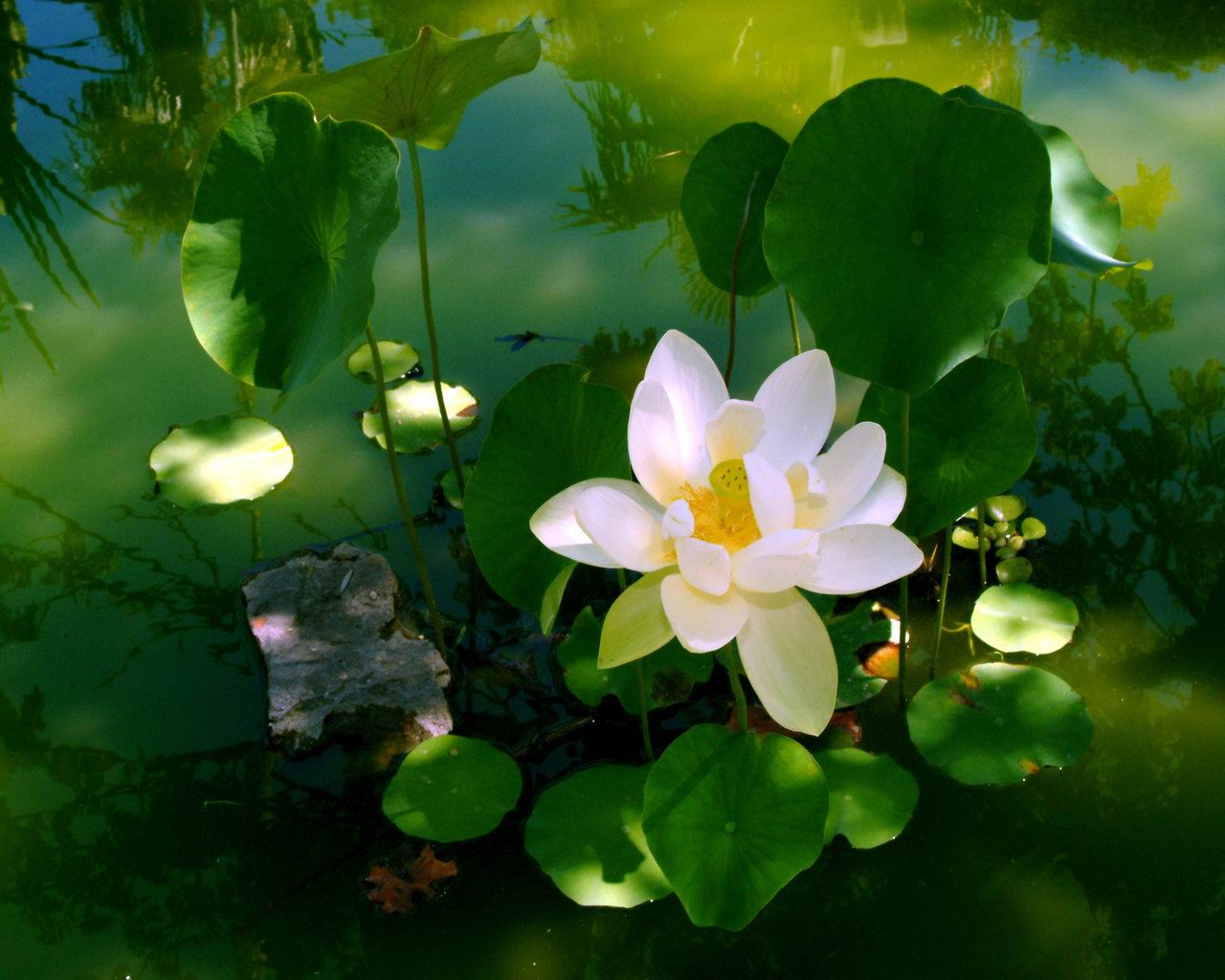
All I know from my own experience is that the more loss we feel the more grateful we should be for whatever it was we had to lose. It means that we had something worth grieving for. The ones I’m sorry for are the ones that go through life not knowing what grief is.

Frank O’Connor

On love, on grief, on every human thing,
Time sprinkles Lethe’s water with his wing.

Walter Savage Landor

Unfinished symphonies

The goal of mindfulness practice is to increase the conditions which lead to our happiness and our freedom. However, the major world wisdom traditions seem to have come to an awareness that  full happiness may not be possible in this world and propose different perspectives based on that. The Buddhist tradition’s fundamental teaching is that life has ultimately an unsatisfactory quality to it and that our suffering comes from not recognizing that. The Old Testament believes that we are on this world with a timeless longing deep inside us, which means that we can never fully find a complete contentment here. As the author of the Book of Ecclesiastes puts it He has also set eternity in their heart. From this perspective therefore, there will always be an restless quality to our life here, because there are (eternal) desires in our hearts which cannot be satisfied by the (finite) experiences which we have. This goes against a lot of what advertising and modern society like to tell us, as they place in front of us a succession of created needs. Although both the Buddhist and the Judeo-Christian traditions differ in the way they resolve the problem, they agree in telling us that no person or no thing can ultimately satisfy our deepest longings and that we will not be fully happy unless we realize that. There is an unfulfilled quality which can manifest itself in our relationships, in disappointments in our families, in a job which does not live up to our dreams, in the place where we live seeming poor in comparison to other places and other lives. To be unfulfilled in this way is to be human. Realizing that it has to be so is the first step to genuine peace.

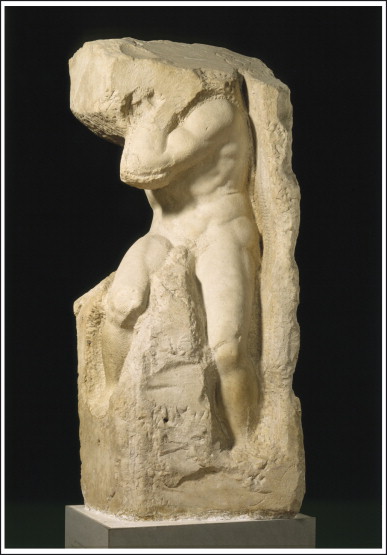
In the torment of the insufficiency of everything attainable, we finally learn that here in this life all symphonies must remain unfinished.

Karl Rahner

The use of meditation in medicine

Some kind of meditative practice is found in all the world’s wisdom traditions, and has been around for thousands of years, says Shauna Shapiro of Santa Clara University, co-author with Linda Carlson of the book The Art and Science of Mindfulness. Most include focusing attention and letting thoughts and emotions go by without judgment or becoming involved.

However, it is striking to note how in recent years meditation is progressively going mainstream, and is now the subject of research in scientific journals. A U.S. government survey in 2007 found that about 1 out of 11 Americans, more than 20 million, has meditated in the previous year. And a growing number of medical centers are teaching meditation to patients for stress and pain relief, as  conventional medicine increasingly embraces healing methods once dismissed as “alternative medicine” and combining them with standard treatment. Jon Kabat-Zinn credits the “colossal shift in acceptance” of meditation to accelerating research on the benefits of meditation.

His enthusiasm is shared by practictioners on the ground, like Dr. Barrie R. Casselith, from the Memorial Sloan-Kettering Cancer Center’s Integrative Medicine Service in New York: ”It’s not invasive, it has no side effects, it has tremendous benefits that are very well documented and it’s something patients can do on their own so it doesn’t cost anything. It’s not a cancer treatment….but… ‘it deals with quality of life and helps with symptoms. It can relieve pain, lower blood pressure and heart rate. It can make people feel calmer, it enhances mood. It does lots of good things.

www.usatoday.com/news/health/2009-06-07-meditate_N.htm

http://www.nytimes.com/1999/11/23/health/a-therapy-gains-ground-in-hospitals-meditation.html

May nothing disturb you: Nada Te Turbe

Today is the feastday of Teresa of Avila, another formidable nun, this time from the 16th Century. She lived in an age of great social change, somewhat like today, and was a strong leader, founding monasteries at a time when most preferred women to be relegated to the kitchen and the home. She was intensely practical and deeply human. However she combined her achievements with a very profound interior life. She reminds us not to neglect the dimension of the soul in this age with our focus on progress and speed.

Despite suffering ill health she had a great trust that a Higher Power was guiding her life and her work. Even if she could not see where things were leading she trusted. These handwritten words were found after her death. May they support all who struggle this evening. The musical version comes from the monastery at Taize, not too far away from here in Bourgogne.

Let nothing disturb you,
Let nothing frighten you,
Everything passes.

God does not go away.
Patience
can attain anything.
He who has God within,
does not lack anything.

Nada te turbe, nada te espante; quien a Dios tiene nada le falta.

Walking through this world

A final post this week with connection to Saint Francis of Assisi, this time a poem about an imagined walk through the world. We walk quickly, to get to our destination. We keep our eyes on ourselves and our own concerns. Our fears keep us turned in on ourselves, comparing our life to what we think it should be.  What if we walked slowly this weekend, noticing, paying attention.…..

I think God might be a little prejudiced.
For once He asked me to join Him on a walk through this world,
and we gazed into every heart on this earth,
and I noticed He lingered a bit longer
before any face that was weeping,
and before any eyes that were laughing.
And sometimes when we passed a soul in worship
God too would kneel down.
I have come to learn: God adores His creation.

Taken from Mala of the Heart: 108 Sacred Poems

Welcoming wolves to the table

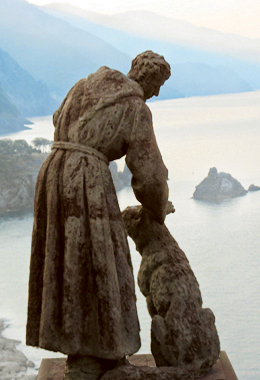
Today is the feastday of St Francis of Assisi (1182 – 1226), perhaps the most popular and likeable Christian saint. The example of his extraordinary heart reminds us of the joy that can be found in a life of meaning and service. Unlike some other saints he seems approachable. In his connection to nature he opens us out to all of creation. I am reminded of two stories from his life, both, not surprisingly, involving animals.

The first is the famous story about the wolf which was terrorizing the people of the town of Gubbio. It had killed several people, and they were now afraid to leave their homes. Francis heard about this and decided to go approach the wolf . When he came upon the wolf, it lunged at him, mouth open wide, about to bite. Francis simply, gently,  greeted the wolf as “Brother Wolf” and spoke to it, telling it not to harm him.  It stopped and lay down at his feet.  Francis and the wolf made a deal: the town would provide food for the wolf for the rest of its life, in exchange for the wolf’s ceasing to harm them. We are told the wolf  placed its right paw into Francis’ hand, and so the wolf lived in peace with the people of Gubbio for the rest of its life.

It is clear Francis was a peacemaker and reconciler – in this case helping the people in a society deal with what pushed them in fear to close their doors and withdraw. But I like to think of this story as a way that we can deal with our fears, the emotions that arise within us and scare us, like anger, jealousy and dislike of others. The stuff that relationships bring up in our lives.  Our normal first response is to be disturbed or frightened by these strong emotions and we move to push them away. However, in themselves,  these are not the problem, but it is our mind’s relationship to them that is. So what learn from Francis is to approach the things that frighten us – not to be afraid of the frightening wolves within us – but to begin by simply, gently looking at them directly. What would it be like to experiment with seeing them just as part of who we are at that moment and instead of pushing them away, to invite them to come close and to stay. As if they are part of the family – “brother wolf”, “brother anger” “brother fear” – and welcome them to the table? This is the practice: to first experience the anxiety you are going through – if it is not too overwhelming – as an embodied feeling, with no shoulds or shouldn’t about it. Our wounds – even the most frightening,  shameful, or self-inflicted ones – do not need to become a moment for showing ourselves further violence. They are, like all our practice, to be occasions of self-compassion and a letting go of judgment.

A second story tells us that Francis and Brother Leo were about to eat when he heard a nightingale singing. Francis seemed to have a special fondness for birds. So he suggested to Leo that they should also sing out their love along with the bird. Leo made the excuse that he was no singer, but Francis lifted up his voice and, line after line, sang a duet with the nightingale, until, late into the night, he tired and had to admit that the bird sang out his joy better than he could. I love the way that Francis opened his heart with all of creation and did not let the self- conscious, doubting “I am not a singer” story – which we all tell ourselves – get in the way. His heart naturally wanted to share and he did not let his fears get in the way.