Sunday Quote: Choosing

You are what you want to become.

Thich Nhat Hahn

Realities which make life beautiful

I was talking earlier today with someone about time spent I spent in the Ecumenical community in Taize in France many years ago, when the founder, Br. Roger,  was still alive. His extraordinary simplicity and humanity was very striking, managing to combine a deep inner life with an understanding of what makes for full human growth. He witnessed a time of hatred and war in his youth and went on to create a community that healed divisions. Many of his words, like these ones, reduce life down to its essence, away from the fears which make us lose faith in each other.

Are there realities which make life beautiful and of which it can be said that they bring a kind of fulfillment, an inner joy? Yes, there are. And one of these realities bears the name of trust. Do we realize that what is best in each of us is built up through a simple trusting? This is something even a child can do.

Br Roger.

How meditation leads to kindness

Think of Mindfulness as the habit of seeing things in an uncomplicated way. We generally don’t. Based on our individual histories, our memories, and our fears, we often make up our reality out of a projected worry and frighten or discourage ourselves. Mindfulness is seeing things as they actually are,  not as we imagine them to be.

Mindfulness practice… supports our ability to best serve. It keeps our motivation going. I say, “When we see, even in the simplest circumstances, how difficult it is to stay content, how easily irritated we become, how many worries we have, how hard it is to relax — we intuit that that must be true for other people as well. All other people. And we start to be kinder. We are kinder to ourselves and, ultimately, more forgiving of others. The world would get happier if everyone relaxed and forgave each other.” Usually people think about that a moment. Then they smile and say, “I think you’re right.”

Sylvia Boorstein

The essential rule for life and happiness

In the different wisdom traditions we find attempts to reduce down to their simplest all of the instructions about living a full life: What is the essence of practice? What leads to true contentment?  We can see that is this tale from the Jewish  tradition, which resembles the simple direct presentation of wisdom found in the Christian Desert Fathers and in the Zen tradition. We are told that a man approached Rabbi Hillel and promised to convert to Judaism if the Rabbi managed to recite the whole of the Jewish teaching, while standing on one leg. Rabbi Hillel stood on one leg and said simply: That which is hateful to you, do not do that to your neighbour. That is the essence of the Law. Everything else is just a Commentary. Go and Study it.

What are you going through?

Mindfulness practice strengthens our capacity to be present for all that is happening in our lives. It also creates a space within so that we can be present to others. It is easy to be there when people are in good space, or when they make us feel good about ourselves. However, as the French Philosopher Simone Weil says in this beautiful quote,  friendship is truly shown when one is able to ask the other  “What are you going through?”. This requires courage and inner strength. To stick with another person when they are confused or frightened requires that we are able to put aside our own concerns for a moment and attend to them. Full attention is the most precious gift we can give another. It is not always easy because of our own needs and the believed story that goes on in our head when we encounter another person. Furthermore, when another person is afraid, it often raises fears in us and our first tendency is to withdraw. Paying attention means we are able to step back from our own stories and be there.

Those who are unhappy have no need for anything in this world but people capable of giving them their attention. The capacity to give attention to a sufferer is a very rare and difficult thing; it is almost a miracle; it is a miracle. Nearly all those who think they have this capacity do not have it. Warmth of heart, impulsiveness, pity are not enough. In the first legend of the Grail it is said that the Grail belongs to the first comer who asks the guardian of the vessel, a king paralysed by the most painful wound, “What is wrong with you? What are you going through?” Only the person who is capable of attention can do this.

Simone Weil, Waiting for God

How to bring light into the dark places within us

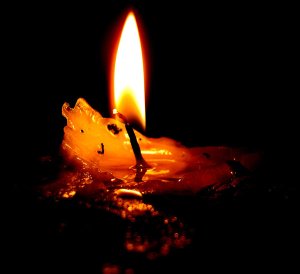
In the Christian Calendar today is the feast of Candlemas. While not as old as the Celtic feast of yesterday, it does date from the 4th Century in Jerusalem, and reflects the same need to mark this period of winter with light and hope. Traditionally it was celebrated by a procession of candles and the blessing of candles for use in the home.

From time to time difficulties occur in our lives which can then seem dark and without hope. Bringing awareness to what is going on inside us at those moments can allow light to shine in the darkness. We sit and observe  what arises and passes away in the mind and body. We  name it – “there is anger“, “there is fear” – thus creating a gap and allowing what we experience to become something known. In this way, our mood and behaviour will not be shaped entirely by invisible, unconscious conditioning, but can become a more reflective response.

When we meditate, we kindle a fire that never dies away.

When we meditate, we’re not idly passing time. In following the breath and learning to deal with our thoughts, we’re laying the foundation for a shift in attitude that has the power to change our lives in a truly meaningful way. There’s a lot of darkness and aggression in our world. Developing our best qualities has an immediate effect on ourselves and others. When we apply ourselves in practice, we’re not only doing something very present; we’re also creating the conditions for how our lives can move forward.

Sakyong Mipham Rinpoche