
The days are getting much shorter here in Ireland, and the colder weather and darker afternoons begin to be felt. This is no surprise as we have passed the old date for the start of winter – the feast of Saint Martin – last Monday. Traditionally, a period of forty days preparation for Christmas began then, a custom dating from the 5th Century. These days coincided with a sense of the natural beginning of winter, with a winding down of work outdoors and the body’s response to that in letting things go and taking recovery time for itself. It was a time of reflection and a simplification of intake, of taking stock and winding down. In today’s world, technology allows us to promote the opposite – longer shopping hours and a speeding up in preparation for the holidays, as Thanksgiving and Christmas advertisements begin to dominate. An ancient way of doing things – probably more in tune with nature’s rhythms – and a modern one. Thus we have a choice.
The first step in any letting go is ‘stepping back’– non-involvement. This initiates letting go by unhooking the mind from the topic that is stirring it up. It’s not a matter of avoiding or suppressing the topic, but of seeing it in a clear and spacious way. Non-involvement is about settling back into the present moment, relaxing into the way things are right now; it’s about letting go of the ‘shoulds’ and ‘shouldn’ts,’ the past, the future and the imaginary, and meeting things as they arise in the present…. Letting go is also about giving things time to shift and settle, and being patient with oneself. It’s about not comparing yourself with others, and letting go of self-images. Letting go makes us more flexible and broad-minded. It’s grounded in the understanding that things change; and that they can change for the better if we’re attentive, mindful, and put aside distractions and negativity.
AjahnSucitto, Meditation, A Way to Awakening
photo kevin law
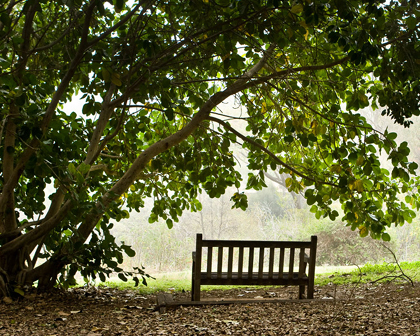 We might ask, “Given my present situation, how long should I stay with uncomfortable feelings?” This is a good question, yet there is no right answer. We simply get accustomed to coming back to the present just as it is for a second, for a minute, for an hour — whatever is currently natural — without its becoming an endurance trial. Just pausing for two to three breaths is a perfect way to stay present. This is a good use of our life. Indeed, it is an excellent, joyful use of our life.


 Mindfulbalance