…and not recognizing

File:Hanging at the Shop (5971682238).jpg

An ancient tale tells how Karamita met the Buddha but did not recognize him. He asked the “stranger” to explain the Buddha’s teachings to him, but did not like them. He then asked him if he had actually ever heard these ideas directly from the Buddha’s lips himself, to which the Buddha with a smile, answered no. Ajahn Amaro comments on this episode:

Ajahn Chah often said that this is a position we often find ourselves in – face to face with the Buddha, sharing a room together, spending hours and hours in deep conversation and not realizing who this is. The truth of life is staring us in the face, but because we have already got programmed with something else that we want and expect, we are missing out on the lessons that life is actually able to teach us.

Ajahn Amaro, Silent Rain

photo alex proimos


Not really present…

File:Person in bluebell wood (14099117974).jpg

I feel a little alarmed when it happens that I have entered a mile into the woods bodily, without getting there in spirit. What business have I in the woods if I am thinking of something outside the woods?

Thoreau, quoted in Writing Nature: Henry Thoreau’s Journal

photo james petts


Noticing what is right

photo

We often ask, “What’s wrong?”

Doing so we invite painful seeds of sorrow to come up and manifest. We feel suffering, anger and depression and produce more such seeds. We would be much happier if we tried to stay in touch with the healthy, joyful seeds inside of us and around us.

We should learn to ask “What is not wrong?” and be in touch with that.

Thich Nhat Hanh, Peace is Every Step

Your entire love

File:Life's Options (5075477519).jpg

Be attentive to what is arising within you, and place that above everything else…What is happening in your innermost self is worthy of your entire love; somehow you must find a way to work at it.

Rilke, Letters to a Young Poet

photo D.Sharon Pruitt

What’s important

File:Border collie running down the beach at low tide.jpg

We hurry through the so-called boring things

in order to attend to that which we deem more important, interesting.

Perhaps the final freedom will be a recognition that everything in every moment is “essential

and that nothing at all is “important.”

Helen Luke, Jungian Therapist

photo kyknoord

A different way of seeing

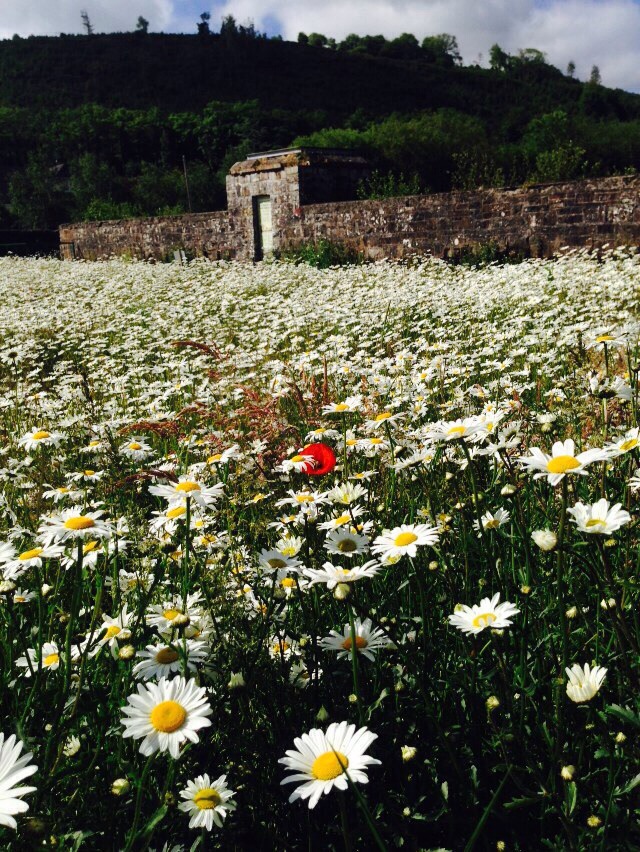
File:Walled Garden through pergola.jpg

Ours seems to be a world that values “strength.” We want  “strong” minds, “tough” wills, “hard as nail” determination, “rugged” personalities, “sturdy” character, and so on.  I wonder if we have confused hardness with the strength it takes to truly give and receive love. Let us praise softness. I’m speaking here of hearts, of soft hearts, of gentle spirits. I’m speaking of the gentleness to give and receive love.

Every heart has a wall around it, a wall that protects, yet also keeps out. Every heart is a walled garden, the original meaning of Paradise –  the inner garden that’s protected by the wall. Yet I wonder how often the wall becomes a fortress, keeping out the very ones who are meant to reach us, nurture us, love us? Let us praise softness. Let us seek a heart that is not hard, but soft. Let us seek a heart that is not hardened like dry land, but a soft soil tilled over again and again.

In many languages, the words for “love” have a connection to words for “seed.” In Arabic and Persian, a word for love (hubb) comes from the seed that is planted in the ground. Sometimes a seed of love is planted in the heart’s ground through a glance, a touch, a word. Will the seed take root? Will it be nurtured? Will it be fed?

Are we strong enough not to keep out, but to welcome in?

Omid Safi, In Praise of Softness

photo greenlamplady