Alone

Sometimes it is healthier to be alone. There are times in life when it is right to choose it – to move from the fear of being alone, to the ability to savour it. Mastering this ability is all about living a life in which we can feel whole and happy inside ourselves, and can take care of ourselves emotionally.

This capacity to be alone is one of the most important signs of maturity in emotional development. In Winnicott’s theory of the development of the self, our ability to be alone is formed through the awareness of a stable loving presence. When we are secure in the knowledge of being cared for, we develop the capacity to be by ourselves. If that knowledge was not formed fully when we were little, we can sometimes throw ourselves into relationships and activities in later life because we do not like being with ourselves. Being able to be alone is the best preparation for healthy relationships because it is founded on a security deep inside and we are not using the relationship to run away from our insecurities.

Therefore, the best model for later life is the child playing contently by itself. Maybe this is why sitting practice is so effective; through it we learn to sit with ourselves, allowing our fears and anxiety arise and pass away without giving them undue space. We can develop strong roots, content in ourselves, at home in the silence, not running, planted firmly.

Therapy is completed when a child can play alone
Winnicott

Hidden

It is a joy to be hidden
but a disaster not to be found
.

D.W. Winnicott

Not letting our fears control us 2: Open to disappointment

One of the more important things for our psychological health is how we have to cope with disappointment. Losses are present in our lives from infancy onwards. Indeed, as Winnicott reminds us, a certain amount of disappointment is necessary as infants in order to allow a secure sense of self to develop. The parent has to gently “disappoint” the child in order to allow the child develop the independence to take on certain tasks for itself, to face the world without relying totally on the parent. This allows the infant have the resilience for facing the ups and downs of this world, as well as understanding that there is nuance in every person, and that we cannot expect anyone to perfectly satisfy all our needs.

If established well, the person can be comfortable on their own and have the space in later life to deal with the inevitable ways in which others let them down. If not, then one can struggle when a partner changes, a parent disillusions, a relationship goes sour or a job turns out to be unfulfilling, because one has looked to them to give life meaning. Another negative aspect could be that the child feels responsible for the loss and may pick up the mistaken idea that negative emotions are wrong, and to admit them is to show weakness or a lack of self-control.

Over the years all these losses add up. Some we have time to acknowledge, some not. Stephen Levine reminds us that grieving that has to go on for all the little losses and disappointments that happen throughout our days. He calls this “our ordinary, everyday grief” which builds up following the “disappointments and disillusionment, the loss of trust and confidence that follows the increasingly less satisfactory arch of our lives”.

One thing we can do in response is try to avoid feeling this grief, by hardening our hearts or denying to ourselves that the loss had any real meaning. However, although this provides a momentary feeling of safety, it can either lead to a gradual deadening of our experience of the world or reappear in our unconscious as anxiety or repeating behaviours. A better option is to stay open to life and acknowledge its inevitable losses, even the little ones. Ultimately, being open to feel the fear of loss is the only way to integrate it. It’s also the only way to a genuine relationship with others, because closeness to others cannot be founded on neediness or on the fear of being alone. Before we can be in relationship with others, we need to be able to accept a certain type of aloneness in ourselves. If we do not see that we will always be disappointed in the things that we think will fill it.

Being Seen

In some of the tribes in Natal, in South Africa, the words used for saying hello, for greeting, are sawu bona, which means “I see you”. The other person responds by saying sikkhona “I am here”. As a greeting it affirms the real presence of the other, by letting them know that they are seen, and allows them to be fully present.

I know that, at a deep level, one of my needs is to be seen and acknowledged. I – like everyone, I suppose – want to have the freedom to reveal my true self, to relax, and not to be worried about the other’s response. “Seeing” does not mean cognitive recognition; rather it is rooted in the heart and is the awareness of my deepest self and my deepest needs are felt by another person. I need someone who has the space to see me and who is able to hold what they see.

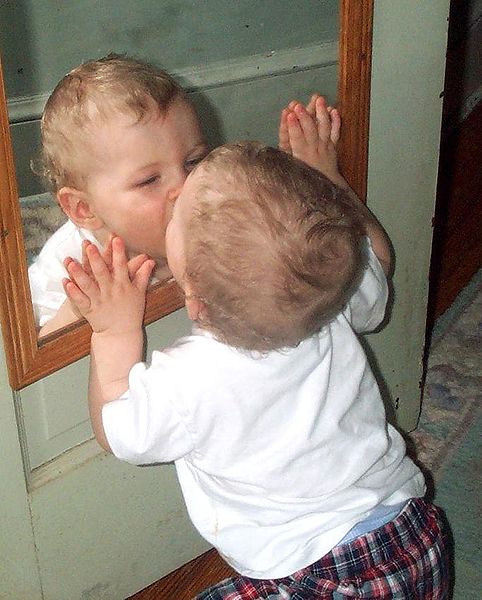
This process begins when we are babies. The young baby needs to be seen and acknowledged by its parents, and when this does not happen it can cause great distress. We are born with a need for mirroring – for having what is happening in us seen and mirrored back to us. The English Psychologist Winnicott wrote that the parent needs to have enough space – and not be caught up in their own needs – so that this mirroring reflects back to the child an accurate picture of what the child is feeling inside. This allows the child feels that its needs are being taken care of and gives the child enough trust in the safety of the world to want to see more of it. In this way the child can minimize any anxiety about the threat of the world and develop independence in exploring it:

It is only under these conditions that the infant can have an experience that feels real. A large number of such experiences form the basis for a life that has reality in it rather than futility. The individual who has discovered the capacity to be alone is constantly able to rediscover the personal impulse and the personal inpulse is not wasted because the state of being alone is something which always implies…. that someone else is there
The Capacity to be Alone

However, when the child does not feel its needs being seen and reflected back, or that the caregiver is not attuned, it learns to become more cautious in order to protect itself from the inconsistency of the carer. The child can learn then that it is dangerous to let its true self be seen and that it should to keep its needs hidden. The capacity to be alone is not as strongly developed and this can lead in later life to an dependence on external activities, such as work, or to an instability in relationships. There may be links here with the practice of meditation. If it develops the capacity to be alone with ourselves it has the potential to heal some of these early life experiences.

Many babies, however, do have to have a long experience of not getting getting back what they are giving. They look and they do not see themselves…The baby gets settled in to the idea that when he or she looks, what is seen is the mother’s face. The mother’s face is not then a mirror.
Play and Reality

It would seem from this that real listening, real mirroring, is one of the greatest gifts we can offer to another person. If we can attune to what is really going on inside them, and not let our needs and our internal chatter predominate, then we allow them to be fully themselves and they can grow.

Winnicott and Space

British Psychoanalyst Donald Winnicott wrote about the importance of a holding environment for the person when she or he is an infant. This is the psychical and physical space where the infant is protected without knowing he or she is protected. This creates a sense of stability and safety. At that early age the relationship between the infant and its environment (caregiver) is the primary and most important reality. Within the context of this relationship, Winnicott spoke of potential space which serves as a bridge between interior experience and external reality. The function of this space is to be a bridge between the multi faceted realm of interior, or unconscious, experience and the time-and space-bound realm of external, or conscious, experience.

Some studies of the effects of meditation are focusing on its effects on those parts of the brain which are laid down in those crucial early attachment experiences between the child and the caregiver. It may be that sitting in silence revisits and nourishes neural patterns related to a sense of stability and attunement.

Sitting in meditation is essentially simplifying space. Our daily lives are in constant movement: lots of things going on, lots of people talking, lots of events taking place. In the middle of that, it’s very difficult to sense what we are in our life.

When we simplify the situation, when we take away the externals and remove ourselves from the ringing phone, the television,the people who visit us, the dog who needs a walk, we get a chance to face ourselves…”

Charlotte Joko Beck