The 10,000 things rise and fall…

The “10, 000 things” is a shorthand way of talking about all the experiences –  good and bad – which arise and pass away in our lifetime.  It stands for all of reality, which contains the right mix of experiences for our growth, and with its ebbs and flows is continually rearranging itself.
The ten thousand things arise together;  In their arising is their return.
Now they flower, and flowering sink homeward,  returning to the root.
The return to the root is peace.
Peace: to accept what must be, and to know what endures.
In that knowledge is wisdom.

Lao Tzu
The heart


Li Po ( 760 A.D), considered the greatest of the Chinese poets,  wrote these famous words on friendship

What is the use of talking,

and there is no end of talking,

There is no end of things in the heart.

Try a different approach: Don’t move on

The core issue is that we are not comfortable with life as it is – changing, with indistinct boundaries, not meeting our unrealistic expectation. As children most of us learn, from parents, relatives, peers, and caregivers, to want something else, such as external approval, the security of things that don’t change, only pleasurable experiences, or the self-satisfaction of always being in the right.

We are like the drug addict looking for an unending high. We don’t find it with one drug, so we try another drug, then another and another. The variations are wonderfully creative and endless. Looking for the perfect partner, job, community, or profession, can be the drug. Looking for the perfect spiritual teacher can also be the drug. We might hop from one to another, exuberant for a while, and then disappointed. We move on.

When we walk the path of mindfulness, we are encouraged to try a radically different approach. We calm our minds, we focus on the present moment, and we embrace what we find.

Pema Chodron

Meeting your destiny


You meet your destiny on the road you take to avoid it.

Jung

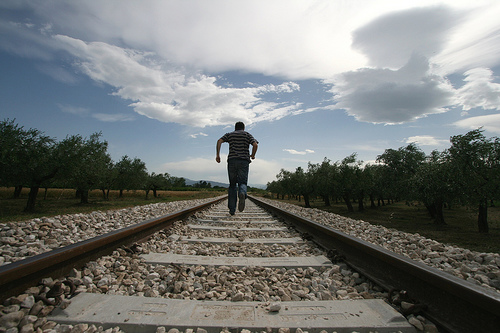
On not running away in times of difficulty

Building on yesterday’s post about staying with the fears and difficulties that are prompted by relationships and manifest themselves as emotions or feelings in the body. As I have said before, the essence of our practice is learning to stay, and in concrete terms this can mean simply staying with the feeling in the body. Running away – into distractions or compulsive activity, or in a more decisive way such as  starting a new relationship or initiating sudden changes of lifestyle – can take us away from the growth which a crisis often offers. Our sitting practice is the place where we work at learning how to do this. It is where we gradually strengthen our capacity  for faithfulness to our actual daily existence, no matter what arises.

The problem with running away when a relationship becomes difficult is that it’s also turning away from ourselves and our potential breakthroughs. Fleeing the raw, wounded places in ourselves because we don’t think we can handle them is a form of self-rejection and self-abandonment that turns our feeling body into an abandoned, haunted house. The more we flee our shadowy places, the more they fester in the dark, and the more haunted this house becomes. And the more haunted it becomes, the more it terrifies us….. Naturally we want to do everything we can to avoid this place, fix it, or neutralize it, so we’ll never have to experience such pain again……This is a vicious circle that keeps us cut off from and afraid of ourselves.

John Welwood, Intimate Relationship as a Spiritual Crucible.

Sunday Quote: Avoiding the real issue


Western laziness consists of cramming our lives with compulsive activity,

so that there is no time at all to confront the real issues.

Sogyal Rinpoche