Words

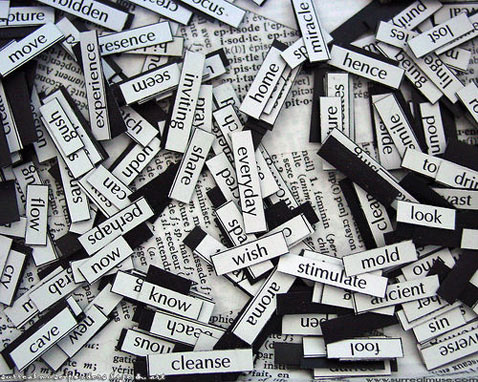
Words are the cognitive contraptions we use to work our way through a world of uncertainty. Words can free us: as symbols they are essential to distance us from experience enough to compare and contrast and reveal patterns in a complex universe. Seeing those patterns with ideas framed in our mind also enables us to communicate those insights to others. In these ways words are a wonderful gateway to understanding and sharing.

Yet words can also entrap us. If we do not recognize the limitations of their boundaries, if we see them as real, their top-down influences on our lives can be devastating. We can come to believe that “intelligence” is something we are either born with, or not. We can think that “we” are good and “they” bad. We can even feel that “I” is something so real  and important that “you” don’t matter. Letting go of such top-down influences is the art of mindful awareness. The receptivity of presence allows us to unleash the shackles that automatically enslave us.

Daniel J. Siegel. The Mindful Brain

Finding space in our inner chatter

Silence, a stilling of not only the voices outside but the inner voices, the roof brain chatter. Now, without the babble or words – inner and outer – I watch my mind, notice when a thought arises. I turn my attention inward, asking, “Who is thinking this thought?” As the mind turns to look, the thinker seems to disappear. But a focus comes from asking, a clearing, a deepening. No “me,” but a presence. Awareness.

When I first worked in a restaurant, I used to daydream of a mute helper, someone who had no interest whatsoever in speaking, She…wouldn’t tell about her plans for vacation, the fights with her mother, the ins and outs of her most recent relationship. In my daydream of a mute helper, I was envisioning a future version of myself, of course. My imagination was sending directions, subtle hints as to how to proceed. How to glimpse the sky, how to open into vastness. The odd thing is that in addition to this sense of spaciousness, I’m starting to feel close to people, to understand and sympathize with them on a new level, to participate in their lives in unexpected ways, to notice those around me as something more than irritants, as subjects rather than objects.

Kimberly Snow, In Buddha’s Kitchen

Still water

We can make our minds so like still water that beings gather about us that they may see, it may be, their own images, and so live for a moment with a clearer, perhaps even with a fiercer life because of our quiet.

W.B. Yeats, The Celtic Twilight

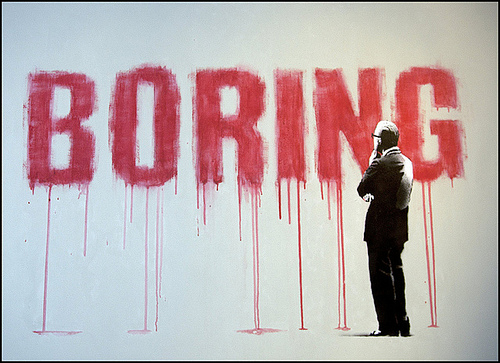
When boring becomes interesting

Like anger and other emotions, boredom most often fools us into diverting our energies entirely to an external situation. This it keeps us from liberating ourselves by seeing our relationship to the emotion itself. We make a big mistake about boredom when we think that it comes because of a particular person or situation or activity. So much of our restlessness in meditation practice and in our daily lives comes from this fundamental misunderstanding. How often do we try to find something new to recapture our interest, something more stimulating or more exciting? 

To realize that boredom does not come from the object of our attention but from the quality of our attention is truly a transforming insight. Fritz Perls, one of those who brought Gestalt therapy to America, said, “Boredom is lack of attention”. Understanding this reality brings profound changes in our lives. Then boredom becomes a tremendously useful feedback for us. It is telling us not that the situation or person or meditation  is somehow lacking, but rather that our attention at that time is half-hearted.

Joseph Goldstein, Insight Mediation

Touching reality

Some people of a scientific turn were once discussing pompously, and to him, distastefully, about the incredible distance of the planets, the length of time light takes to travel to the earth etc., when he burst out “Tis false! I was walking down a lane the other day  and at the end of it,  I touched the sky with my stick”

Alexander Gilchrist, Life and Works of  William Blake

Mary Oliver has this extract at the start of one of her books of poetry, and then leads into these reflections prompted by the seeing of some butterflies.  It shows that there are different ways of seeing the same reality. In this case, Blake, with eyes of a poet or eyes of awareness, recognizes the closeness of the universe to us, even in our very breath. Sometimes our thoughts and preconceptions can get in the way of us experiencing life fully.

Seven white butterflies…

lob their white bodies into the invisible wind

weightless lacy,  willing to deliver themselves unto the universe

now each settles down on a yellow thumb on a brassy stem

now all seven are rapidly sipping from the golden towers

who would have thought it could be so easy?

Mary Oliver, Seven White Butterflies

Not creating more – holding things as they actually are

One problem with meditation is that many people find it boring. People get bored with emptiness. They want to fill up emptiness with something. So recognise that even when the mind is quite empty, the desires and habits are still there, and they will come and want to do something interesting. You have to be patient, willing to turn away from boredom and from the desire to do something interesting and be content with the emptiness of the sound of silence. And you have to be quite determined in turning towards it….One can believe that the sound of silence is something, or that it is an attainment. Yet it is not a matter of having attained anything, but of wisely reflecting on what you experience. The way to reflect is that anything that comes and goes; and the practice is one of knowing things as they are.

We keep with what is, recognising conditions as conditions and the unconditioned as the unconditioned. It’s as simple as that. The practice then becomes one of turning away from conditioned phenomena, not creating anything more around the existing conditions. So whatever arises in your consciousness – anger or greed or anything – you recognise it is there but you make nothing out of it. You can turn to the emptiness of the mind – to the sound of silence. This gives the conditions like anger a way out to cessation; you let it go away.

Ajahn Sumedho, The Sound of Silence