Sunday Quote: Each moment


How we spend our days is,

of course,

how we spend our lives.

Annie Dilliard

Not being frightened by change

Deviations from the norm are either something we resist or welcome.  What determines our reaction is how much our “norm” includes the possibility of change, surprise, unexpected occurrences.  If sameness is a demand we make of our partner, our job, our children, our friends, our world, then we are going to be seriously challenged when the inevitable happens.   People grow; they evolve; change their minds, rethink their politics, get new jobs, move to different cities. They find new friends, gain or lose weight, take up yoga while we sit in front of the TV.  If we feel a loss or a threat from their growth, it is time to expand our sense of what “normal” is.

As the song says “Everything must Change. Nothing stays the same.”  The temporariness of form or experience is something we can rely upon, absolutely. It is in the variations of weather, the ups and downs of relationships, the shift from toddler to teen, the necessity of learning new skills, that keeps us in harmony with the nature of things.  A kind of non resisting ability to let things flow is a high awareness and a healthy way to live. Knowing that change will surely come, we are more likely to treasure the moment and celebrate it now.

Carol Carnes

Listening to the soul

Things do fall apart. It is in their nature to do so. When we try to protect ourselves from the inevitability of change, we are not listening to the soul. We are listening to our fear of life and death, our lack of faith, our smaller ego’s will to prevail. To listen to your soul is to stop fighting with life – to stop fighting when things fall apart; when they don’t go our way, when we get sick, when we are betrayed or mistreated or misunderstood. To listen to the soul is to slow down, to feel deeply, to see ourselves clearly, to surrender to discomfort and uncertainty and to wait.

Elisabeth Lesser.

Cultivating mental skills

Inner conflicts are often linked with excessive rumination on the past and anticipation of the future. You are not truly paying attention to the present moment, but are engrossed in your thoughts, going on and on in a vicious circle, feeding your ego and self-centeredness. This is the opposite of bare attention. To turn your attention inside means to look at pure awareness itself and dwell without distraction, yet effortlessly, in the present moment.

If you cultivate these mental skills, after a while you won’t need to apply contrived efforts anymore. You can deal with mental perturbations like the eagles I see from the window of my hermitage in the Himalayas deal with crows. The crows often attack them, diving at the eagles from above. But, instead of doing all kinds of acrobatics, the eagle simply retracts one wing at the last moment, lets the diving crow pass, and then extends its wing again. The whole thing requires minimal effort and causes little disturbance. Being experienced in dealing with the sudden arising of emotions in the mind works in a similar way.

Matthieu Ricard, This is your Brain on Bliss

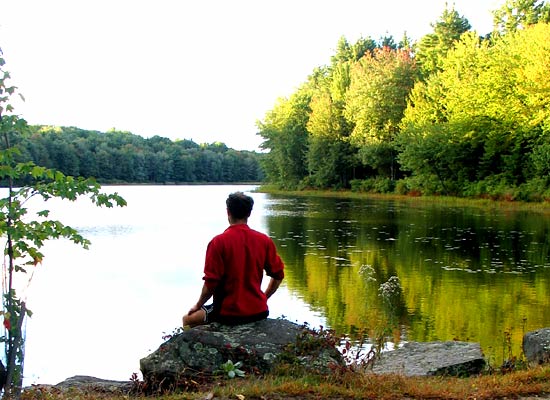
Photo: Janis Ringuette

Staying within the moment

A key skill for sustaining mindfulness in daily life is being able to distinguish between our experience and our interpretation of our experience. Experience is simply whatever is happening in the moment — a sound, a taste, a body sensation, an emotion, an interaction, etc. Interpretation is the mind’s reaction to our experience. One way to understand this difference is that when we are directly experiencing a moment of life, we are “within” it; when we are interpreting it, we are “outside” it. 

Once you begin to recognize that interpretation is only your view of an experience, it becomes possible for you to begin to release your compulsion to interpret every moment. Ideally, your goal is to create a new habit or “default setting” for responding mindfully rather than reacting unskillfully to all types of experiences….You can begin to break your habit of automatically interpreting every experience by practicing being mindful of your experience within the experience. So when an unpleasant moment arises, be interested in the direct experience of what happens. You might say to yourself,  “I’m just going to be interested in this,” and then watch what happens. Just be in the moment and let the experience form.

Philipp Moffitt, Maintaining Mindfulness in Daily Life

Taking charge of how we experience life

I have written before about Jill Bolte Taylor who suffered a severe hemorrhage in the left hemisphere of her brain in 1996. After this stroke  she could not walk, talk, read, write, or recall any of her life. It took  her eight years  to completely recover all of her functions and thinking ability, and in that time she observed closely the action and functioning of her brain. She noticed that it was possible to choose whether to hook into a feeling as it arises in the brain and prolong its presence in my body, or just let it quickly flow right through.  As a result she now encourages people to practice this brain development and to “Step to the Right” of  their – often judgmental –   left hemisphere brain chatter in order to live a more balanced life. This can be done by setting aside time for meditation, yoga or other activities. In this way we can take control over a lot of what passes through the mind and not over-identify with it.

As my left brain became stronger, it seemed natural for me to want to “blame” other people or external events for my feelings or circumstances. But realistically, I knew that no one had the power to make me feel anything, except for me and my brain. Nothing external to me had the power to take away my peace of heart and mind. That was completely up to me. I may not be in total control of what happens to my life, but I certainly am in charge of how I choose to perceive my experience.

Jill Bolte Taylor, My Stroke of Insight