Connecting

still5

If you are connected to the body you are in the present moment. Now, any time we do mindfulness meditation, which is this very simple practice of noticing, we bring our attention to the experience, living that experience, and registering what’s here. If you are with your breathing it’s not only being with your breath — breath in breath out breath in — it is also letting the experience of breathing be registered in that experience. You are taking in the sensations of that experience in a deeper, fuller way. It’s like you are on the beach on a nice sunny day, you’re on the edge of the ocean, and you stand there and take in the breeze, the smell of the ocean, the sight. You really register the experience; you take it in. So, in the same way, you sit with your breath and take in the fullness of the experience of breathing in.

Gil Fronsdal

Breathing and letting go

File:Katie Walking Labyrinth 2.jpg

Just staying with  Thich Nhat Hanh to start this day, as his simple words can be one way of working with fearful thoughts as they arise.  So if you notice yourself getting anxious, or the mind beginning to rush and lean forward, you might like to try saying these words to yourself,  aligning them with the rhythm of your breathing:

I breathe in, I breathe out.

Deeper, gentler.

I become calm, I let go.

I smile, I am free.

photo: jamesjen

The wind blows through

File:Cloud over yucatan mexico 02.jpg

Maybe it is because it is windy here in Ireland, that I  post  a reflection on the wind to help us deal with moments we are afraid,  feeling deficient, or burdened with the need to “become”, to be better, as Sharon Salzberg described this morning :

It is essential to understand that an emotion is merely something that arises, remains and then goes away. A storm comes, it stays a while, and then it moves away. At the critical moment remember you are much more than your emotions. This is a simple thing that everyone knows, but you may need to be reminded of it: you are more than your emotions.

Thich Nhat Hahn, Healing Pain and Dressing Wounds

Not leaning

File:Baum Sardinien.jpg

In our usual mind state, we are continually activating the process that in Buddhist terminology is known as “bhava,” which literally means “becoming.” In this space of becoming, we are subtly leaning forward into the future, trying to have security based on feeling that we can hold on, we can try to keep things from changing. We are continually out of balance in this state – in meditation we might notice that we even try to feel the next breath while the present one is still happening. When we speak about letting go, or unplugging, or renouncing, we are talking about dropping the burden of becoming and just returning our awareness to the natural center of our being, returning to a state of natural peace.

Sharon Salzberg, How Doing Nothing Can Help You Truly Live, Huffington Post

photo arcalino

Changing and unchanging

File:Moon in dawn reflection on lake scenic.jpg

In the MBSR group last night in Moone we were talking about how each day we are confronted with new experiences and challenges – unexpected deadlines, getting a parking ticket, the wind bringing down trees. We can be faced with changing feelings and attitudes, moods and emotions. However, as we said,  it is not so much the experiences in our life that are crucial but how we relate to our experiences. Through sitting we are nourishing something that does not change – our awareness – which allows us say, as Tara Brach suggested yesterday,  “This too”:

The water in the stream may have changed many times,

but the reflection of the moon and the stars remains the same.

Rumi

Developing inner resources

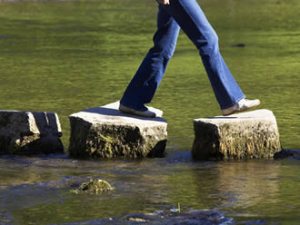
stepping-stones

A full life is not made up of an uninterrupted succession of pleasant  sensations, but really comes from transforming the way we understand and work through the challenges of our existence. Training our mind makes it not only possible to cope with mental toxins like hatred, obsession and fear that poison our existence…..but also gives us the inner resources to successfully face the highs and lows of life, without being distracted or broken by them, and allows us draw deep lessons from them.

Matthieu Ricard, The Art of Meditation