….And keeping our faces toward change

imageLife is either a daring adventure, or nothing.

To keep our faces toward change and behave like free spirits in the presence of fate is strength undefeatable.

Helen Keller

In a general sense we seem to prefer things to remain the same and dislike too much uncertainty (except  maybe when the normal dull Irish Summer has been replaced by warm sunny days).  Change unsettles and can prompt an almost instant movement towards turning away or tightening up.  So it is a challenge to “keep our faces towards change” –  as Helen Keller says-  by going against our instinct for once and staying with something that our fears tell us to avoid.  When we consistently buy into our fears and strengthen fearful  thoughts, we can forget some of the larger truths of life, or  lose sight of our essential confidence and strength. An avoidance mentality leads us to expect trouble and weakens our ability to live with how the present moment is unfolding.

One of the fundamental truths of existence is that life changes, and changes in ways that we cannot expect. So developing this capacity to turn towards change is a necessary skill for working with life. It is probably best to practice it in smaller matters, so that it is somewhat developed when the bigger changes happen. So it is good to sometimes look at some small things we avoid and see what we can learn from them. We could practice with something like some paperwork we have been putting off, a contact we have been delaying, or staying in the presence of  someone who disturbs us instead of running away.  In this way we can be curious about  what happens when we  move towards something rather than moving away.

photo of dawn at Dunmore East Co. Waterford, Ireland

Staying put

File:Abbaye-de-tamié-savoie.png

In meditation we discover our inherent restlessness. Sometimes we get up and leave. Sometimes we sit there but our bodies wiggle and squirm and our minds go far away. This can be so uncomfortable that we feel it’s impossible to stay. Yet this feeling can teach us not just about ourselves but also about what it is to be human. All of us derive security and comfort from the imaginary world of memories and fantasies and plans. We really don’t want to stay with the nakedness of our present experience. it goes against the grain to stay present. The  instruction is,  Stay…stay…just stay.  So whenever we wander off, we gently encourage ourselves to “stay” and settle down.

Pema Chodron, The Places that Scare you

Today the stage of the Tour de France takes place around Annecy and goes up the Col de Tamié. On last Sunday I was fortunate enough to be in that part of the world as I went to the liturgy in Cistercian Abbey of Tamie, founded in 1132. As always,  I was struck by the silence as I sat in the ancient church, as the thick walls keep out most sounds and I was conscious of a depth of stillness. I have visited the place often and I recognized the faces of the monks. They have been there, every day since I last visited, performing the same work in that isolated place, without been seen, repeating the same chants and prayers seven times a day, starting at 4 in the morning until 8 in the evening, in the depth of the cold winter and the relative warmth of the summer. And then on Monday I visited the monastery of Bolton Abbey in Kildare, a place I had not seen for over 10 years. Again, the same monks, the same liturgy, even though years have passed.  A continuity across miles and across years.

The founder of Western monasticism, Saint Benedict, placed an emphasis on this capacity to stay put.  He saw in the latin word “stabilitas” –  to be still, to stop, to persevere – a remedy for the troubles of his age, namely, insecurity, the movements of people, cultural and political upheavals. “Staying put” for Benedict meant that the person resisted the temptation to move from idea to new idea, and instead remained in the monastery where they had entered long enough to put down roots in order to grow and bear fruit. Perhaps he can teach us something today in this similar age, with the added distraction of increased communication and media. Many people today have lost their points of reference, and have little sense of community or family. Commitment is often presented as against personal growth and rituals seen as stifling or boring.

Benedict was drawing attention to a psychological fact, the need to stay put, to not run away or move when we come face to face with our internal restlessness.  He echoes the psychological wisdom found in the Desert Fathers who said frequently that the first work we had to do was to learn to stay, and quieten the mind in this manner. As Abba Moses replied simply when a visitor requested some novel, wise words “Go into your room and sit there, and your room will teach you all you need to know”. There is no substitute for learning to befriend ourselves. There is some link between calming the body’s desire for novelty and movement and calming the mind.

These words are not far from those we find in meditation teachers from a different tradition today. The basic  practice which we return to each day is taking our seat and staying there. Slowly it settles the mind. Gradually something is transformed in us and an interior peace can grow. We come face to face with our deep interior confusion, but we decide not to run away. It worked in the time of Saint Benedict and for those monks in the quiet valley of Tamie and the plains of Kildare.  It can also work for us in our restless age with its desire for novelty and 15 minutes of fame.

 

Doing things quietly

File:Footprints in sand.jpg

I’m just sick of ego, ego, ego. My own and everybody else’s. I’m sick of everybody that wants to get somewhere, do something distinguished and all, be somebody interesting. I’m sick of it. I’m sick of not having the courage to be an absolute nobody. I’m sick of myself and everybody else that wants to make some kind of a splash.

J.D. Salinger, Franny and Zooey

photo Júlio Reis

Intention

tearmann

Breathing in, breathing out, feeling resentful, feeling happy, being able to drop it, not being able to drop it, eating our food, brushing our teeth, walking, sitting — whatever we’re doing could be done with one intention. That intention is that we want to wake up, we want to ripen our compassion, and we want to ripen our ability to let go, we want to realize our connection with all beings. Everything in our lives has the potential to wake us up or to put us to sleep. Allowing it to awaken us is up to us.

Pema Chodron, Comfortable with Uncertainty

I had lunch yesterday in the coffee shop run by the Camphill Community  in the lovely village of Kilcullen, County Kildare, about 25 miles south of Dublin.  It was about 10 years since I was last  there  but I found it as inspiring and nourishing –  in every sense – as before.  The Camphill communities focus on creating meaningful and inclusive lives for people with intellectual disabilities and special needs, where everyone contributes at the level of their ability, and where the contribution of everyone is valued. As the Henri Nouwen quote this morning reminds us, our value resides more in what we are, even though we frequently seek it in what we do.

The apt name of the coffee shop is the Gaelic “An Tearmann” which means “Refuge” or “Sanctuary” and it raises funds that support the community living and working near Kilcullen as they work towards creating an environment for healing and development. I was struck by some words on the front of the menu, where they thanked visitors for their support in the creation of an “intentional community”. It reminded me that every moment, even lunch or a cup of coffee, can be made more intentional or conscious, and that we are challenged to reflect on the overall direction or intention of our lives, and what values our choices support.

Being comes before doing

friendship-thumb-350x262

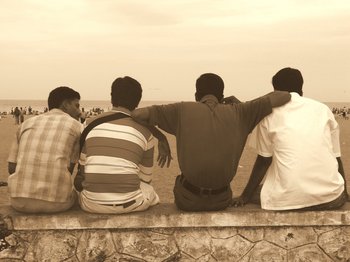
My own desire to be useful, to do something significant, or to be part of some impressive project is so strong that soon my time is taken up by meetings, conferences, study groups, and workshops that prevent me from walking the streets. It is difficult not to have plans, not to organize people around an urgent cause, and not to feel that you are working directly for social progress. But I wonder more and more if the first thing shouldn’t be to know people by name, to eat and drink with them, to listen to their stories and tell your own, and to let them know with words, handshakes, and hugs that you do not simply like them, but truly love them.

Henri Nouwen

The best laid plans of mice and men….

On Monday I had a good experience of the fact that sometimes  things do not turn out exactly as I imagined or maybe hoped for.   I am in the middle of a house  relocation and one part of the schedule did not slot into place knocking other dependent elements into a waiting pattern.

I noticed that this produced two effects in the mind. The first – a very familiar occurrence – is to create doubt, and an immediate subtle tendency to blame myself arises.  Not good enough. Should have foreseen that.  Should have checked.  Should not have been so naive.  It is noticeable that when some thing goes wrong we quickly move to think that we are wrong. In those moments, if we look closely, we can feel separate and alone. A gut sense of us as deficient can come into play. Stories – about ourselves and about how our lives are going – are always arising in our minds and we can mistake them for reality. Practice helps us to see this as a process rather than holding onto the content and to turn our attention to how do we want to work with it. In other words space enters in.

Another thing I noticed is the habit of turning our plans into some sort of determined goal, and losing our focus on the path which is always fluid and ongoing. In other words, we already have a fixed outcome in our mind and failing to achieve that creates dissatisfaction. Our sense of things being right is attached to the future turning out in a particular way, which may or may not happen. This means that we do not find it as easy to respond to what actually happens, and to stay in the present moment. Our practice is to find happiness in what is actually happening and not attaching it to what we thought should have happened, and then going on to blame ourselves, others or events.