Being slow to label

File:Cebus apella eating grapes-0006.jpg

When we taste something, what is the ‘realness’ of it? We can say, ‘It tastes nice’ but this is what we think about it, not what the taste is. We can say, ‘It’s a grape’, but that’s a designation, a perception, isn’t it? What is the actual taste? We say, ‘It’s sweet’, but ‘sweet’ is a judgment, isn’t it? We come to understand that the reality of it is indefinable, and that for most of our life we are operating at the level of interpretations and classifications, of secondary experiences, rather than living the actuality of it. We never even know who we really are, because everything is constantly changing; the reference points are changing so although we feel we’re something, nothing quite fits. So as long as we identify with the world of change and appearance, this is all we shall ever feel ourselves to be, just an appearance that changes and wants to find a certain position.

Ajahn Sucitto, Gnosis and Non-Dualism

photo MatthiasKabel

Sunday quote: Wasting time in comparisons

rest

Do not wish to be anything but what you are

and try to be that perfectly.

St Francis de Sales

Lost in our heads

File:Head of statue of John of Nepomuk in Třebíč, Czech Republic.jpg

Meanwhile, here we are, missing the fullness of the present moment, which is where the soul resides.  It’s not like you have to go someplace else to get it.  So the challenge here is, Can we live this moment fully?   Over a lifetime, you may wind up in the situation where you are never actually where you find yourself.  You’re always someplace else, lost, in your head, and therefore in a kind of dysfunctional or non-optimal state.  Why dysfunctional?  Because the only time you ever have in which to learn anything or see anything or feel anything, or express any feeling or emotion, or respond to an event, or grow, or heal, is this moment, because this is the only moment any of us ever gets.  You’re only here now; you’re only alive in this moment. The past is gone, and I don’t know what’s coming in the future.  It’s obvious that if I want my life to be whole, to resonate with feeling and integrity and value and health, there’s only one way I can influence the future:  by owning the present. 

Jon Kabat Zinn

photo : frettie

Letting go of the ideal to work with the now

File:Downpatrick sunset (01), September 2009.JPG

One thing that I am getting used to being back in Ireland is the changing nature of the weather, which varies from day-to-day and  even a number of times during the day. Yesterday was a lovely warm, sunny, day,  with a beautiful sky at sunset, while today the sky is hidden behind grey clouds with the prospect of rain later. I was talking with friends in Switzerland who are going through a period of very hot weather, and immediately my mind formed the idea of the “ideal” summer, with constancy and reliability in the weather. However, nice as that would be, one advantage of changing weather is that it allows us practice with letting go of ideals and “shoulds”,  and moving with how things actually are.  This is a good training in letting go of the “push-pull” dynamic of happiness which is ingrained in us.  We seem to alternate between “pulling” – wanting some things that are going on in our lives (or in others’ lives or in an idealized version of our life) or “pushing away” –  not wanting elements of what is happening to us at the moment. Real happiness comes from stepping out of that dynamic, from waking up to to the root cause.

Here are some thoughts from Ajahn Sucitto on how to work with the way the mind likes to form ideals – the weather, the ideal day, the ideal way our life should be –  which can become judgmental  and oppressive. He suggests the development of  a working philosophy of “good enough”, and argues that this cannot achieved through thinking alone, but in a balance between the head, the heart and being grounded in the body, here and now. There is a kindness in approaching life this way, which is often lacking in the thinking mind. 

Not feeling good enough is a true experience. Something’s wrong. But you don’t get good enough through following the idea or the ideal or those performance-driven drives that cause you to fragment. Good enough begins with being whole, with the heart, head and body senses all in the same place. So you enquire: is my body with me now? Is my heart unwilling? Resisting? Or settling into being here? How do I free myself from self-criticism and feeling inadequate? And to look at the topic in another light – where would that self-respect come from? That has to be a relational sense; which is a heart sense, not my thinking mind. The problem is that we mostly orient through the thinking faculty. And for this faculty absolutes and ideals are easy. You can think in terms of absolute right and wrong. You can conceive of the perfect person and the perfect society. What you can’t conceive of in any clear and definite way is what is good enough. The thinking mind can’t grasp that one.  It’s only realizable through the heart faculty.

Ajahn Sucitto, Good Enough

photo ardfern

Balance

7951394

The wise man knows how to run his life so that contemplation is possible.

Gabriel Marcel

Continually judging

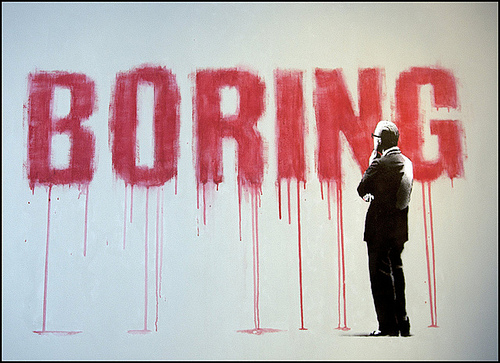
Boring2

We are taught to make sense of things by imposing our judgement on everything in front of us. Naturally, as we grow up, we question some of the judgements and interpretations thrown our way, we agree with some and we disagree with others, and fit our personal understanding with our experience. But we rarely question the act of judging itself. Without much analysis we simply keep interpreting and reinterpreting reality as good or bad, right or wrong, useful or detrimental,  fun or boring, constantly tweaking our conceptions as new experiences  reinforce or undermine what we think we “know”

Karuna Cayton, The Misleading Mind