A change in climate

rain-puddle

Let me say this before rain becomes a utility that they can plan and distribute for money. By “they” I mean the people who cannot understand that rain is a festival, who do not appreciate its gratuity, who think that what has no price has no value, that what cannot be sold is not real, so that the only way to make something actual is to place it on the market. The time will come when they will sell you even your rain. At the moment it is still free, and I am in it. I celebrate its gratuity and its meaninglessness.

Nobody started it, nobody is going to stop it. It will talk as long as it wants, this rain.

As long as it talks I am going to listen.

Thomas Merton, Rain and the Rhinoceros

Procedures, memories, patterns

We all have well-established habits of thought, emotion, reaction and judgement, and without the keen awareness of practice, we’re just acting out these patterns.

When they arise, we’re not aware they’ve arisen.
We get lost in them, identify with them, act on them  —  so much of our life is just acting out patterns.

Joseph Goldstein

As I was washing my hands the other evening  before the meal I turned on the tap marked “C” and started to wash.  After a moment something registered, and I thought “this water is cold, it should be getting warm by now”. And then I realized that “C” in an anglophone country like Ireland refers to “cold” whereas “C” in a francophone bathroom would indicate hot water. I noticed that my behaviour had been automatic, done without conscious awareness,  based on procedural,  formed,  memories. I had turned the “C” tap without thinking and gradually my brain caught up with the fact that this was not France and that the patterned behaviour would not get the desired result.

Frequently we operate on procedural memories or knowledge. This is fine for something like driving, which is fairly automatic regardless of whether one is driving on the right or the left. However, doing things in an automatic way can mean that we fit things into familiar boxes, or do not see things as new but presume that they will be the same as before. We do not give the moment a chance to reveal any new riches, because we have it figured out even before it happens. We can reduce others and,  even more frequently,  ourselves,  to limited pre-defined expectations and not believe in any possibility for change.

Seconds at a time

05-29 BEE POLLEN web A

Most of life only lasts a moment. Then our life becomes a memory, a dream. We are only alive a millisecond at a time. This moment! Or as one teacher put it, holding his thumb and forefinger about a quarter-inch apart, “All of life is only just this much –just a moment in time.” When we open to this very instant in which awareness produces consciousness, we are fully alive. Completely present. Big-minded. To the degree we are present for “just this much”,  this living moment, we are alive.

Stephen and Ondrea Levine, Embracing the Beloved

Being comes before doing

friendship-thumb-350x262

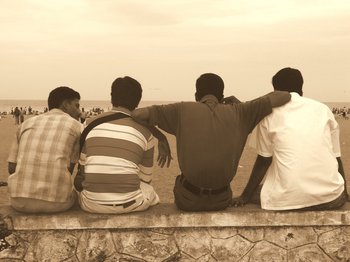
My own desire to be useful, to do something significant, or to be part of some impressive project is so strong that soon my time is taken up by meetings, conferences, study groups, and workshops that prevent me from walking the streets. It is difficult not to have plans, not to organize people around an urgent cause, and not to feel that you are working directly for social progress. But I wonder more and more if the first thing shouldn’t be to know people by name, to eat and drink with them, to listen to their stories and tell your own, and to let them know with words, handshakes, and hugs that you do not simply like them, but truly love them.

Henri Nouwen

Totally still

File:Still Water At Dusk.jpg
Ajahn Chah would ask “Have you ever seen still water?” They would nod, “Yes, of course, we’ve seen still water before.” Then he would ask, “Well then, have you ever seen flowing water?”  They’d respond, “Yes, we’ve seen flowing water.”“So, did you ever see still, flowing water?” “No. That we have never seen.”   He loved to get that bewilderment effect.

Ajahn Chah would then explain that the mind’s nature is still, yet it’s flowing. It’s flowing, yet it is still. He would use the word “citta” for the knowing mind, the mind of awareness. The citta itself is totally still. It has no movement; it is not related to all that arises and ceases. It is silent and spacious. Mind objects — sights, sounds, smell, taste, touch, thoughts, and emotions — flow through it. Problems arise because the clarity of the mind gets entangled with sense impressions. By contemplating our own experience, we can make a clear distinction between the mind that knows (citta) and the sense impressions that flow through it. By refusing to get entangled with any sense impressions, we find refuge in that quality of stillness, silence, and spaciousness.  This policy of  non-interference allows everything and is disturbed by nothing.

Ajahn Amaro,  Small Boat

photo Miguel Virkkunen Carvalho

Like a therapist

File:US Navy 060822-N-2832L-128 Navy Lt. Rachel Oden, of Casa Grande, Ariz., a physical therapist plays with a young girl during her first day of physical therapy for her neuromuscular control deficits.jpg

We are trying to develop a different relationship with the mind.  Awareness contributes to the subduing of harmful emotions and this awareness extends to everything, including ourselves. We need to treat ourselves with the same objective distance that a therapist uses for her clients. By subduing the harmful emotions and afflictive states of mind, our aim is to increase our helpful emotions or mental states, like empathy, gentleness, compassion, wisdom, generosity, warmth and so on. The more we become aware of our inner workings, the more adept we become at applying the mental balancing techniques that will offer us true mental health

Karuna Cayton, The Misleading Mind

U.S. Navy photo of physical therapist Rachel Oden