Non-productive patterns of thought

When we sit and try to quieten the mind, the first thing we usually notice is how many thoughts we have. For those who are beginning meditation this is what strikes first. However, even those who have practiced meditation for some time can still have times when the thinking mind is very busy One way of working with that busyness is to broadly label the  thoughts, thus allowing them pass through and reducing the amount of weight which we give to them. This has the effect of turning down the amount of energy associated with them and creating more space and calm in the mind. In other words, rather than getting caught up, we step out of the stream:

If you label your disruptive thoughts, you will get an idea of your habitual thought patterns. We use one descriptive word such as ‘future,’ ‘past,’ ‘planning’, ‘remembering’, ‘wanting’, ‘rejecting’, ‘resisting’, ‘bored’, ‘disinterest’, ‘nonsense’, ‘fantasy’, ‘dream’. It doesn’t matter which word comes to mind first. Eventually you can see a pattern, for example that you are constantly planning. When you notice your thought patterns in this way, you can see they are non-productive and drop them.

Ayya Khema

Being as fluid as life itself is

It seems to me that fear is more basic than the emotions. It comes from our basic confusion. Fear touches on the most basic aspect of the human dilemma: “How do we live in an uncertain world?”  We understand this when we sit to practice. We don’t really know what to do with our experience. We either get lost in our thoughts or try to suppress them. Somehow, we can’t find our resting place with the energy and expression of our mind. It can feel overwhelming – scary. … So we can say that, due to our inability to relax around experience, we contract in fear or get lost in our confusion. It says in the teachings that this “overwhelm” causes us to cling tightly. This experience of clinging tightly is what we misunderstand as the self. We continue to look for stability and security, and yet the world (our inner and outer worlds) is not a static situation. What we experience as a self, we could say, is a continued desire for happiness and freedom from suffering. The problem we have is that there is so much bewilderment around our experience and not knowing what to do with it, we contract out of fear…..There is panic, which is a frozen,  very physical,  sensation. Our breath gets shallow. We feel like life is something happening to us, rather than feeling a part of the bigness of life.

But however contracted we get,  life continues to flow.…no matter how tightly we hold on. We can’t separate ourselves from life. Even a fortress is part of life. And even as a fortress we are still in relationship with life and our mind. That we are part of the great interdependence of life means that actually, we are very, very big – infinite, in fact.  So the purpose of practice is to find our true relationship with life, rather than contract. Trying to create security in a world that is fluid is a good definition of pain/samsara. The purpose is to value life and let it touch us and change us – so that we can be as fluid as life, which is a poignant and beautiful, freeing and emboldening experience.

Elizabeth Mattis-Namgyel, Moving Beyond Fear

Thoughts while working in the garden

Patience is the ability to watch something until it changes. Ajahn Sucitto

Each day there are plenty of opportunities to practice patience in our lives. However, for both inner and outer reasons, staying still does not come easy for most of us.  This is firstly because there is always active in the mind a strong tendency towards becoming, which translates as a desire to move on to the next thing. This can mean that there is always activity going on in thoughts, sometimes useful, sometimes less so, but always leaning forward. Past memories can also rise up and move us,  meaning that stuff which happened yesterday or last year can make us feel restless and anxious for resolution now. The energy is always flowing and we tend to get caught up in it. And because the mind is always moving, the body tends to want to move also, and we end up believing that unless we are in some way active we are wasting our life.

It is also true that society today encourages us to see any delay as a waste of time. We have gotten so used to instant results, faster broadband, instant downloads and so on  that we are tricked into thinking that this model applies to everything, such as our interior life, or how to respond to setbacks such as illness or job loss, or other transitions in life.  However, nature reminds us of a different rhythm, as when we are working in the vegetable garden and observing the tomatoes as they slowly move towards being ripe. Or waiting for the right time to re-seed a lawn, as the weather now is too hot and I will have to wait for a month or two. There is nothing we can do to hurry things up or change the pace at which it is right to go.

If you really aren’t trying to get anywhere else in this moment,  patience  takes care of itself. It is a remembering that things unfold in their own time. The seasons cannot be hurried. Spring comes, the grass grows by itself. Being in a hurry usually doesn’t help and it can create a great deal of suffering – sometimes in us, sometimes in those who have to be around us. Patience is an ever-present alternative to the mind’s endemic restlessness and impatience. Scratch the surface of impatience and you will find lying beneath it, subtly or not so subtly is anger. It’s the strong energy of not wanting things to be the way they are and blaming someone (often yourself)  or something for it.

Jon Kabat Zinn, Wherever you go, There you are

…and letting go of an idea of perfection

https://i0.wp.com/www.wga.hu/art/m/michelan/1sculptu/giulio_2/slave6.jpg

When we seek happiness through accumulation, either outside of ourselves–from other people, relationships, or material goods–or from our own self-development, we are missing the essential point. In either case we are trying to find completion. But according to Buddhism, such a strategy is doomed. Completion comes not from adding another piece to ourselves but from surrendering our ideas of perfection.

Mark Epstein, Going to Pieces without Falling Apart: A Buddhist Perspective on Wholeness

Contentment with oneself…

When  you  sit, let things settle and allow all  your  discordant self  with  its ungenuineness and unnaturalness to  dissolve,  out of  that  rises  your real being. You  experience  an  aspect  of yourself which is more genuine and more authentic-the “real” you.  As  you  go deeper, you begin to discover and connect  with  your fundamental goodness. The  whole point of meditation is to get used to the that  aspect which you have forgotten. In Tibetan “meditation” means  “getting used to”. Getting used to what? To your true nature.  This  is  why,  you are told to “rest in the nature of mind”. You  just quietly  sit  and let all thoughts and concepts dissolve.  It  is like  when the clouds dissolve or the mist evaporates, to  reveal the clear sky and the sun shining down. When everything dissolves like  this, you begin to experience your true nature, to  “live”. Then you know it, and at that moment, you feel really good. It is unlike  any  other  feeling of well being  that  you  might  have experienced.  This is a real and genuine goodness, in  which  you feel  a  deep sense of peace, contentment  and  confidence  about yourself.

Sogyal Rinpoche,  Essential Teachings on Meditation

Letting go of urgency

Sometimes I grow weary of the days with all their fits and starts.
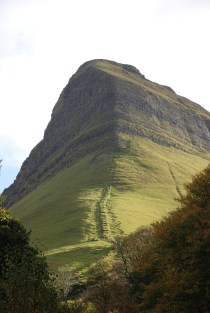
I want to climb some old grey mountain, slowly, taking
the rest of my life to do it, resting often, sleeping
under the pines or, above them, on the unclothed rocks.
I want to see how many stars are still in the sky
that we have smothered for years now, forgiving it all,
and peaceful, knowing the last thing there is to know.
All that urgency!  Not what the earth is about!
How silent the trees, their poetry being of themselves only.
I want to take slow steps, and think appropriate thoughts.
In ten thousand years, maybe, a piece of the mountain will fall.

  Mary Oliver, The Poet Dreams of the Mountain