A value in being lost

There is immense value in “finding ourselves lost” because we can find something when we are lost, we can find our selves. Indeed, the deepest form of wandering requires that we be lost.  Imagine yourself lost in your career or marriage, or in the middle of your life. You have goals, a place you want to be, but you don’t know how to reach that place. Maybe you don’t know exactly what you want, you just have a vague desire for a better place. Although it may not seem like it, you are on the threshold of a great opportunity. Begin to trust that place of not knowing. Surrender to it. You’re lost. There will be grief. A cherished outcome appears to be unobtainable or undefinable. In order to make the shift from being lost to being present, admit to yourself that your goal may never be reached. Though perhaps difficult, doing so will create entirely new possibilities for fulfillment.

Surrendering fully to being lost –  and this is where the art comes in  – you will discover that, in addition to not knowing how to get where you had wanted to go, you are no longer so sure of the ultimate rightness of that goal. By trusting your unknowing, your old standards of progress dissolve and you become eligible to be chosen by new, larger standards, those that come not from your mind or old story or other people, but from the depths of your soul. You become attentive to an utterly new guidance system.

Bill Plotkin, Being Lost but not lost in Life
The freedom of not comparing to an ideal self

We can always see ourselves in terms of what’s wrong with us as persons. There are always so many flaws and inadequacies. There is no perfect personality that I have ever noticed. Personality is all over the place. Some of it is all right and some of it is really wacky. There is no personality that you can take refuge in. You are never going to make yourself into a perfect personality. So when you judge yourself you find so many problems, inadequacies, flaws and weaknesses. Maybe you are comparing yourself to some ideal person, some unselfish and superlative personality. However, that which is aware of personality is not personal. These personality conditions arise and cease…. Your refuge is in this awareness rather than in trying to make yourself into an ideal man or woman – mature, responsible, capable, successful,  “normal”  and all the rest – these are ideals.

Ajahn Sumedho, The Sound of Silence

Letting it all pass through

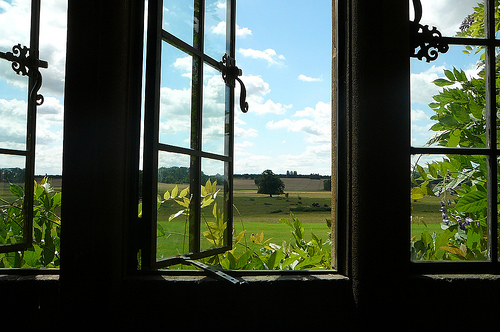
Just go into the room, and put one chair in the center. Take the one seat in the center of the room, open the doors and windows, and see who comes to visit. You will witness all kinds of scenes and actors, all kinds of temptations and stories, everything imaginable. Your only job is to stay in your seat. You will see it all arise and pass, and out of this, wisdom and understanding will come.

Ajahn Chah

How to deal with our inner commentator

A great distraction at times are so-called “running commentary” thoughts such as, “Now I am not thinking of anything,” “Things are going very well now,” “This is dreadful; my mind just won’t stay still” and such like……..All such thoughts should simply be noted as “Thinking,” and, as Huang Po says, “dropped like a piece of rotten wood.” “Dropped,” notice, not thrown down. A piece of rotten wood is not doing anything to irritate you, but is just of no use, so there is no point in hanging on to it…Nor is there any need to try to retrace the links in a chain of associated thoughts, nor to try to ascertain what it was that first started the chain. Any such impulse should itself be noted simply as “Thinking,” and the mind should revert to the breathing. However badly things have just been going, one should take up again at the only place one can – where one is – and go on from there.

Bhikku Mangalo, The Practice of Recollection

All things arise and pass away


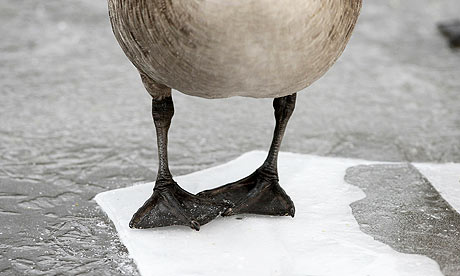
To what can our life on earth be likened?
To a flock of geese,
alighting on the snow.
Sometimes leaving a trace of their passage.

Su Shi (1037 – 1101), Remembrance

Letting thoughts – our own and others – define us

The deep cold continues,  and hardens the snow which fell in the past few days.  I am reminded of this Mahamudra text:

When a wintry wind strikes and stirs up water,
Though soft, it takes the form of stone.
When concepts attempt to disturb mind’s nature,
Appearances become very dense and solid.

In our practice we notice whatever passes through the mind-body in the form of thoughts or emotions. When under pressure we can sometimes turn them into a very solid reality, allowing them define us at that moment, as somehow a bad or defective person.  However, no matter how solid they seem, practice helps us to hold them fluid, seeing them just as energies in the mind,which can be worked with when we hold them in awareness.