Sunday Quote: Taking time


All this hurrying soon will be over. 

Only when we slow down do we touch the holy.

Rilke

Tuning in to ourselves

Perhaps the most common and pernicious form of non-listening is our non-listening to ourselves. So much of what we actually feel and think is unacceptable to us. We have been actually conditioned over a lifetime to simply not hear all our own self-pity, anger, desire, jealousy, wonder. Most of what we take to be our adult response is no more than our unconscious decision not to listen to what goes on inside us. And as with any human relationship, not listening to ourselves damages our self-respect. To allow ourselves to feel what we actually do feel – not to be afraid or dismayed but to open up a space inside our hearts large enough to safely contain what we feel, with the faith that whatever comes up is workable and even necessary – this is what any healthy, mature human being needs to do and what we so often fail to do.

Norman Fischer, Taking Our Places

This moment!

Most of life only lasts a moment. Then our life becomes a memory,  a dream. We are only alive a millisecond at a time. This moment! Or as one teacher puts it, holding his thumb and forefinger about a quarter-inch apart  “All of life is only just this much – about a moment at a time”. When we open to the very instant in which awareness produces consciousness, we are fully alive. Completely present. Big-minded. To the degree that we are present for “just this much”, this living moment, we are alive. Otherwise we numb to the vibrancy,  and beg upon our deathbed for just one more chance.

Stephen and Ondrea Levine, Embracing the Beloved.

Where we grow

We never grow by dreaming about a future wonderful state or by remembering past feats. We grow by being where we are and experiencing what our life is right now. We must experience our anger, our sorrow, our failure, our apprehension; they can all be our teachers., when we do not separate ourselves from them. When we escape from what is given, we cannot learn, we cannot grow. That’s not hard to understand, just hard to do. Those who persist, however, will be those who grow in compassion and understanding. How long is such practice required? Forever.

Charlotte Joko Beck, Everyday Zen

Seeing with fresh eyes

As Mary Oliver reminded us yesterday, how we look and  pay attention is crucial in our work in counterbalancing the mind’s tendency to focus on the negative. So our day-to-day practice is to notice with fresh eyes, and not allowing our beliefs about what we “know” get in the way of the richness of moment-to-moment experience. We can try this today with the people we meet and when we are in familiar situations.

No moment is the same as any other. Each is unique and contains unique possibilities. Beginner’s mind reminds us of this simple truth. The next time you see somebody who is familiar to you, ask yourself if you are seeing this person with fresh eyes, as he or she really is, or if you are seeing only the reflection of your own thoughts about this person.

Jon Kabat Zinn, Full Catastrophe Living

Noticing colour in grey days

Some similar thoughts, this time from a poet and not a neuroscientist. She encourages us to notice the little moments of colour that come into every day as a way of going against the heart’s tendency to close in on itself:

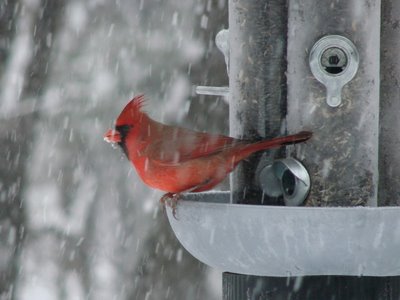
Red bird came all winter firing up the landscape as nothing else could.
Of course I love the sparrows, those dun-colored darlings so hungry and so many.
I am a God-fearing feeder of birds.
I know He has many children,
not all of them bold in spirit.
Still, for whatever reason —
perhaps because the winter is so long
and the sky so black-blue,
or perhaps because the heart narrows
as often as it opens —
I am glad
that red bird comes all winter
firing up the landscape
as nothing else could.

Mary Oliver, Red Bird