What if I knew I would never see it again?

Exploring nature with your child is largely a matter of becoming receptive to what lies all around you. It is learning again to use your eyes, ears, nostrils, and finger tips, opening up the disused channels of sensory impression. For most of us, knowledge of our world comes largely through sight, yet we look about with such unseeing eyes that we are partially blind. One way to open your eyes to unnoticed beauty is to ask yourself, “What if I had never seen this before? What if I knew I would never see it again?

Rachel Carson, Ecologist , The Sense of Wonder.

Staying with the way things are

The ancient festival of Samhain, which lies behind modern-day Halloween, marked the end of the Celtic year as well as putting an end to agricultural work and trade. It meant that people followed the rhythm of nature and wound down their activity. This festival began that period of resting and was an occasion for meeting up, for building bonfires, celebrating the harvest and for storytelling. It was also the traditional time for slaughtering animals in order to prepare stores of meat and grain to last through the coming winter. The bonfire tradition still persists in Ireland and England to this day. Despite the fanciful modern notion that it was a night when  the spirit world was particularly close, it is more correct to say that the whole Celtic worldview saw very little division between the worlds, and this view was present every day of the year. This does not mean the modern Halloween emphasis on ghosts and goblins but rather a  sense of an openness to the spiritual in the everyday, reflected in the Irish langauge’s belief that the other world was always there right beside you, in every field and on every hilltop, in the trees and animals and even in the stones.

We move from this worldview when we think that life is better somewhere else, other than in the tasks we face this day, and everyday. We often treat the things that we have to do, especially if they are repetitive or mundane,   as moments to be gotten “out-of-the-way” so that we can get to something more “meaningful” or exciting. But, as the Irish poet Paddy Kavanagh, who is rooted in this Celtic worldview,  reminds us, God is in the bits and pieces of everyday. He saw his writing as an attempt to explode the atoms of ordinary experience. And all wisdom traditions  agree with this ancient way of seeing, as do modern stress reduction programmes, when they speak about paying attention to what is happening now, and not rushing past it.  The way to contentment is not by waiting to have the best of everything but by being able to start with what we already have – this schedule, the personality we have, the situation we are actually in, the demands of this day.  In working with these we are putting ourselves in contact with this actual moment and not doing what we frequently prefer – living in thoughts or idealistic dreams about it.

Let the beauty we love be what we do.
There are hundreds of ways to kneel and kiss the ground.

Rumi
How to relate to our daily life

How we stay in the middle between indulging and repressing is by acknowledging whatever arises without judgment, letting the thoughts simply dissolve, and then going back to the openness of this very moment. That’s what we’re actually doing in meditation. Up come all these thoughts, but rather than squelch them or obsess with them, we acknowledge them and let them go. Then we come back to just being here.

After a while, that’s how we relate with hope and fear in our daily lives. Out of nowhere, we stop struggling and relax. We see our story line, drop it, and come back to the freshness of the present moment.

Pema Chodron, Comfortable with Uncertainty

Every morning a new day is created

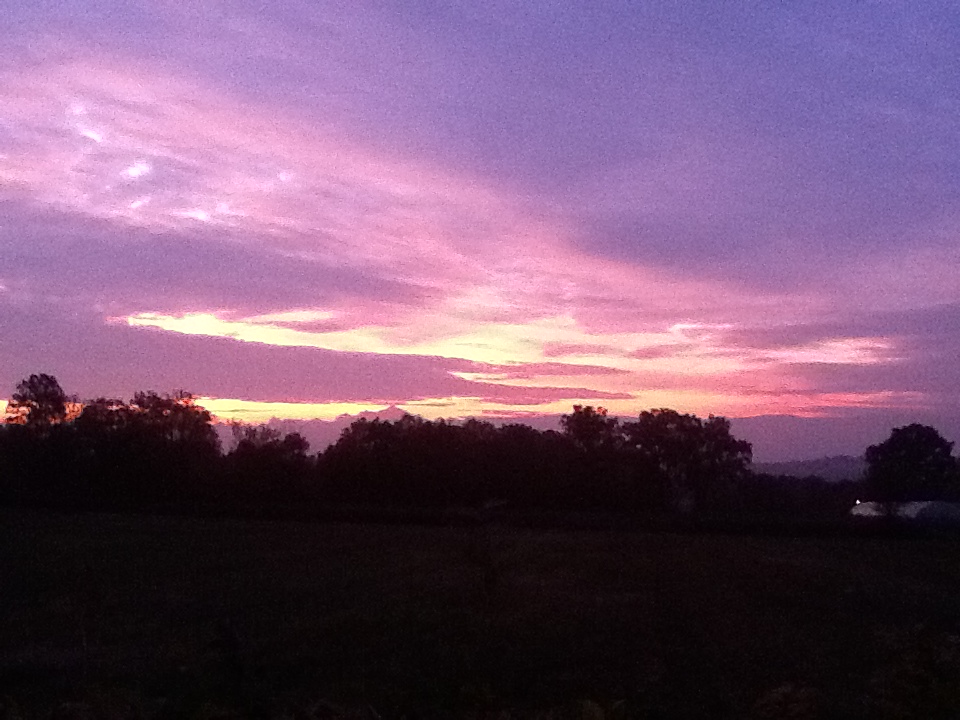
A simple poem, suggested by the sky at dawn this morning. Even as the days shorten, and darkness seems to encroach more, the light at dawn is beautiful. There are moments of light and strength, even at those times when we seem to struggle.

Every morning the world is created…

If it is in your nature to be happy..

And if your spirit  carries within it

the thorn that is heavier than lead….

there is still somewhere deep within you

a beast shouting that the earth

is exactly what it wanted –

each pond with its blazing lilies is a prayer heard and answered

lavishly, every morning,

whether or not you have ever dared to be happy,

whether or not you have ever dared to pray.

Mary Oliver

…. and the self is continually changing…

Some similar reflections, this time from a neuroscientific point of view:

Now we come to perhaps the single greatest source of suffering  –  the apparent self. Look into your own experience. When you take things personally –  or hunger for approval –  what happens? You suffer. When you identify with something as “me” or try to possess something as “mine,” you set yourself up for suffering, since all things are frail and will inevitably pass away. When you stand apart from other people and the world as “I,” you feel separate and vulnerable  – and suffer. On the other hand, when you relax the subtle sense of contraction at the very nub of “me” –  when you’re immersed in the flow of life rather than standing apart from it, when ego and egotism fade to the background  –  then you feel more peaceful and fulfilled. 

The experiences of self you just had — that it has many aspects, is just part of the whole person, is continually changing, and varies according to conditions — depend on the physical substrates of self in your brain. Thoughts, feelings, images, and so on exist as patterns of information represented by patterns of neural structure and activity. In the same way, the various aspects of the apparent self – and the intimate and powerful experience of being a self – exist as patterns in the mind and brain. The many aspects of self are based on structures and processes spread throughout the brain and nervous system, and embedded in the body’s interactions with the world.….In sum, from a neurological standpoint, the everyday sense of being a unified self is an utter illusion: the apparently coherent and solid “I” is actually built from many subsystems and sub-subsystems over the course of development, with no fixed center, and the most fundamental basis of the sense of “I”  –  subjectivity  –  emerges in the field of interactions the body has with the world.

Rich Hansen, Buddha’s Brain : The Practical Neuroscience of Happiness, Love, and Wisdom

Early morning thoughts…for the day that begins…

Mindfulness is the aware, balanced acceptance of the present experience.  It isn’t more complicated than that. 


It is opening to or receiving the present moment, pleasant or unpleasant, just as it is, without either clinging to it or rejecting it.

Sylvia Boorstein