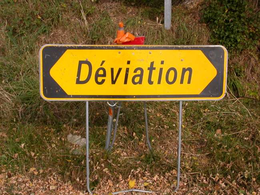
What happens today is not a deviation from life

The Buddhist teachings are fabulous at simply working with what’s happening as your path of awakening, rather than treating your life experiences as some kind of deviation from what is supposed to be happening. The more difficulties you have, in fact, the greater opportunity there is to let them transform you. The difficult things provoke all your irritations and bring your habitual patterns to the surface. And that becomes the moment of truth. You have the choice to launch into the lousy habitual patterns you already have, or to stay with the rawness and discomfort of the situation and let it transform you, on the spot.

Pema Chodron

Noticing the effects of a franctic age 1

Will put up one or two posts on the effects of our speeded-up world and social media on the human psyche, partly prompted by reading this address of Pope Benedict XVI to a group of contemplative monks. His remarks, although from a philosophical perspective, reflect the most recent scientific research on the fact that increased internet and social media usage seems to effect and change the very nature of the brain itself.

Technical progress, markedly in the area of transport and communications, has made human life more comfortable but also more keyed up, at times even frantic. Cities are almost always noisy, silence is rarely to be found in them because there is always a lingering background noise, in some areas even at night. In the recent decades, moreover, the development of the media has spread and extended a phenomenon that had already been outlined in the 1960s: virtuality that risks getting the upper hand over reality. Unbeknown to them, people are increasingly becoming immersed in a virtual dimension because of the audiovisual messages that accompany their life from morning to night.

The youngest, who were already born into this condition, seem to want to fill every empty moment with music and images, as for fear of feeling this very emptiness. This is a trend that has always existed, especially among the young and in the more developed urban contexts but today it has reached a level such as to give rise to talk about anthropological mutation. Some people are no longer capable of remaining for long periods in silence and solitude.

Pope Benedict XVI, Address to Carthusian Monks, Carthusian monastery of St. Bruno, Lamezia Terme, Italy, Oct. 11, 2011

The right response

Life is given to us; every moment is given.

The only appropriate response therefore is gratefulness. When we wake up to the fact that everything is a gift, it is only natural to be thankful and to look on everything that happens as a chance to respond to the Given Life.

David Steindl-Rast, The Music of Silence

Awareness is the refuge within

Awareness is your refuge:
Awareness of the changingness of feelings, of attitudes, of moods, of material change and emotional change: Stay with that, because it’s a refuge that is indestructible.
It’s not something that changes. It’s a refuge you can trust in.
This refuge is not something that you create. It’s not a creation. It’s not an ideal. It’s very practical and very simple, but easily overlooked or not noticed.
When you’re mindful, you’re beginning to notice,
it’s like this.

Ajahn Sumedho,

…..where peace comes dropping slow

Yeats’ father would read to him from Walden when he was a child. Later, when living in London he wrote this poem, wishing he could retire to the quietness of nature on an island he knew as a boy. Most of us do not have the luxury of a real island to go to, but we create our refuge within ourselves and take shelter there when the storms of the day get too strong. We allow the mind and the body to settle, even if only for a brief moment, and allow peace to drop slowly in.

I WILL arise and go now, and go to Innisfree,
And a small cabin build there, of clay and wattles made:
Nine bean-rows will I have there, a hive for the honey-bee,
And live alone in the bee-loud glade.

And I shall have some peace there, for peace comes dropping slow,
Dropping from the veils of the morning to where the cricket sings;
There midnight’s all a glimmer, and noon a purple glow,
And evening full of the linnet’s wings.

I will arise and go now, for always night and day
I hear lake water lapping with low sounds by the shore;
While I stand on the roadway, or on the pavements grey,
I hear it in the deep heart’s core.

WB Yeats, The Lake Isle of Innisfree

The island within…..

Two posts today on creating a quiet space within –  an island – to which we can retreat when things get frazzled or too hectic. This is our “hermitage”, where we can feel at home. To do this we can simple take a moment’s break from time to time, or use the breath as a way of centering or grounding when the events of the day speed up. Or simply  by creating gaps, taking time before answering the phone, or pausing before taking the elevator.

You should go home to your hermitage; it is inside you. Close the doors, light the fire, and make it cozy again. That is what I call ‘taking refuge in the island of self.’ If you don’t go home to yourself, you continue to lose yourself. You destroy yourself and you destroy people around you, even if you have goodwill and want to do something to help. That is why the practice of going home to the island of self is so important. No one can take your true home away.

Thich Nhat Hahn, Peace Begins Here