Trying to become something

Practice is based on a complete acceptance of ourselves, as we are, balanced with a gentle, non-judging movement to change aspects of our behaviour which lead to unhappiness. Any desire for change comes within the framework of that non-judgmental acceptance, and an ease with the status quo.
We know when we are far from that. We can feel an urgency in our desire to change, a leaning forward that is tinged with fear. There can be all sorts of reasons for this, such as an fundamental lack of acceptance of ourselves. Or we have an “indirect acceptance“,  when we can only see good in ourselves if someone outside approves us. Or we get mixed up between been needed and being loved. Whatever the reason,  we can look to mediation to fix us, and it becomes attached to an outcome, ultimately adding to our unhappiness with ourselves. The reality of our lives is that we are three-steps-forward-two-steps-back-kinda-people, and need to accept ourselves as that.

Ajahn Sumedho encourages an awareness of what we call “the becoming tendency”, meaning the use of meditation to become something. You do this to get that. It’s a kind of busy-ness and doing-ness and leaning — taking hold of a method, or others’ ideas, or quick  solutions in order to get somewhere. This habit is the cause of many of our troubles, and can so easily take over our meditation. It can permeate the whole effort of spiritual practice. Indeed, he states that the becoming tendency can take over and gets legitimized by being called “meditation.”

Meanwhile, we miss the fact that we are losing the main point and that what we are doing has turned into a self-based program. We get caught in the illusion, trying to make the self become something other. We can relax without switching off, and consequently we can enjoy the fruits of our work. This is what we mean by letting go of becoming and learning to be. If we’re too tense and eager to get to the other end, we’re bound to fall off the tight rope.

Ajahn Amaro

Life is a blessing

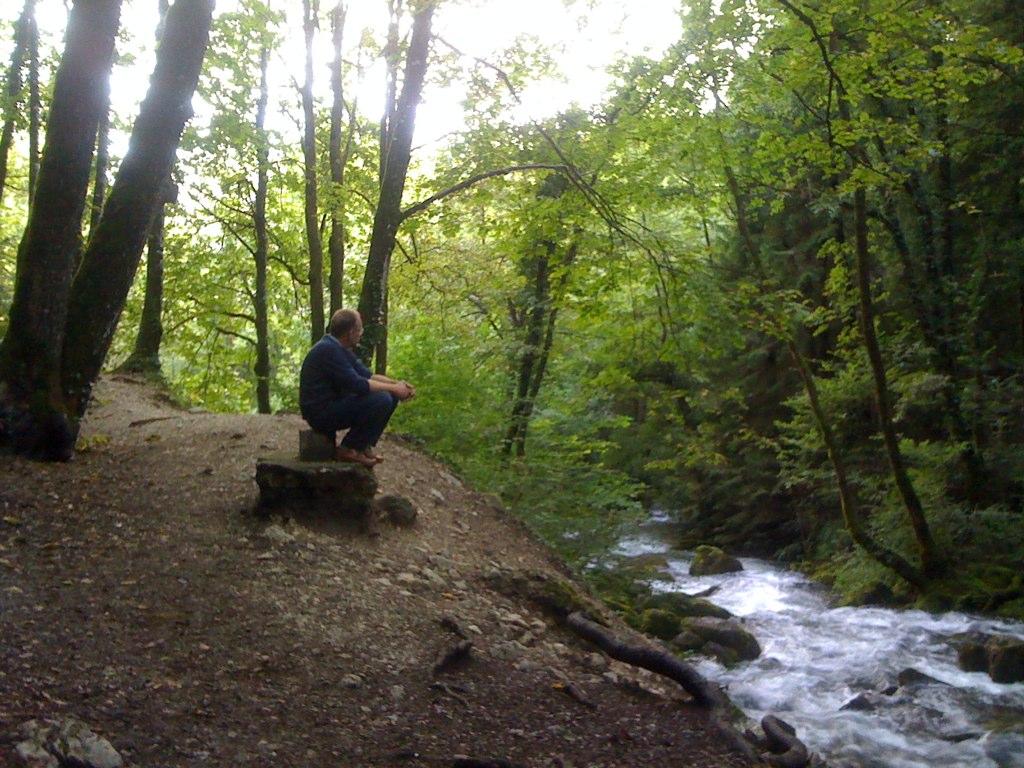
When we notice and celebrate the little things each day, then life becomes a place of wonder, celebration and of gratitude. A walk along the river in the forest, the taste of a dessert, support when someone is ill, encouragement and advice along the road. This poem from Mary Oliver sees blessing in the smallest of creatures, in the shortest of moments. Such an appreciation of life helps us when we are tempted to take the little slights of each day too seriously.

What is this dark hum among the roses?
The bees have gone simple, sipping,
that’s all. What did you expect? Sophistication?
They’re small creatures and they are
filling their bodies with sweetness, how could they not
moan in happiness? The little
worker bee lives, I have read, about three weeks.
Is that long? Long enough, I suppose, to understand
that life is a blessing.

Mary Oliver, Hum

Things we are not aware of

When an inner situation is not made conscious, it appears outside as fate. That is to say, when the individual … does not become conscious of his inner opposite, the world must perforce act out the conflict.

C.G. Jung

A lot of the time, we are not fully conscious of everything that is going on within us; our unlived life, or the parts that have been formed by the unlived lives of others,  is out of sight but exercising influence over our choices. We can see this sometimes when we look back at decisions made or life choices and wonder why we ended up in a certain place. Or when we see repeating patterns in our relationships. Jung suggests that if we do not attend to what is going on inside us, things or people appear in our outer lives in accord with that inner dynamic, and the outer choices we make reflect this inner drama. He suggests that the more we ignore the inner issues, the more we act them out in the world  around us. If we do not do this work, we risk remaining on the surface of life, rather than than incorporating our opposites into healthy choices.

The seasons of the heart

Even as the stone of the fruit must break, that its heart may stand in the sun, so must you know pain.

And could you keep in your heart the miracles of your life, your pain would not seem less wondrous than your joy;

And you would accept the seasons of your heart, even as you have always accepted the seasons that pass over your fields.

And you would watch with serenity through the winters of your grief.

Kahil Gibran The Prophet

Where is God?

God changes appearances every second.

Blessed is the man who can recognize him in all his disguises. One moment he is a glass of fresh water; the next, your son bouncing on your knees, or an enchanting woman, or perhaps merely a morning walk.

Nikos Kazantzakis

Using time wisely

For those of us who live in nanosecond time, a moment becomes very, very short, and in each moment we ask how much we have gotten done. How much did I cram into it? Was I successful in multitasking? As one woman in a class I was working with said to me, “I have finally figured out how to relax. When I go from my job teaching to my consulting job and I’m driving in my car, I listen to a self-help tape, I eat lunch on the way, I talk on my cellular phone, and I relax at the same time.”

This approach to time management simply turns up the speed on the treadmill of our lives. I propose we evolve beyond time management to “timeshifting”-which is different from merely “downshifting.” The practice of timeshifting recognizes that every single moment has a particular rhythm to it, and that we have the capacity to expand or contract an individual moment as appropriate. One way to shift what’s going on in our world is not to try to rush to do more, but to allow ourselves to go deeper into that moment of being present. Our ability to shift gears, to shift our rhythm to meet that moment and be present in it, is what allows us to experience the fullness of life – to create our life in the way we want it to be.

Stephan Rechtschaffen.