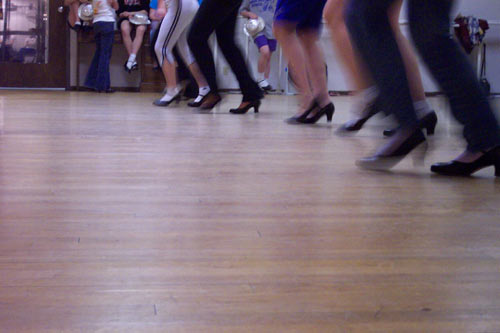
Life Dances

Life dances and you have to dance with it, whether it is taking you on a wonderful ride or is stepping on your toes. This is the necessary price and transcendent gift of being incarnate; alive in a body. But it is just life dancing. Life will move you in the rhythm and direction of its own nature. Each moment is a fresh moment in the dance, and if you are lost in clinging to the past or clinging to your fears of the future, you are not present for the dance.

Philip Moffitt

Within each one of us lies great potential, the potential to relate ot others and this world in a more authentic way.  However, not every potential is fulfilled. Sometimes, it is a fear of change or a fear to take a risk which blocks the development,  creating  a narrowness of attention and a loss of confidence. We can doubt whether we have the strength to do what is before us, or we sometimes can be held back by what others or convention dictates. Courage is needed to reach our full potential and allow situations emerge. Developing our future happiness can demand that we take the risk to engage with our lives.

Every day we unconsciously take refuge in something that we think will offer us security and protection. It can be fear, as it seems better not to reach out or not to try new things.  It is easier to remain in our comfort zone, preferring to avoid possible scenarios. It has been shown that whether we make positive – “approach goals” –  or  mainly negative, – “avoidance goals” –  can lead to the difference between a life that is thriving and a life that is focused on surviving. Often when a future outcome is not clear, the first instinct is to move away. As recent posts stated, we can be dominated by experiences in the past, conscious or unconscious , or the fear of the future. We can get stuck, unable to see the rich, fluid potential of now.

How can we create a space where we’re not trapped by negativity and respond more fully to the richness offered in this moment? We begin by settling the mind, settling the body, and getting in touch with the breath. When we stay in the here-and-now, we can see the stories that arise continually much more clearly. Now is now. There is not another now. If we realize that, we stop putting things off and engage in our life in a more wholehearted way.

Meditation helps our mind to not dwell on what might happen or on what we have lost. If we practice setting our minds on those things all the time, we can miss the fact that each moment is fresh, offering a new start.   In meditation we strengthen confidence in our natural mind, which is limitless. Working in this way reduces the fear of the future, allowing us create ourselves afresh.  We step out onto the floor and take the chance. We accept the other’s hand. We dance. The greatest sadness is not the possibility that we will appear foolish;  it is that we will not get up off our seat.

Stories 2: How the past defines us

More on story and myth, this time from an excellent recently-published Buddhist perspective:

The Buddha taught that,  over time, the unobserved thought settles into character. Character is more than our temperament and personality; it is the fundamental way we see life, including our suppositions, ideas and views of who we are and what life is. When we look out of our eyes we see what we have been conditioned to see, and part of that conditioning is the assumed reality of the person who is having the experience.

Character is reinforced through our narrative, the ongoing story of “me”. We confirm our current reality through the recollection of how we have always been. For instance, if we have assumed a victim mentality from our past, we may have a predisposition to overcompensate and react strongly when we are imposed upon. Our personal narrative reveals our strengths and limitations, and engenders a self-attitude. As our story moves on, each chapter predisposes “me” to behave in a certain way, and though this proliferating tendency was never specified in our early history, the ongoing story gets captured within its momentum.

Rodney Smith, Stepping out of Self-Deception

Taking Responsibility 2: Ending blame

A similar reflection to the earlier one from Hollis, this time from a Buddhist perspective:

From a meditator’s point of view, as long as we’re looking for someone to blame, our mind is unable to settle. By putting ourselves into a mind space where we’re constantly projecting out into the world—trying to find someone or something who could be responsible for our unhappy state—we abandon the possibility of harmony. Blame is a form of aggression. Looking outward for an object to which we can attach our negativity and irritation hinders our ability to have peace. The meditation path encourages us to be bigger, more openminded, more mature. It’s suggesting that we take responsibility for our behavior. This means that one day we will simply have to stop blaming the world.

Blame is an obstacle on the path of openmindedness and understanding. By blaming others when the world doesn’t move the way we want, we’re creating narrow parameters into which everything must fit. We become dead-set on what will solve our problem; nothing else will do. Blame ties us to the past and reduces who we are. Our possibilities become confined to one small situation.

Sakyong Mipham Rinpoche, End Blame

Stories 1: The Myths that sustain us

We are always guided by some myths, whether we are aware of it or not. From an early age we gather the elements which will come together as our personal myth. In our first relationships of love we get the attitudes and information which will determine the story we tell ourselves about the trustfulness of others. In this way,  our basic sense of self is consolidated in the first two or three years of life.

Dan McAdams*, Professor of Psychology and Professor of Human Development and Social Policy at Northwestern University, has studied the stories which we tell ourselves as we make our way through life. He says that we have already by age three established a narrative tone, which lasts with us into adulthood. This narrative tone can be optimistic, stating that the world is trustworthy, predictable, knowable and good, or it can be pessimistic, believing that the world is unpredictable and unsafe, and that stories will end up with unhappy endings. Thus, as yesterdays post said, deep down we see life as fundamentally friendly or as frightening. This narrative tone is the most pervasive element underlying  the personal myth which we use to guide us throughout our adult years, and gives our life a unity. For some people this unity can take the shape of an ongoing worry or fear, for others a belief that hope will prevail.

*Dan P. McAdams, The Stories we live by: Personal myths and the making of the self

Each moment, the only moment

The opportunity to experience yourself differently is always available.

Mingyur Rinpoche

Seeing the world directly

Facing the bluntness of reality is the highest form of sanity and enlightened vision….Devotion proceeds through various stages of unmasking until we reach the point of seeing the world directly and simply without imposing our fabrications….There may be a sense of being lost or exposed a sense of vulnerability. That is simply a sign that ego is losing its grip on its territory; it is not a threat.

Chogyam Trungpa Rinpoche