What We Feel is Not Who We Are

From the Christian author Henri Nouwen, some ways of working with negative thoughts, from a deeper perspective of our inner self, rooted in meaning:

“Our emotional lives move up and down constantly. Sometimes we experience great mood swings from excitement to depression, from joy to sorrow, from inner harmony to inner chaos. A little event, a word from someone, a disappointment in work, many things can trigger such mood swings. Mostly we have little control over these changes. It seems that they happen to us rather than being created by us.

Thus it is important to know that our emotional life is not the same as our spiritual life. Our spiritual life is the life of the divine within us. As we feel our emotions shift we must connect our spirits with the Spirit of God and remind ourselves that what we feel is not who we are. We are and remain, whatever our moods, God’s beloved children.”

Solstice

At Newgrange in Ireland, a huge Neolithic burial chamber dating from about 3200 BC was built in such a way that sunlight reached into the inner chamber just once during the year, at dawn on this day, the winter solstice.

It seems that many ancient people held special celebrations around this time, attuned as they were to the rhythm of nature. It is certainly true that the divine was recognized intensely by the Celts and other peoples in the workings of nature and easily discerned in the changing seasons. We can only wonder what this meant for them, and ask does it mean anything similar to us now?

In spite of all our modern technology, a huge part of our mood is related to the sun, and we are ever more conscious of the weather. It may be that there is a deep interior need to mark the shortest day by reminding ourselves of the light, of renewal or rebirth. Even at the darkest point of winter, we can believe in the return of the Sun. It reminds us that no matter how dark our interior life can become, light can still penetrate to illuminate and warm us.

May we too celebrate hope and light on this day.

Saint Nicholas and the practice of generosity

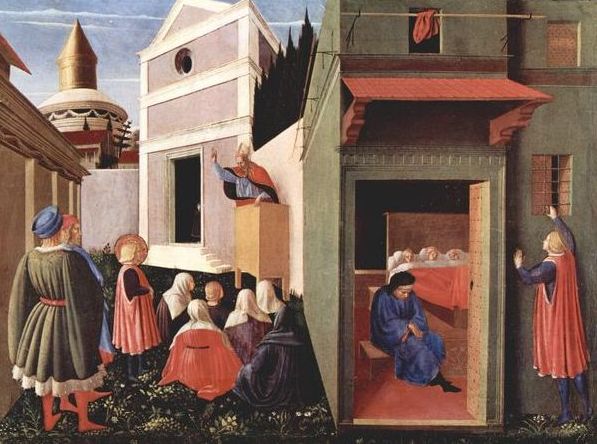
Today is the feast of Saint Nicolas, which is at the origins of gift-giving to children around this period. In some countries these gifts are left in childrens’ shoes. The tradition is based on his generosity as Bishop of Myra, as he was accustomed to leaving gifts for the poor while they were asleep.

One story tells of a poor man with three daughters. In those times a woman’s father had to offer prospective husbands something of value, a dowry. The greater the dowry, the better was the chance that a young woman would find a good husband. Without a dowry, a woman was unlikely to marry and was in danger of poverty, prostitution or slavery. But this man was poor, and so his daughters, without dowries, were destined to be sold into slavery. Mysteriously, on three different occasions, a bag of gold appeared in their home – providing the necessary dowries. The bags of gold, tossed by the Bishop through an open window, – as seen in this exquisite painting by Fra Angelico – landed in stockings or shoes left before the fire to dry, while the girls slept unaware in bed.

There is so much in this tale, about generosity, or awareness of what we have been given, or the real meaning of this period, or about caring for those who are in difficulty at this time.

” In the African understanding of ubuntu, our generosity comes from realizing that we could not be alive, nor could we accomplish anything, without the support, love, and generosity of all the people who have helped us to become the people we are today. Certainly it is from experiencing this generosity of God and the generosity of those in our life that we learn gratitude and to be generous to others.”

Archbishop Desmond Tutu

“I think that generosity has many levels. We have to think generously, speak generously, and act generously. Thinking well of others and speaking well of others is the basis for generous giving. It means that we relate to others as part of our ‘gen’ or ‘kin’ and treat them as family. Generosity has to come from hearts that are fearless and free and are willing to share abundantly all that is given to us.”

Henri Nouwen

More Lessons from Saint Martin

The psychological rule says that when an inner situation is not made conscious, it happens outside as fate. That is to say, when the individual remains undivided and does not become conscious of his inner opposite, the world must perforce act out the conflict and be torn into opposing halves.” Jung

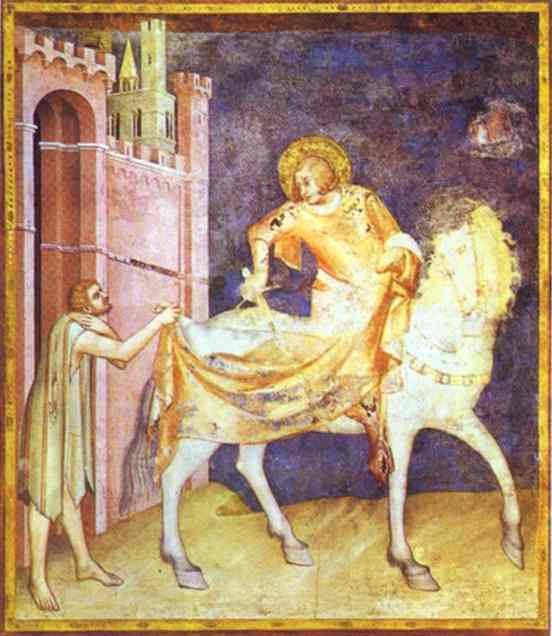
The most famous event in the life of Saint Martin occured when he met a poor man begging on a very cold day. The beggar was shaking and blue from the snow but no one reached out to help him. We are told that Martin was overcome with compassion, took off his expensive cloak, cut it in two, and gave the half to the beggar. Later that evening he had a dream in which Jesus was wrapped in the cloak, and said “Here is Martin who has clothed me”

These early stories may be based on historical events but also can have a symbolic meaning. A beggar covered in sores and nearly naked disturbed most of the people who passed by and shunned him. His presence and appearance bothered them. We have many instances today where we are bothered, as individuals or as a society, by those who are different, by strangers, by conflicting views, by different cultural practices. These can give rise to fears and to the desire to exclude these people or their opinions from our sight and our surroundings. In times of fear, such as the current economic climate, it is easy to look to blame others, to find someone outside and project the negativity onto them.

I think the beggar in the story can also be seen as the weak, needy or wounded parts of our inner selves. We can be are uncomfortable with parts of our own life and history. We too can have wounds and injures caused by others or by our own life history.These parts of our lives can become our shadow side – all that has been split off, unrealized or every potential that has never been developed. We all carry with us a histroy of neglected, unrealized, underdeveloped talents and possibilities that can be there, begging for our attention. Or there can be parts of our lives that we are actively afraid of or uncomfortable with, such as addictions, repeating behaviours or powerful emotions which arise from time to time. We feel, at times, panic, anxiety, loneliness, anger and a lack of safety.

Today’s fast paced society means that we have plenty of opportunity for looking away, for rushing by. Even more so, we have strong habits of not wanting to experience the unpleasant, or preferring to turn away. Or we can project an underdeveloped or disowned part of yourself onto another person. Consequently the deep message in times like these go by without our full attention. In these difficult moments, it can be easier to avoid looking at our inner world and focus our attention outside ourselves, or perhaps rushing to find a fix for what appears to be wrong.

What Saint Martin’s example prompts us to do is firstly not to turn away or rush to fix but to turn towards, to recognize our own suffering, our own wounds and the places that scare us in our lives. He then shows us to extend compassion to our poor and needy selves – after recognizing our wounds and suffering, to respond to them with love. This means not looking away, not seeking distractions when offered the opportunity to be present for our own pain, or the difficult moment that scares us. The practice is to try and be open to all emotions even those that are frightening and to hold them first in simple attention. Understanding and caring for the shadow aspects of our lives is a path towards wholeness.

As Rumi said:
Don’t turn your head. Keep looking at the bandaged place.
That’s where the light enters you.

Facing up to Loss

Traditionally, in the Christian yearly calendar, November is the month for remembering those who have died.The roots of this tradition are probably found in the basic human awareness of the approach of winter and the shortening of the days. As well as reminding us of the impermanence of all things, including our health and life, it helps us reflect on the other losses which we face at times in our lives, such as when faced with change, or sickness or having to move. The most basic practice in these moments is to be aware of the feelings these losses provoke and not to run from them.

On some basic yet very deep level all of us feel fundamentally alone, and until we face this directly, we will fear it. Most of us will do almost anything to avoid this fear. Many, when faced with the fear of aloneness, get extra busy, or try to find some other escape. Ultimately, however, the willingness to truly feel the fear of aloneness and loss is the only way to transcend it. It’s also the only way to develop intimacy with others, because genuine intimacy can’t be based on neediness or on the fear of being alone.”

Ezra Bayda

Pause

Today, Sunday, is a Day of Rest. There is a lot of wisdom in the religious traditions which set aside times and rhythms of rest. The Bible tells us that God rested on the seventh day, and even allowing for the anthropomorphic nature of the description, we can see that this contains a deep truth. It is clear that God did not rest because of tiredness, but to show that a rhythm of work and pausing is somehow deeply related to our holiness and our wholeness. The Hebrew word for “rested” can sometimes also mean to touch ones soul, drop into one’s breath, or can refer to the inner being of the person. When we pause we create the space to drop into and nourish our inner being.

This is increasingly needed in a society where an emphasis on work, productivity and speed has thrown it completely off balance. It focuses on purpose and mistakes that for meaning. Pausing allows us touch the sources of meaning in our lives. Letting busyness go and entering into a space kept empty nourishes us. It is not wasted unproductive time. On the contrary, doing nothing may be the most important work we can do.