Natural kindness

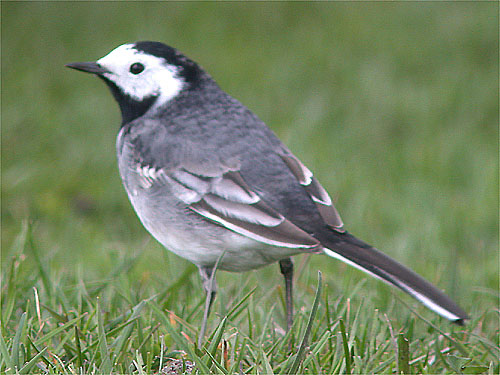
Had some lovely visitors to the garden this morning, as an adult wagtail fed its chicks, probably not long out of the nest. The young ones followed the adult, waiting for food and running across the grass when they saw some being offered. We do not normally get wagtails visiting the garden, even allowing for the fact that they keep a  low profile when nesting. However,  this year we are extremely lucky with the amount of birds we see, especially the blackbirds who are nesting in the trees at the end of the garden. After the thunderstorms of the past two days they love to fill the air with song.

The instinctive tenderness of the adult’s care for the chick was very moving. It seems to me that, when we are not afraid, we have a natural movement of kindness and compassion towards others. It is only when fear enters into the equation that we withdraw and hold back, and our natural desire for caring connection is blocked and gets confused.  At some level, even though we may not be aware of it, this causes a division within, some kind of cognitive dissonance and we deal with this by blaming the other or by justifying ourselves. These stories simply mean that we stay cut off from our deep self and from others, ensuring that we will never be fully happy as most of the energy from that part of our life or our history goes into splitting and withdrawal rather than into kindness.

Mindfulness practice is about cultivating a space in our minds and a harmony with our inner capacity for compassion. This means noticing when the mind is fearful or defensive. When we see this  it is a good practice is to focus on the warmth of our own kindness and direct it first and foremost towards ourselves. We need to have the same tenderness that the mother bird demonstrated this morning towards the hungry,  weak and frightened parts of our own heart. In this way we gradually find strength not to automatically run away from the fear when it arises. We can let go of what we carry within and relax in the more natural condition of love and trust.

The only reason we don’t open our hearts and minds to other people is that they trigger confusion in us that we don’t feel brave enough or sane enough to deal with. To the degree that we look clearly and compassionately at ourselves, we feel confident and fearless about looking into someone else’s eyes.

Pema Chodron

Upcoming Events Summer months

The extra time we can have in the summer months gives us an  opportunity to deepen our Mindfulness practice. It is a good idea to consider doing a short retreat or workshop to help you apply the ideas and practice more fully to your everyday life. Although we do not have too many possibilities as English speakers in this part of the world,  there are a number of  events occuring this Summer which you may like to consider.

As I have mentioned before, we are extremely fortunate that James Baraz, one of the best-known meditation teachers in the U.S., is coming to give his Awakening Joy Workshop over 4 days from August 4 – 7.  This excellent interactive  workshop is a gentle way to deepen your practice as it is not as intensive as some of the other possibilities which are usually run in complete silence. It will be held in the lovely setting of the Kientalerhof Centre in the Bernese Oberland. You can download the flyer here: Awakening Joy Flyer 8 April upload

It is always good to keep an eye on the website for the Meditation Centre in Beatenberg. I see there are still places available for the 8 day  Vipassana  (Insight) meditation retreat, starting on August 13th.  However, this is only open to meditators who have already some experience in silent retreats.

A bit further afield, some people who have completed the MBSR Course in Geneva have attended retreats in Gaia house in England. You can find a link to their website on the right hand side of this page. They offer a number of weekend or longer weekday retreats, all in silence. For example, there is a short  retreat entitled “Living With Illness” from Monday 22nd August to Wednesday 24th August, which may be of interest to those dealing with illness or working with those close to death.

I will post more details of other possibilities as they come to my notice.

Roots in the past 3: The wound of the heart

It’s in relationships that our unresolved psychological issues show up most intensely. That’s because psychological wounds are always relational — they form in and through our relationships with our early caretakers.  The core psychological wound, so prevalent in the modern world,  forms out of not feeling loved or intrinsically lovable as we are. Inadequate love or attunement is shocking and traumatic for a child’s developing and highly sensitive nervous system. It damages our capacity to value ourselves, which is also the basis for valuing others.  I call this the “relational wound“ or “wound of the heart.”

There is a whole body of study and research showing how close bonding and loving attunement — what is known as “secure attachment”— have powerful impacts on every aspect of human development. Secure attachment has a tremendous effect on many dimensions of our health, wellbeing, and capacity to function effectively in the world: how our brains form, how well our endocrine and immune systems function, how we handle emotions, how subject we are to depression, how our nervous system functions and handles stress, and how we relate to others.

John Welwood

Noticing the space around

Most of our suffering comes from habitual thinking. If we try to stop it out of aversion to thinking, we can’t; we just go on and on and on. So the important thing is not to get rid of thought, but to understand it. And we do this by concentrating on the space in the mind, rather than on the thought.

Our minds tend to get caught up with thoughts of attraction or aversion to objects, but the space around those thoughts is not attractive or repulsive. The space around an attractive thought and a repulsive thought is not different, is it? Concentrating on the space between thoughts, we become less caught up in our preferences concerning the thoughts. So if you find that an obsessive thought of guilt, self-pity, or passion keeps coming up, then work with it in this way — deliberately think it, really bring it up as a conscious state, and notice the space around it. This way, we begin to have a perspective on the impermanent nature of thinking.

Ajahn Sumedho

Freshness

We had such welcome rain last night. We are already on water restrictions here. Ok, maybe not good for the planned barbecue, but great for the plants and the garden, and especially for the farmers.  There is a freshness that only comes after a storm, as well as growth that only comes with the rain. The law is universal, not just for Nature but also for our inner life.  There are times we need to shelter a while but in the morning after we  find everything fresher and more alive.

Climb the mountains and get their good tidings. Nature’s peace will flow into you as sunshine flows into trees. The winds will blow their own freshness into you, and the storms their energy, while cares will drop off like autumn leaves.

John Muir

Roots in the past 2: Suffering has an internal cause

Suffering comes from how the mind interacts with pain. Because your mind is conditioned by past life events, when it encounters an experience it perceives as painful or unpleasant, there is immediate and direct suffering that is far greater than the actual discomfort of the situation. The increased discomfort happens in your mind, not in the actual experience. This means suffering has an internal cause, and you therefore have the ability to affect how much you suffer – you can dance with life and be a partner in how your life unfolds. With mindfulness of the cause of suffering, what is unpleasant simply remains unpleasant, even though it is not your preference.

Philip Moffitt, Dancing with Life