
The forest is peaceful, why aren’t you?
You hold on to things, causing your confusion.
Let nature teach you.
Hear the bird’s song, then let go.
Ajahn Chah
The forest is peaceful, why aren’t you?
You hold on to things, causing your confusion.
Let nature teach you.
Hear the bird’s song, then let go.
Ajahn Chah

The line from the Dhammapada, a compilation of sayings attributed to the Buddha, that seems the best expression of wisdom, is: “Anyone who understands impermanence, ceases to be contentious.”
Does that make sense to you on as many levels as it does to me? I understand it, primarily, as meaning “I have only a certain span of life allotted to me, so I don’t want to waste a single moment of it fighting.” Other times, if I catch myself on the brink of contention, the instruction reminds me, “Whatever is happening will change, and what I add to this situation is part of the change. Agonizing makes it worse.” And sometimes, if I remember that whatever is happening will cause results that I really cannot anticipate (although I often do and worry needlessly), I say to myself, “I have no idea whether this changed circumstance, which I resent, is actually a good or a bad thing in the long run. I can wait to see.”
Sylvia Boorstein, Happiness is an Inside Job

Life always gives us
exactly the teacher we need
at every moment.
This includes every mosquito,
every misfortune,
every red light,
every traffic jam,
every obnoxious supervisor (or employee),
every illness, every loss,
every moment of joy or depression,
every addiction,
every piece of garbage,
every breath.
Every moment is the guru.
Charlotte Joko Beck

I remember I would sometimes go visit Ajahn Sumedho in his room. On the wall he had a picture of an old man sitting inside his little cottage on a rainy day, sitting just inside the window, looking out, and in his hand he held a cup of coffee. And I remember Ajahn Sumedho saying, for him this was the essence of meditation. It was really nothing more than just relaxing, and watching the happening of existence. Nothing needed to be explained. Nothing needed to be worked out. There’s just the event of existence presenting itself. Everything we are is simply presented. Whatever words come out, come out, but they’re not important; they’re simply the movement or the non-movement of whatever this happening is and it’s happening all by itself.
Darryl Bailey
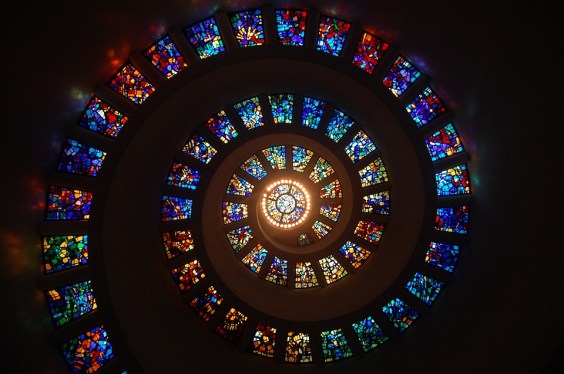
It is hard to find better guidance than this. Knowing it deep down would be so nice: to be without anxiety about my imperfections or messy reality or about what is not fully achieved in my life:
One thing, all things, they move and intermingle without distinction.
To live in this realization
is to be without anxiety about imperfection.
The mind of absolute trust is beyond all thought, all striving,
is perfectly at peace, for in it there is no yesterday, no today, no tomorrow.
Seng T’san, 7th Century Zen Patriarch, Hsin Hsin Ming

The weekend, which allows the possibility to get out in nature, is a good time to share some of Mary Oliver’s poetry. This one is about flowers and how some are less “perfect” than others. But it is also about relationships and what hopes we have for our heart, about a greater beauty that embraces the clearly imperfect and allows us cast away the hassles of the everyday which are not us. We are nourished.
Shared moments, flowers, meanings and the stories that feed us.
What in this world
is perfect?
I bend closer and see
how this one is clearly lopsided–
and that one wears an orange blight–
and this one is a glossy cheek
half nibbled away–
and that one is a slumped purse
full of its own
unstoppable decay.
Still, what I want in my life
is to be willing
to be dazzled —
to cast aside the weight of facts
and maybe even
to float a little
above this difficult world.
I want to believe I am looking
into the white fire of a great mystery.
I want to believe that the imperfections are nothing —
that the light is everything — that it is more than the sum
of each flawed blossom rising and fading. And I do.
Mary Oliver, The Ponds

