Noticing colour in grey days

Some similar thoughts, this time from a poet and not a neuroscientist. She encourages us to notice the little moments of colour that come into every day as a way of going against the heart’s tendency to close in on itself:

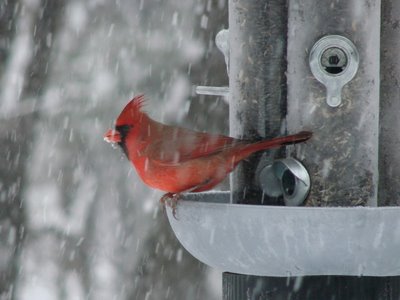
Red bird came all winter firing up the landscape as nothing else could.
Of course I love the sparrows, those dun-colored darlings so hungry and so many.
I am a God-fearing feeder of birds.
I know He has many children,
not all of them bold in spirit.
Still, for whatever reason —
perhaps because the winter is so long
and the sky so black-blue,
or perhaps because the heart narrows
as often as it opens —
I am glad
that red bird comes all winter
firing up the landscape
as nothing else could.

Mary Oliver, Red Bird
Taking in the good things that happen

Some writers state that this is the week when people find their mood low, as the excitement of Christmas and New Year fades and they find that not much has actually changed in their lives. It does not seem that there is much scientific findings for their claim – indeed the term ” Blue Monday”, coined for the first day of the week, seems to have come from a Travel Agency’s campaign to get us to book our summer holidays around this time. That being said, there does seem to be good scientific support for the brain’s tendency to focus on the difficult things in our lives and remember or amplify them. Because of that, this week and every week,  we have to consciously work against that leaning, both by becoming familiar with  our negative stories and by practicing the way we pay attention.

Here is one good way of doing that, outlined by Rick Hanson, the author of the excellent Buddha’s Brain. Sincere thanks to regular reader Kathy at http://pocketperspectives.wordpress.com/ for bringing this series of videos to my attention.

…but rather, looking inside

One of Tony De Mello’s stories, with a similar theme – We often think that what we want is outside us. Rather, the real work we need to do is within:

One day God got tired of being pestered by people asking for this and for that, so God calls a meeting of the most trusted angels and asks for suggestions as to where one can hide from pestering people. One angel advises God to hide on the highest peak of the highest mountain because no one will search there. Another angel says, “No, hide in the depth of the deepest ocean in the world and no one will search for you there.” Finally, God turns to the most trusted angel and asks: “Where do you suggest I should hide?” And the angel responds: “Hide in the human heart! No one will search for you there.”

Sunday Quote: Open a window


Keep knocking,

and the joy inside will eventually open a window

and look out to see who’s there.

Rumi

Faith in the possibilities of this day

Being alive necessarily means uncertainty and risk, times of going into the unknown. If we withdraw from the flow of life, our hearts contract. We hold back so much that we feel separate from our own bodies and minds, separate from other people, even people we really care about. In the grip of other intense emotions, like grief and jealousy, we might feel anguish, but fear shuts us down, arrests the life-force. To be driven by fear is like dying inside. When the suffering is overwhelming, we may try to recoil from how bad it feels by numbing our reactions. Many of us survived childhood in just this way. But, ultimately, cutting ourselves off from what is happening locks us into fear and makes us unable to see that we might find another way to respond outside the small section delineated by the dots, defined by our assumptions.

Faith, in contrast, reminds us of the ever-changing flow of life, with all its movement and possibility. Faith is the capacity of the heart that allows us to draw close to the present and find there the underlying thread connecting the moment’s experience to the fabric of all of life. It opens us to a bigger sense of who we are and what we are capable of doing.

Sharon Salzberg, Faith

From time to time,check in with the senses

To orientate ourselves to the present moment we can do this simple exercise. We pay attention to the doors of the eyes, ears, nose, mouth and body to see what exactly is happening there. Just as the captain of a ship checks his compass to determine his position; so we can check each of the sense-doors to determine our position – which is, of course, the present. If we are not careful, these inner worlds of ours easily become choked with troublesome thoughts, perceptions, memories and characters. But are these private worlds we drag around a true reflection of the outside world? Aren’t they just based largely on our own mistaken perceptions? How many times do we pass judgement on something, only to have it promptly overturned moments later? Our inner worlds are – for the most part – disconnected from reality, from what is actually going on right now.

And so it is crucial that we learn to be mindful of what is happening around us; that we pause to pay attention to what is occurring, in the present, at each of the sense-doors. The sense-doors are our windows to the world, and to stop the creation of more mental proliferation we must be vigilant and learn to just observe. To be mindful of what is actually happening around us puts a break on these meanderings of the mind and we become aware of what is right in front of our noses. This practice serves to help remind us of the simplicity of the moment.

Ajahn Manapo, Dhamma Diary Blog